
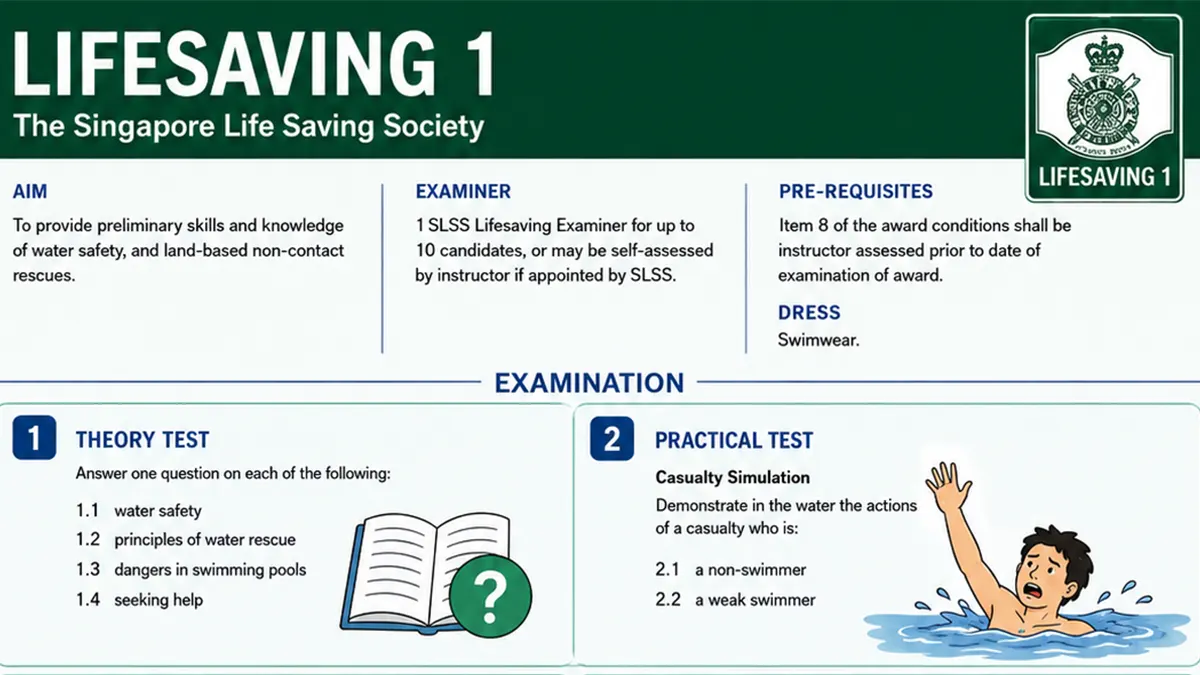
Lifesaving 1 Course Singapore
Your first step toward becoming a certified lifesaver. Learn water safety, reaching rescues, and throwing rescues — certified by the Singapore Life Saving Society (SLSS).
What is the Lifesaving 1 course?
The foundational SLSS lifesaving award for beginners
The Lifesaving 1 (LS1) course is the entry-level award in the Singapore Life Saving Society (SLSS) Lifesaving 1-2-3 pathway. It introduces you to the essentials of aquatic safety — how to spot danger, how to call for help, and how to assist someone in trouble using safe, non-contact rescue techniques without entering the water yourself.
LS1 is a mandatory prerequisite for Lifesaving 2 and ultimately the Bronze Medallion, Singapore’s gold-standard lifeguard qualification. Whether you are a student building your co-curricular record, an aspiring swim coach, or simply someone who wants to be prepared around water, Lifesaving 1 is the right place to start.
What you will learn
- Water safety principles and hazard recognition
- Identifying different swimmer types and distress signals
- Reaching rescues — using poles, towels, and clothing
- Throwing rescues — ring buoys and throw bags
- Elementary self-rescue and basic survival floating
- When and how to call for help correctly
- Land-based, non-contact rescue methods
- Pass requirement: swim 100m in any recognised stroke
Who should enrol
- Students aged 11 and above
- Parents who want water-safety awareness
- Aspiring swim coaches (LS1 is a prerequisite for SG-Coach Level 1)
- NSFs preparing for aquatic-related postings
- Anyone who spends time near pools, beaches, or reservoirs
- Beginners with no prior lifesaving training
Lifesaving 1 course outline
Based on the official SLSS Awards Syllabus
| Topic | Key skills covered | Format | |
|---|---|---|---|
1 |
Introduction to water safety | Hazard awareness, pool rules, recognising distress | Theory |
2 |
Swimmer identification | Non-swimmer, beginner, competent swimmer, distressed swimmer profiles | Theory |
3 |
Reaching rescues | Rescuing a casualty 1–2m away using a pole, towel, or clothing from the pool deck | Practical |
4 |
Throwing rescues — buoyant aid | Throwing a ring buoy or floating aid to a casualty 5m away in deep water | Practical |
5 |
Self-rescue & survival skills | Survival float, treading water, elementary backstroke survival technique | Practical |
6 |
Casualty assistance on land | Helping a casualty out of the water safely after rescue | Practical |
7 |
Assessment & theory test | Written theory test + practical evaluation; swim 100m in any recognised stroke | Exam |
The SLSS lifesaving pathway
Lifesaving 1 is your starting point toward becoming a certified lifeguard in Singapore
Certificate validity: All SLSS Lifesaving awards are valid for 3 years. Recertification requires re-sitting the practical assessment.
Why Lifesaving 1 matters in Singapore
More than a certificate — a life skill
Singapore’s network of public swimming pools, beaches, reservoirs, and waterways means most residents spend time near water regularly. Drowning remains a leading cause of accidental death globally, yet most incidents are preventable with basic water-safety knowledge and timely intervention.
The Lifesaving 1 course equips you with the two non-contact rescue techniques proven most effective in bystander situations — reaching and throwing — which allow you to help without putting yourself at risk. These skills are immediately useful and can bridge the critical gap between an incident and the arrival of emergency responders.
Beyond personal safety, LS1 is a recognised stepping stone for career pathways. Completing Lifesaving 1, 2, and 3 (together sometimes called LS123) is a prerequisite for the SLSS Bronze Medallion — the certification required to work as a lifeguard at public swimming pools and ActiveSG facilities in Singapore.
Frequently asked questions
Everything you need to know about Lifesaving 1
How old do I need to be to take Lifesaving 1?
You must be at least 11 years old (or turning 11 in that calendar year) to enrol in Lifesaving 1. There is no upper age limit, and the course is suitable for adults too.
Do I need to know how to swim before joining Lifesaving 1?
Yes. You must be able to swim 25 metres comfortably and tread water for 2 minutes. The pass requirement for LS1 is swimming 100 metres in any recognised stroke, so a basic level of swimming ability is essential before you enrol.
What is the difference between Lifesaving 1, 2, and 3?
Lifesaving 1 focuses on water safety fundamentals and land-based, non-contact rescues (reaching and throwing). Lifesaving 2 builds on this with basic resuscitation awareness and in-water assisted rescues. Lifesaving 3 adds swimming rescues, defensive techniques, and initial resuscitation skills as preparation for the Bronze Medallion. Each level must be completed in order.
Is the Lifesaving 1 certificate recognised in Singapore?
Yes. The LS1 award is issued by the Singapore Life Saving Society (SLSS), the national authority for water safety and drowning prevention in Singapore. It is widely recognised by schools, sports organisations, and employers as the official entry-level lifesaving certification.
How long does the Lifesaving 1 course take?
Course length varies by provider and schedule. Most schools run LS1 over 3 to 4 sessions of approximately 2 to 3 hours each. Express weekend programmes allow you to complete LS1 in a single weekend, while regular intake programmes spread it across 2 to 4 weeks.
How long is the Lifesaving 1 certificate valid?
All SLSS Lifesaving awards are valid for 3 years from the date of issue. To maintain your certification, you must re-sit the practical assessment before the certificate expires.
Can Lifesaving 1 help with National Service (NS)?
Lifesaving 1 alone is the first step on the pathway. Completing the full LS1-2-3 sequence and obtaining the SLSS Bronze Medallion can be advantageous when applying for aquatic-related NS roles. Declare your certifications during CMPB processing for consideration.
Ready to take your first step?
Join our next Lifesaving 1 intake. Classes are kept small to ensure quality coaching from SLSS-certified instructors.