Why Is My Child Afraid of Swimming? What Parents Can Do
A child can be laughing at the poolside one minute and gripping your shoulder tightly the next. If you are asking, “why is my child afraid swimming?”, the fear is not usually stubbornness or a lack of ability. It is your child’s way of saying that the water feels unpredictable, uncomfortable, or too difficult to manage right now.
The most helpful response is not to push harder or avoid pools altogether. It is to identify what feels unsafe, then build confidence through small, repeatable successes. With patient support and structured instruction, many children move from fear to calm participation and, eventually, reliable water-survival skills.
Why Is My Child Afraid of Swimming?
Children are rarely afraid of swimming for just one reason. A child who says, “I don’t like swimming,” may be reacting to water on their face, the depth of the pool, a previous scare, cold water, separation from a parent, or the feeling of not being in control.
For some children, the trigger is obvious. They may have slipped at the pool deck, swallowed water, or been startled when another child splashed them. Even a minor incident can feel large to a young child because they do not yet have the experience to judge what is safe and what is manageable.
For others, fear develops more gradually. A child who has missed lessons, changed pools, or advanced too quickly may realize that classmates are doing skills they cannot yet do. They may then avoid putting their face in the water, refuse to float, or cry before class. This is often a confidence gap, not a character problem.
Children can also pick up on adult anxiety. If pool time is filled with warnings, rushing, or visible worry, a child may learn that water is something to fear. Safety rules matter, but calm and consistent messaging matters too.
Common reasons children feel nervous in the water
A fear of swimming may be connected to one or more of these experiences:
- Water entering the nose, ears, or eyes
- Difficulty breathing out underwater or holding the breath comfortably
- Fear of deep water or not being able to touch the bottom
- A previous fright, such as slipping, swallowing water, or unexpected submersion
- Sensory discomfort from noise, crowds, chlorine, temperature, or splashing
- Feeling pressured to perform in front of parents, coaches, or peers
- Starting lessons at a level that is too challenging
The exact cause matters because the solution should match the fear. A child who dislikes water on their face needs a different starting point from a child who can put their face in but panics when asked to float independently.
Signs Your Child Needs a Slower Swimming Progression
Some hesitation is normal when children learn a new water skill. However, repeated distress deserves attention. Watch for behaviors such as crying before every lesson, refusing to enter the pool, clinging to the wall, holding the breath for long periods, or becoming upset whenever water reaches the face.
A child may also appear cooperative but avoid key skills. They might jump only while holding an instructor’s hands, rush through a back float, or insist on staying where they can stand. These behaviors are useful information. They show where the child’s confidence ends.
Do not assume that more exposure alone will solve the problem. Frequent pool visits can help, but only when the experience remains controlled and positive. Repeatedly placing a frightened child in situations that feel overwhelming can strengthen the fear instead of reducing it.
What Parents Can Do at the Pool
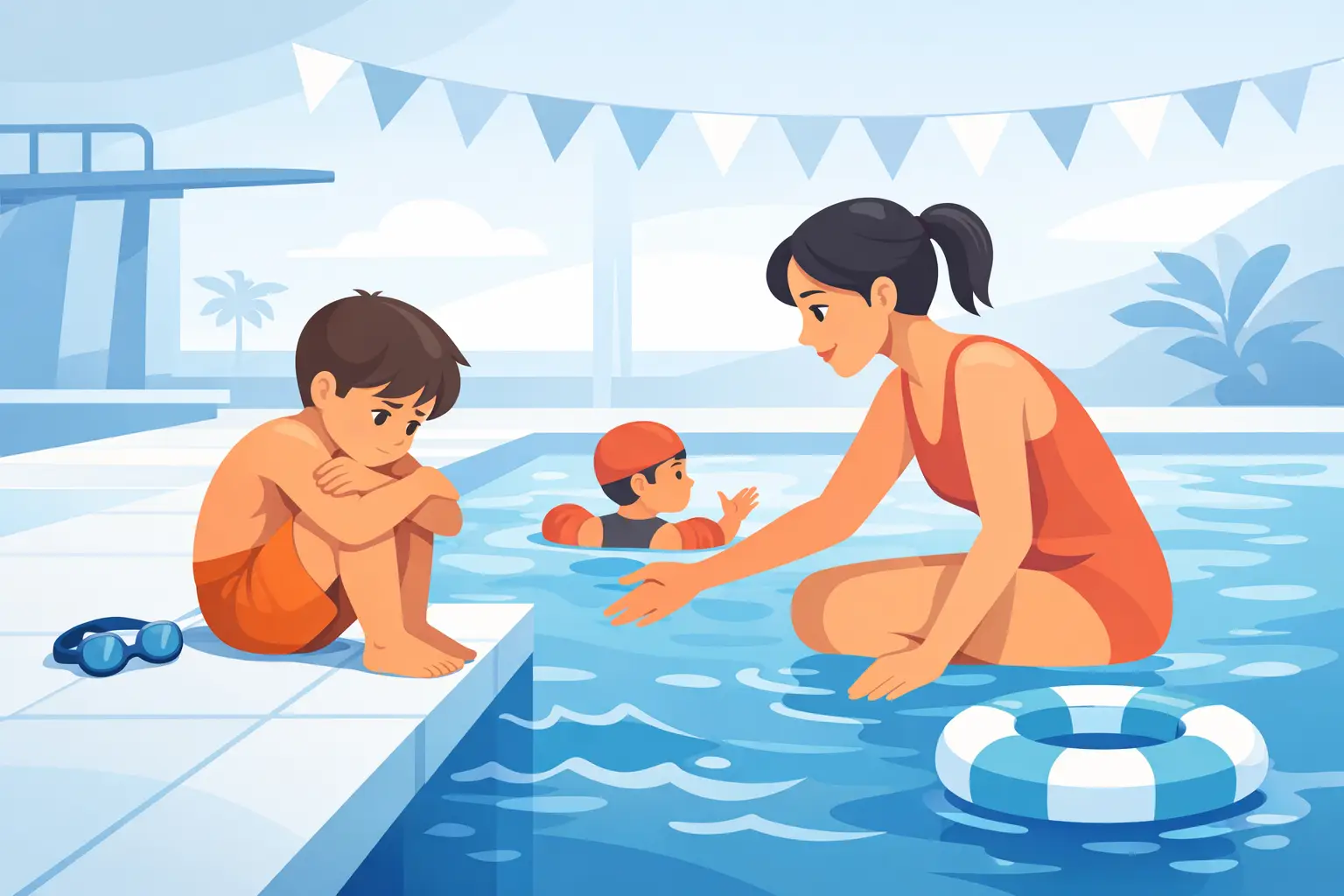
Your role is to make the next step feel achievable. This does not mean promising that nothing will ever feel scary. It means showing your child that they can be nervous and still learn safely.
Start by lowering the demand. Instead of asking your child to swim across the pool, focus on one manageable task: sit on the steps, blow bubbles, wet the cheeks, or hold the wall while kicking. Praise the specific action, not just the result. “You put your chin in the water and blew three bubbles” is more meaningful than “Good job.”
Give your child choices that preserve safety. You might ask whether they want to enter by the steps or sit first, whether they prefer goggles before bubbles, or whether they want to practice floating with your hands under their shoulders or back. Small choices create a sense of control.
Keep your language steady. Avoid saying, “Don’t be scared,” because it can make children feel that their fear is wrong. Try, “I can see this feels big. We will practice one small part together.” This acknowledges the feeling while keeping the expectation clear.
It also helps to separate practice from play. During a family swim, spend a few calm minutes practicing one skill, then allow time for enjoyable water play within arm’s reach. If every pool visit becomes a test, children can begin to resist the environment itself.
Build Comfort Before Teaching Full Strokes
A child does not need to master front crawl immediately. Water confidence should come before stroke technique, especially for a fearful beginner. The first goals are usually safe entry and exit, breathing control, face immersion, floating, kicking, and moving a short distance with support.
Breathing is often the foundation. Children who hold their breath tightly become tense, tire quickly, and feel alarmed when water reaches the face. Gentle bubble practice teaches them that they can control their breathing in the water. Begin with blowing bubbles on the surface, then progress to putting the mouth, nose, and eventually the whole face in the water.
Floating is another essential confidence skill. A child who learns to relax on their back with support begins to understand that water can hold them up. This can be difficult at first because floating requires stillness and trust. Support should be reduced gradually, not removed suddenly.
The pace depends on the child. Some children are ready to move forward every lesson. Others need several successful attempts at the same skill before they can progress. Repetition is not wasted time when it is building calm, safe habits.
When Structured Swim Lessons Make the Difference
Parents can create positive pool experiences, but a qualified instructor provides something different: a planned progression. Structured lessons break swimming into teachable skills, use age-appropriate methods, and help children gain independence without being pushed beyond readiness.
The right class placement is especially important. A fearful child may do better in a small group, a semi-private setting, or one-to-one coaching where the instructor can adjust the pace. A larger group can be motivating for some children, but it may feel overstimulating for a child who needs more reassurance and practice time.
Ask whether the program teaches water survival alongside stroke development. Children need more than the ability to move forward with a float or kick. They should gradually learn safe entry, returning to the wall, floating or treading, and responding calmly to basic water challenges. These are practical safety outcomes, not just lesson milestones.
AQZOG uses structured progression to help swimmers build confidence from foundational water adjustment through measurable skill development and SwimSafer readiness. For a child with water fear, the priority should be a coach who observes carefully, sets realistic next goals, and recognizes progress before moving to the next stage.
What Not to Do When a Child Is Afraid of Swimming
Well-meaning adults sometimes try to solve fear quickly. Forcing a child to jump in, dunking them unexpectedly, or telling them they are too old to be scared can damage trust. Even if the child completes the task, they may associate swimming with embarrassment or loss of control.
Avoid comparing your child with siblings or classmates. Swimming development is affected by age, temperament, sensory preferences, experience, and previous exposure. A child who starts cautiously may later become a very capable swimmer because they have built strong foundations.
Do not rely on flotation devices as the only path to confidence. They can be useful tools when supervised and used intentionally, but children also need opportunities to feel buoyancy, practice supported floats, and learn how to reach safety. The goal is gradual skill development, not permanent dependence on equipment.
When Fear Needs Extra Support
Most childhood swimming fear improves with patient practice and skilled coaching. However, consider a more individualized approach if your child has persistent panic, a strong reaction after a water-related incident, sensory processing concerns, or fear that is not improving after several positive attempts.
Speak with the instructor about what they observe during class. A good coach can identify whether the challenge is breathing, separation, sensory discomfort, balance, or a particular skill. For intense or broad anxiety, guidance from a pediatric health professional may also be appropriate.
Your child does not need to love the water on the first day. The first meaningful win may be simply sitting on the pool edge without tears, placing their face in for one second, or floating with calm support. Treat that moment as progress. Confidence in water is built one safe experience at a time, and each small success gives your child a stronger reason to try again.