Adult Aquaphobia Recovery Starts With Safety
A crowded pool can make water fear feel worse: splashing nearby, uncertain footing, and the pressure of watching other adults swim with ease. Adult aquaphobia recovery is not about forcing yourself to “get over it.” It is a structured process of replacing panic with practical skills, predictable routines, and repeated evidence that you can stay safe in the water.
For many adults, fear begins with a past incident: swallowing water, slipping in a pool, being pushed beyond depth before they were ready, or never learning to swim at all. The response is real. Your body may tense up before you even enter the pool, making floating, breathing, and coordinated movement harder. A skilled instructor treats that reaction as information, not a failure.
Why Adult Water Fear Needs a Different Approach
Adults often arrive with more self-awareness than children, but also more pressure. They may worry about looking embarrassed, holding up a class, or failing at something they believe they should already know. Those concerns can lead people to avoid water for years, even when they want to join family outings, exercise safely, or prepare for travel.
The right starting point depends on the level of fear. Someone who can stand comfortably in shallow water but cannot put their face in may progress differently from someone who panics when water reaches their waist. Neither learner should be rushed into deep water as a test of courage.
Recovery works best when lessons have clear, manageable goals. Instead of being told to swim a full length, a learner may first practice standing securely, controlling their exhale, holding the pool wall, and returning to a stable position. Each completed task gives the brain a new message: water can be managed.
The First Goals in Adult Aquaphobia Recovery
Early lessons should focus on control rather than distance. Before a learner works on strokes, they need reliable ways to breathe, orient themselves, and recover their balance. These are water survival foundations, not minor beginner drills.
Start Where You Can Stand
A shallow, supervised area gives fearful adults a dependable reference point. You can feel the pool floor, pause when needed, and practice entering and exiting without pressure. This does not mean staying in the shallow end forever. It means building skills from a position of safety.
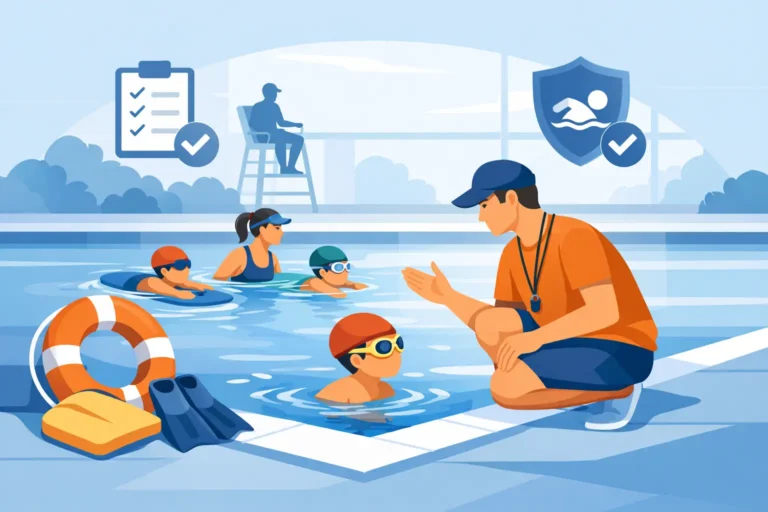
An instructor may begin with walking through water, holding the wall, and practicing gentle splashes on the arms and face. The pace should be calm and purposeful. If anxiety rises sharply, the task can be reduced to a smaller step rather than abandoned altogether.
Learn to Exhale Before You Try to Swim
Holding your breath is a common fear response. Unfortunately, it can make the body tense and cause a rushed, panicked inhale when the face comes up. Controlled exhaling is one of the most useful early skills for adult learners.
A typical progression starts with blowing bubbles while standing, then lowering the mouth, nose, and eventually the full face into the water. The goal is not to tolerate discomfort. The goal is to establish a repeatable breathing pattern: exhale underwater, lift or turn to breathe, then return to position.
Practice Recovery, Not Just Floating
Many adults are told that they must float before they can learn anything else. Floating is valuable, but it can be intimidating when taught without preparation. A better approach is to teach recovery alongside it.
For example, a learner can practice holding the wall, extending into a short front float, then bringing the feet down to stand. Later, they may learn a back float with support and a controlled return to standing. Knowing how to recover reduces the fear of losing control.
What Structured Lessons Should Look Like
A supportive instructor is essential, but encouragement alone is not enough. Adult learners benefit from a visible plan that shows what they are practicing and why. AQZOG uses structured progression because confidence grows faster when learners can recognize real improvement from one lesson to the next.
A strong adult water-confidence program usually includes pool orientation, safe entry and exit, breath control, submersion at an appropriate pace, floating and recovery, basic propulsion, and simple survival responses. Stroke technique comes later, once the learner can stay calm and regain a safe position.
Private lessons can be especially helpful for severe aquaphobia, trauma-related fear, or adults who need a slower pace. The coach can adjust distance, depth, physical support, and repetition in real time. Group lessons can also work well for adults with mild to moderate fear, particularly when groups are small and learners are placed at a similar level.
The trade-off is straightforward: private coaching provides maximum individual attention, while group instruction offers routine, social reassurance, and often a more affordable path. The best format is the one that lets you attend consistently without feeling overwhelmed.
How to Measure Progress When You Still Feel Nervous
Confidence is not always the absence of nerves. In the early stages, progress may look like feeling anxious but still completing a task safely. That is meaningful improvement.
Use specific measures rather than judging yourself by whether you can already swim laps. You may notice that you can enter the pool without gripping the rail, place your face in the water for several seconds, exhale without rushing, or float with less assistance. You may also recover from a wobble without panic.
Keep a simple record after each lesson. Write down one skill that felt more controlled and one skill to repeat next time. This helps counter the common feeling that “nothing changed” when progress is actually happening in small, important stages.
Do not compare your timeline with another swimmer’s. Adults bring different histories, comfort levels, physical abilities, and goals to the pool. Someone training for a triathlon needs a different pathway from a parent who wants to supervise children confidently or an adult preparing for a water-safety assessment.
Mistakes That Can Set Recovery Back
The biggest mistake is treating fear as something to overpower. Being pushed into deeper water, having water thrown unexpectedly in your face, or being told to relax when you are panicking can reinforce the original fear. A challenge should feel achievable with coaching, not like a threat.
Another mistake is practicing only when you feel completely ready. Avoidance can make fear stronger over time. Instead, choose small, planned exposure: attend the lesson, stand in the shallow end, complete the breathing drill, and leave after a successful repetition. Consistency matters more than dramatic breakthroughs.
It is also wise to avoid practicing alone until you have basic water-safety skills and a safe environment. Use a supervised pool, stay within your standing depth when appropriate, and tell your instructor if a drill triggers panic. Good coaching relies on honest feedback.
Building From Survival Skills to Swimming Confidence
Once breathing, floating, and recovery become more reliable, swimmers can begin to travel through the water with short kicks, arm actions, and supported glides. The first goal may be moving a few feet calmly, then returning to the wall. Distance can increase gradually as technique and comfort improve.
At this stage, basic backstroke or freestyle skills may be introduced. Back-based skills can help some learners feel more able to breathe, while others initially dislike having water near their ears or not seeing where they are going. Front-based skills may feel more familiar but require steady exhaling. There is no single correct sequence for every adult.
Water safety remains part of every stage. Learners should know how to enter safely, move to an exit, hold a stable float or rest position, and ask for help. These abilities create practical confidence far beyond a single swim lesson.
If water fear has been linked to a traumatic event or causes intense distress outside the pool, working with a qualified mental health professional alongside a trained swim instructor may be appropriate. Swimming lessons build physical and situational skills; therapeutic support can address the deeper emotional response.
Your first successful lesson does not need to end with a perfect stroke. It can end with something more useful: stepping out of the pool knowing exactly what you did, how you stayed safe, and what you are ready to practice next.