Best Swimming Lessons in Singapore for Real Progress
A child who can splash happily is not necessarily safe in deep water. An adult who can move across a pool may still panic when unable to touch the floor. That is why families and learners searching for the best swimming lessons in Singapore should look beyond a convenient time slot or the lowest fee. The right program develops calm, capable swimmers with measurable skills that hold up in real situations.
Swimming is an essential life skill in Singapore, where public pools, school programs, holidays, and water-based activities are part of everyday life. Strong instruction should give each learner a clear pathway: build confidence, develop controlled movement, learn water survival, and progress toward recognized SwimSafer certification where appropriate.
What Defines the Best Swimming Lessons in Singapore?
The best program is not always the largest class, the closest pool, or the fastest promise. It is the one that matches the learner’s age, starting ability, goals, and comfort level while maintaining consistent coaching standards.
For young children, the priority is usually water confidence and safety awareness. They need time to become comfortable with entering the water, putting their face in, floating, kicking, and responding to simple instructions. Pushing formal strokes too early can create anxiety or poor technique. A good coach knows when to encourage a child and when to slow the pace.
For school-age learners, structured progression matters more. They should be able to see what they are working toward, whether that is independent swimming, a specific SwimSafer stage, stronger strokes, or practical test readiness. Parents should not have to guess whether weekly lessons are producing progress.
For adults, the best lessons begin with an honest assessment. A complete beginner, a learner with water fear, and a swimmer preparing for a triathlon need very different coaching. Adult classes should be supportive without being vague, with a practical plan that builds breathing control, floating, movement, and efficient technique at a manageable pace.
Look for a Clear Progression System
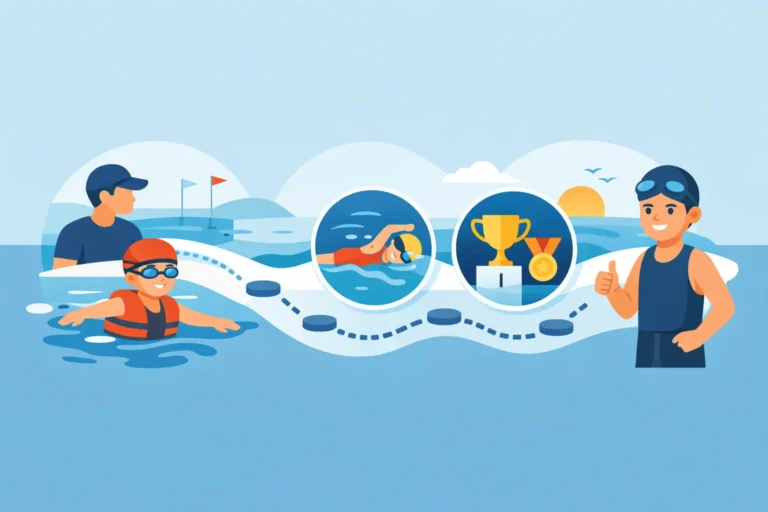
A structured curriculum turns lessons into a pathway rather than a series of unrelated activities. Learners should work through skills in a sensible order: water entry, submersion, breathing, buoyancy, propulsion, stroke development, and water survival. As confidence increases, the coach can introduce deeper-water skills, treading water, distance swimming, and more advanced technique.
This is particularly important for SwimSafer learners. SwimSafer is not simply about passing an assessment. It is designed to develop survival competence, water safety knowledge, and responsible decision-making around water. Lessons that include regular practice of test components, practical expectations, and theory preparation give children a stronger foundation than last-minute test coaching.
Choose the Right Lesson Format
Group, private, and semi-private lessons can all be effective. The best choice depends on the learner, not a one-size-fits-all formula.
Weekly group classes are often a strong option for children who are comfortable learning with peers. They offer routine, social motivation, and repeated practice over time. The key trade-off is attention: smaller, well-organized groups generally allow coaches to observe and correct each child more consistently.
Private one-to-one coaching is valuable when a learner needs focused attention. It can help adults overcome water fear, support children who need extra confidence before joining a group, and accelerate technical improvement for swimmers working toward a specific goal. Private lessons are also useful for short-term preparation before an assessment, although meaningful improvement still requires regular practice.
Semi-private classes work well for siblings, friends, or adults at similar ability levels. They provide more individualized feedback than a standard group format while preserving the motivation that comes from learning alongside someone familiar.
Holiday intensive programs can create faster momentum because learners spend more time in the water over a shorter period. They are helpful for beginners who need an early confidence boost or children preparing for a SwimSafer practical test. However, an intensive course is most effective when followed by continued practice. Swimming skill is physical memory, and that memory strengthens through consistent repetition.
Safety Is More Than Swimming Distance
Many parents understandably ask, “How far will my child be able to swim?” Distance matters, but it is only one measure of readiness. A safer swimmer can enter and exit the water with control, regain composure after submersion, float or tread water, orient themselves, and make sensible choices in unfamiliar conditions.
A high-quality lesson should include more than laps. Coaches should teach safe entries, basic rescue awareness, deep-water confidence, personal flotation concepts, and the limits of a swimmer’s own ability. These skills are especially relevant when children move between shallow teaching pools, deeper public pools, hotel pools, beaches, and water-play environments.
Parents should also observe whether safety is actively managed during class. Are learners grouped by capability? Does the coach maintain clear supervision? Are instructions simple and age-appropriate? Is a nervous child supported without being forced? A calm, organized lesson environment helps children learn faster because they feel secure enough to try.
Questions to Ask Before Enrolling
Before choosing a program, ask how the school assesses new learners and how it decides on class placement. A child placed in a class that is too advanced may lose confidence, while one placed far below their ability may become disengaged.
Ask about the coach’s experience with the learner’s age group and goal. Teaching toddlers is different from preparing a child for a SwimSafer practical test. Teaching an adult who fears deep water is different from correcting freestyle technique for fitness swimming.
It is also worth asking how progress is communicated. Useful feedback is specific: which skills are secure, which ones need work, and what the next milestone is. General reassurance is welcome, but visible progress gives parents and learners confidence that their time in the pool is being used well.
Consider these five practical checks when comparing schools:
- A structured pathway from beginner confidence to advanced skills or certification
- Coaches experienced in child development, adult learning, and water safety
- Class placement based on ability rather than age alone
- Convenient public pool locations that make weekly attendance realistic
- Preparation options for SwimSafer stages, mock practical tests, and theory requirements
Matching Lessons to Each Stage of Learning
Toddlers need a gentle water introduction focused on trust, movement, and safe routines. The aim is not to create a perfect freestyle swimmer at age three. It is to help the child become relaxed in the water, respond to instruction, and establish the foundations for future independent swimming.
Children who are ready for formal instruction benefit from regular group lessons with clear milestones. As they advance, SwimSafer stage training gives their learning direction and helps parents understand the practical water-survival skills being developed.
Learners preparing for a SwimSafer assessment may need focused support in specific areas such as entries, floatation, treading water, survival sequences, or swim distance. Mock practical tests can reveal gaps early, allowing time for targeted correction instead of hoping a child will perform well on the day.
Adults should be encouraged to begin at their true level. Starting from the basics is not a setback. It is often the quickest route to lasting confidence because it corrects breathing habits, body position, and fear responses before they become harder to change. Once those basics are stable, adults can progress toward fitness swimming, stroke efficiency, open-water confidence, triathlon preparation, or lifesaving pathways.
Progress Requires Consistency
The strongest swimming results rarely come from one exceptional lesson. They come from a reliable schedule, experienced feedback, and enough time in the water for new movements to become natural. Missing several weeks can interrupt confidence, especially for younger children or hesitant adults.
Convenience therefore matters. A nearby public pool location and a class time that fits family routines can be more valuable than a program that looks ideal on paper but is difficult to attend consistently. The best swimming school is one that combines accessible scheduling with coaching quality and a clear development plan.
Since 2007, AQZOG has built its instruction around this principle: every swimmer should know what they are learning, why it matters for safety, and what comes next. Whether the goal is a child’s first confident float, SwimSafer certification, or an adult’s first independent lap, the right coaching turns uncertainty into steady achievement.
Choose lessons that treat swimming as more than a weekly activity. When a learner can stay calm, make safe decisions, and move confidently through water, the result reaches far beyond the pool.