8 Best Ways to Build Water Confidence Safely
A child who clings to the pool wall or an adult who avoids putting their face in the water does not need to be pushed harder. They need a clear next step that feels safe and achievable. The best ways to build water confidence start with trust in the environment, trust in the instructor, and repeated success with manageable skills.
Water confidence is not the same as being able to swim a full lap. It is the ability to stay calm, make safe decisions, control breathing, and recover when water feels unfamiliar. For children, that foundation supports SwimSafer progression and lifelong water safety. For adults, it can turn years of avoidance into a practical, empowering life skill.
1. Start Where the Swimmer Feels Safe
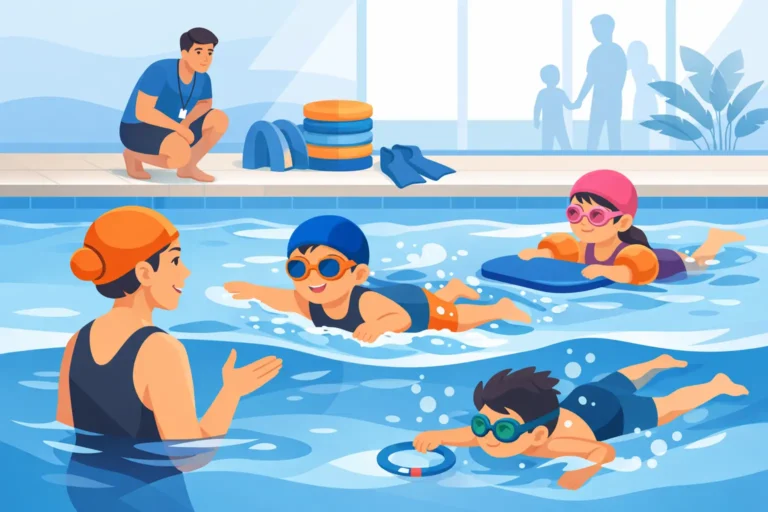
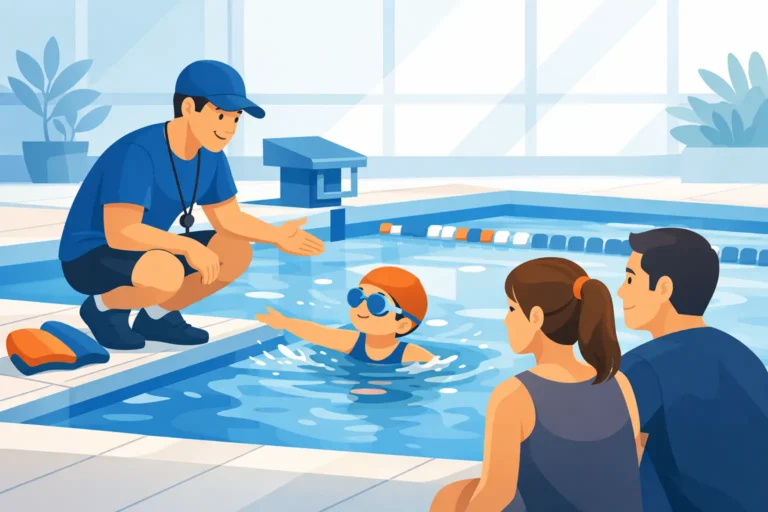
Confidence grows when the starting point is appropriate. A nervous toddler may begin by sitting on the pool edge, splashing, and holding an instructor’s hands. A school-age child may be comfortable standing in shallow water but anxious about floating. An adult beginner may need time simply to become comfortable with water around the face.
There is no benefit in rushing past these signals. Starting in water where the swimmer can stand comfortably often reduces tension and allows them to focus on one task at a time. As calm responses become more consistent, the instructor can gradually introduce deeper water and more independent movement.
This progression matters because fear often comes from feeling out of control. A well-paced lesson gives the swimmer choices, clear boundaries, and a predictable routine. They learn that water has rules, but those rules can be understood and managed.
2. Make Breath Control the First Technical Priority
Many swimmers believe they are afraid of water when the real issue is breathing. Holding the breath too long, lifting the head suddenly, or inhaling at the wrong moment can make even shallow-water activities feel overwhelming.
Begin with simple, repeatable practice: blowing bubbles with the mouth, placing the nose and mouth in the water, then submerging the full face for short periods. The goal is not to force submersion. The goal is to show the swimmer that they can control their breathing before, during, and after contact with water.
For young children, games can make this process feel natural. Blowing bubbles to move a floating toy or counting underwater for one or two seconds creates a reason to practice without turning the exercise into a test. Adults often respond well to understanding the purpose: exhaling underwater prevents the rushed, panicked inhale that can happen when the face returns to the surface.
3. Teach Floating Before Focusing on Strokes
A swimmer who can float calmly has a valuable water-survival skill, even before learning a formal stroke. Back floats, front floats, and simple recovery movements help swimmers understand buoyancy and discover that their body can be supported by water.
This can be a major breakthrough for someone who assumes they will sink. In reality, floating takes relaxation, body position, and breath control more than strength. Tense shoulders, bent hips, and a lifted head can make the body feel heavy. With patient support, swimmers learn to lengthen their body and let the water provide lift.
An instructor may first support the swimmer at the back or hips, then reduce that assistance gradually. That transition must be deliberate. Removing support too early can damage confidence; maintaining it for too long can create dependence. The right pace is different for every learner, which is why structured coaching is more effective than simply telling someone to relax.
4. Practice Safe Recovery Skills Early
Water confidence should always include the ability to respond when a swimmer loses balance, gets splashed, or ends up in an unexpected position. These are practical survival skills, not advanced extras.
Children and adults should learn how to regain standing position in shallow water, roll from front to back, move toward a wall, hold the wall safely, and climb out when appropriate. As they progress, they can practice controlled entries, treading water, and moving through deeper water with an instructor nearby.
For children working toward SwimSafer stages, these skills support assessment readiness while building real-world awareness. A certificate is meaningful when it reflects calm, reliable performance in water. Repeating recovery drills in a supportive setting helps swimmers react with a plan instead of panic.
5. Use Small, Measurable Progressions
Big goals such as “swim independently” can feel distant. Smaller milestones create momentum. A child might first put their ears in the water, then float with support, then kick for three seconds, then travel to the wall. An adult might begin with bubble control, progress to a supported back float, and later complete a short distance with a kickboard.
Each successful step gives the swimmer evidence that they are improving. This is especially valuable for learners who have had a frightening experience or who compare themselves with more advanced swimmers.
A structured program should make progress visible. Parents should know what their child is practicing, what skill comes next, and how that skill connects to water safety and formal progression. Adult learners also benefit from clear benchmarks because they can see that confidence is being built through skill, not luck.
6. Keep Practice Consistent, Not Intense
One long pool session cannot replace regular exposure. Water confidence develops through repetition, especially when practice is calm and positive. Weekly lessons give swimmers time to absorb a skill, return to it, and perform it with greater independence.
Holiday intensive programs can accelerate progress for learners who are ready for concentrated practice, but they work best when the swimmer has a suitable foundation and continues practicing afterward. For a highly anxious beginner, slower weekly exposure may be the better choice. More lessons are not always better if the pace leaves no time to process success.
Outside formal lessons, families can reinforce confidence by reviewing pool rules, encouraging supervised water play, and celebrating effort rather than only distance swum. Avoid making comparisons between siblings or classmates. The swimmer who takes one calm, independent float may have made more meaningful progress than the swimmer who completes a lap with poor control.
7. Choose Instruction That Balances Encouragement and Standards
A kind instructor matters, but encouragement alone is not enough. Swimmers need correct technique, clear safety expectations, and an instructor who knows when to challenge them. The strongest teaching environments combine reassurance with measurable standards.
Look for lessons that group swimmers appropriately by age and ability, teach water-survival skills alongside stroke development, and provide a defined pathway from beginner confidence to independent swimming. For test-focused learners, mock practical practice and theory preparation can reduce uncertainty before SwimSafer assessments.
At AQZOG, structured progression is designed around this balance. Learners are supported at their current level while working toward specific outcomes, whether that means a toddler’s first independent float, a child’s next SwimSafer stage, or an adult’s first confident swim across the pool.
8. Build Confidence Beyond the Lesson
Pool confidence must carry over to different situations. Once a swimmer is comfortable with familiar routines, carefully introduce variation: a different pool depth, a supervised jump-in, swimming toward a parent or instructor, or practicing safe turns at the wall.
Variation should be introduced only after core skills are reliable. A child who is still fearful of face submersion does not need a deep-water challenge. Conversely, a swimmer who has mastered basic floating may need a new goal to avoid becoming overly dependent on the same exercise.
Parents can support this process with calm language. Instead of saying, “Don’t be scared,” try, “You know how to hold the wall, take a breath, and turn onto your back.” Specific reminders bring the swimmer back to skills they can use.
Water confidence is built one controlled experience at a time. Give each swimmer a safe place to try, a qualified instructor who recognizes real progress, and enough repetition to turn new skills into calm habits.