How to Improve Swim Endurance Faster
Two swimmers can put in the same effort and get very different results. One finishes a set feeling controlled. The other is breathless after a few laps, even though both are reasonably fit. In swimming, endurance is not just about working harder. If you want to understand how to improve swim endurance, you need to look at technique, breathing, pacing, and training structure together.
That matters whether you are an adult trying to swim longer without stopping, a triathlon trainee building open-water fitness, or a parent supporting a child through structured swim progression. Good endurance in the pool is a skill. It can be trained, measured, and improved with the right approach.
Why swim endurance breaks down so quickly
Many swimmers assume poor endurance means poor fitness. Sometimes that is true, but often the bigger issue is efficiency. Water punishes wasted movement more than land-based exercise does. A slightly lifted head, a rushed kick, or a breath taken too late can raise effort levels fast.
This is why some beginners feel exhausted after 25 yards while experienced swimmers can hold a steady rhythm for much longer at a lower heart rate. The experienced swimmer is not always stronger. More often, they are moving through the water with less resistance and better control.
For children, endurance can also drop when they tense up, lose body position, or panic when tired. For adults, the common pattern is overkicking, holding the breath, and starting too fast. In both cases, the solution is usually not just more laps. It is better-quality laps.
How to improve swim endurance with better technique
If your stroke is inefficient, endurance training becomes frustrating. You keep adding effort, but your distance does not improve much. That is why technique work should be part of any endurance plan.
Start with body position. A horizontal body line reduces drag and helps each stroke travel farther. If your hips and legs sink, every lap becomes more demanding. Keeping your head neutral and eyes slightly downward usually helps.
Next is the catch and pull. Many swimmers move their arms a lot without actually holding the water well. That leads to a high turnover rate and low distance per stroke. A cleaner catch creates more propulsion without forcing you to sprint.
Kicking also needs balance. A strong kick supports the stroke, but nonstop hard kicking can drain energy quickly, especially for newer swimmers. In endurance swimming, the kick should stabilize the body and support rhythm rather than dominate the effort.
This is where structured coaching makes a real difference. A swimmer who learns proper breathing timing, body alignment, and stroke mechanics will usually improve endurance faster than someone who only tries to push through fatigue. AQZOG has long emphasized that strong swimming is built through safe, progressive skill development, and endurance is part of that progression.
Breathing is usually the hidden problem
Ask swimmers why they get tired, and many will say, “I just run out of energy.” Often, what they really mean is that they run out of air management.
In swimming, poor breathing creates tension. Tension raises heart rate. A higher heart rate makes every lap feel harder. This cycle can begin within a single length of the pool.
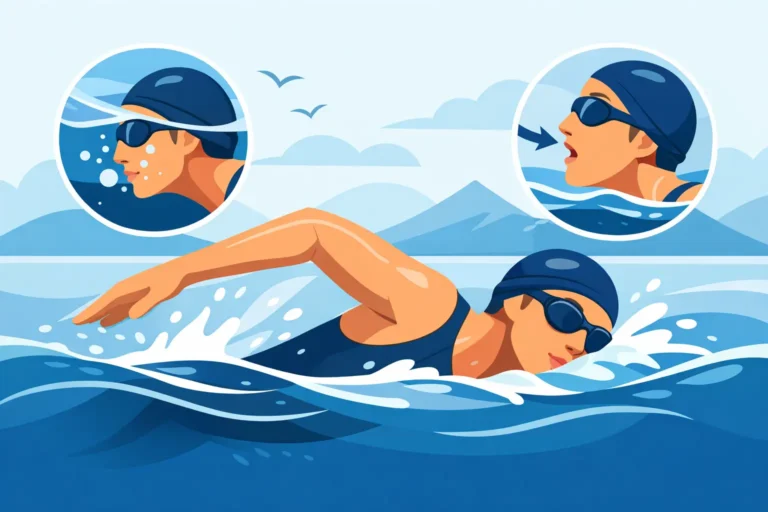
The first correction is simple but not always easy. Exhale steadily underwater. Many swimmers hold their breath and then try to inhale and exhale at the same time when they turn to breathe. That creates a rushed, panicked pattern. A full underwater exhale allows a quicker, calmer inhale.
The second correction is timing. Breathing too late in the stroke usually causes the head to lift, which drops the hips and increases drag. Breathing should feel connected to body rotation, not like a separate emergency action.
For newer swimmers, bilateral breathing can be useful for balance, but it is not mandatory for everyone. If breathing every three strokes causes breathlessness and poor form, breathing every two strokes may be more practical during endurance sets. It depends on the swimmer, the stroke, and the training goal.
Pacing matters more than most swimmers realize
One of the fastest ways to improve endurance is to stop swimming the first lap like the last lap of a race.
Poor pacing is common in both children and adults. A swimmer pushes hard at the start, accumulates fatigue quickly, and then struggles through the rest of the set. This creates the impression of low endurance, when the real issue is effort control.
A better approach is even pacing. Swim the first part of the set at a controlled, repeatable speed. If you are doing 8 x 50, the goal is not to survive the first three and collapse on the last five. The goal is to keep stroke quality and timing stable across all repeats.
This is especially important for test readiness, distance goals, and open-water preparation. Endurance is not just the ability to suffer longer. It is the ability to maintain useful technique under manageable fatigue.
What training structure actually works
If you are wondering how to improve swim endurance in a practical way, the answer is consistency plus progression. Random hard sessions rarely produce steady results.
A strong endurance plan usually includes three elements. First, easy aerobic volume builds comfort in the water. Second, interval work teaches the body to recover while holding form. Third, technique-focused swimming prevents bad habits from becoming permanent.
For example, a beginner adult might start with short repeats such as 8 x 25 with 20 to 30 seconds rest, focusing on calm breathing and relaxed strokes. Over time, that can progress to 6 x 50, then 4 x 100. A child working toward stronger lap swimming may use shorter repeats with more rest, especially if confidence and coordination are still developing.
More advanced swimmers may benefit from threshold sets, such as 10 x 100 at a sustainable pace with controlled rest. But harder is not always better. If technique falls apart halfway through, the set may be too demanding for the current level.
Dryland fitness helps, but it is not the whole answer
General fitness supports swim endurance, especially core control, shoulder stability, and aerobic conditioning. Walking, cycling, and strength work can all help. For triathletes, this crossover is obvious.
Still, a fit runner can feel surprisingly tired in the pool. That is because swimming places unique demands on breathing control, body position, and coordinated propulsion. Dryland training helps support endurance, but it cannot replace time spent practicing efficient movement in water.
For children, this point is even more important. A child does not need a complex gym plan to improve swim stamina. They need age-appropriate instruction, confidence in the water, and enough structured practice to build rhythm without fear or fatigue overload.
Common mistakes that slow progress
The first mistake is doing too much too soon. If every session feels like a test, swimmers often become discouraged or reinforce poor habits. Progress should be challenging but manageable.
The second is ignoring rest. Short, planned rest intervals are not a weakness. They allow swimmers to repeat quality movement. Endless struggling through sloppy laps can build fatigue, but not necessarily endurance.
The third is measuring progress only by total distance. Distance matters, but so do stroke count, pace consistency, breathing control, and recovery between repeats. A swimmer who completes 400 yards with calm breathing and stable form is progressing more meaningfully than one who thrashes through 500 with poor technique.
Another common issue is training without feedback. Swimmers are often unaware of what is costing them energy. A coach can spot whether the problem is head position, kick timing, crossover in the arms, or simple overexertion at the start.
How parents and adult learners should think about endurance
For parents, endurance should not be treated as a race to complete more laps at any cost. In swimming, safety and control come first. A child who can stay calm, breathe properly, and maintain form is building a stronger long-term foundation than one who is pushed beyond skill level.
For adult learners, especially those returning to swimming after years away, patience matters. Early gains can come quickly, but plateaus are normal. Sometimes the next improvement comes from a technical adjustment rather than a harder workout.
If a swimmer has ongoing fear, repeated breathlessness, or difficulty sustaining even short distances, it is worth addressing the root cause rather than simply adding volume. Better instruction usually saves time.
A simple way to build swim endurance each week
A workable weekly plan might include one technique-focused session, one aerobic endurance session, and one interval-based session. That balance gives you room to improve efficiency while also building capacity.
Over several weeks, increase only one variable at a time. Add a little distance, reduce rest slightly, or improve pace consistency. Changing everything at once makes it hard to tell what is working and can lead to fatigue or frustration.
The swimmers who improve most are usually not the ones who train with the most intensity. They are the ones who train with purpose, repeat good habits, and allow progress to build step by step.
Swim endurance improves when the body feels safer, the stroke becomes cleaner, and effort is paced well enough to last. Focus on that, and longer swims stop feeling like a struggle and start feeling controlled.