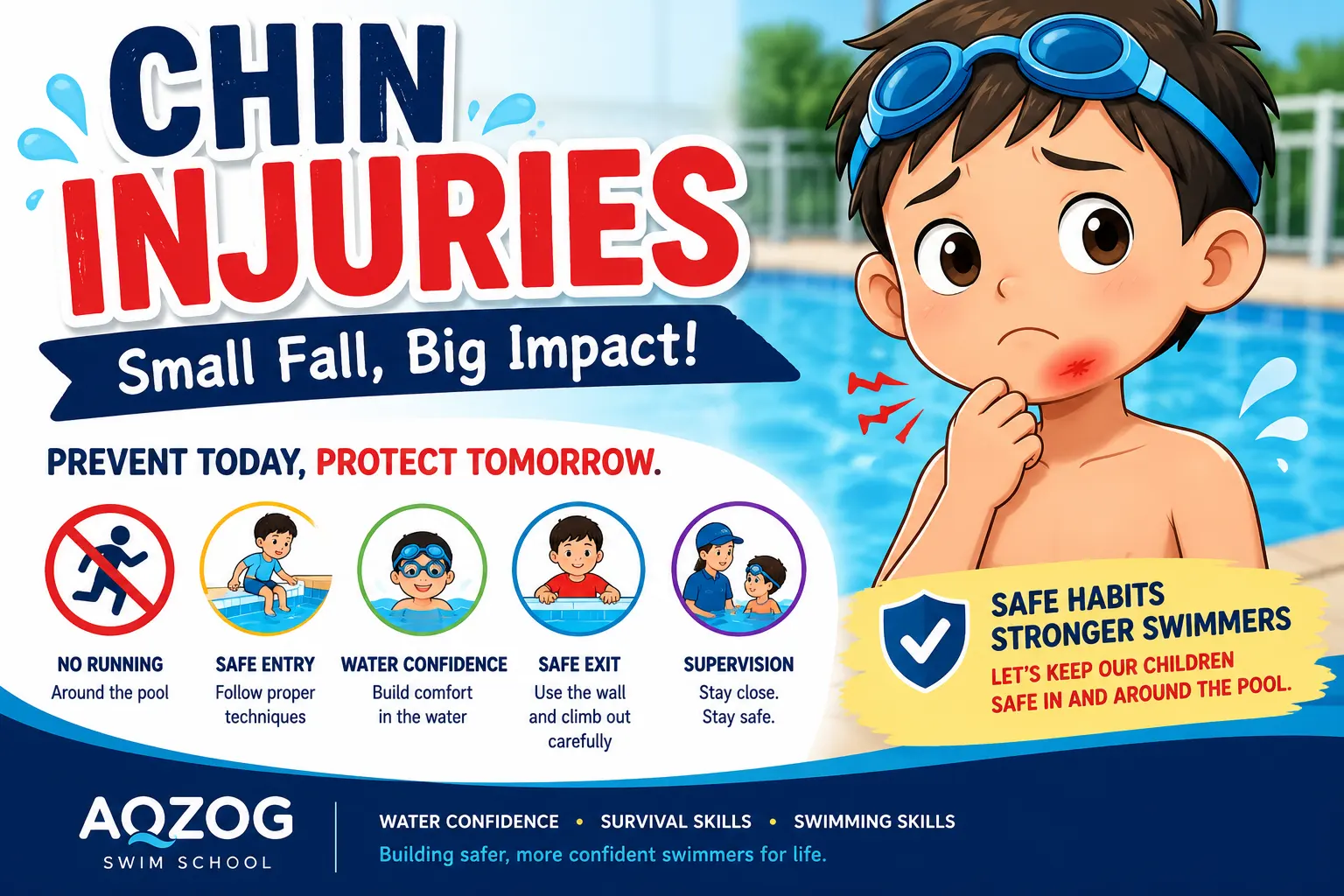
Chin Injuries in Beginner Swimmers: A Preventable Risk Every Parent Should Know
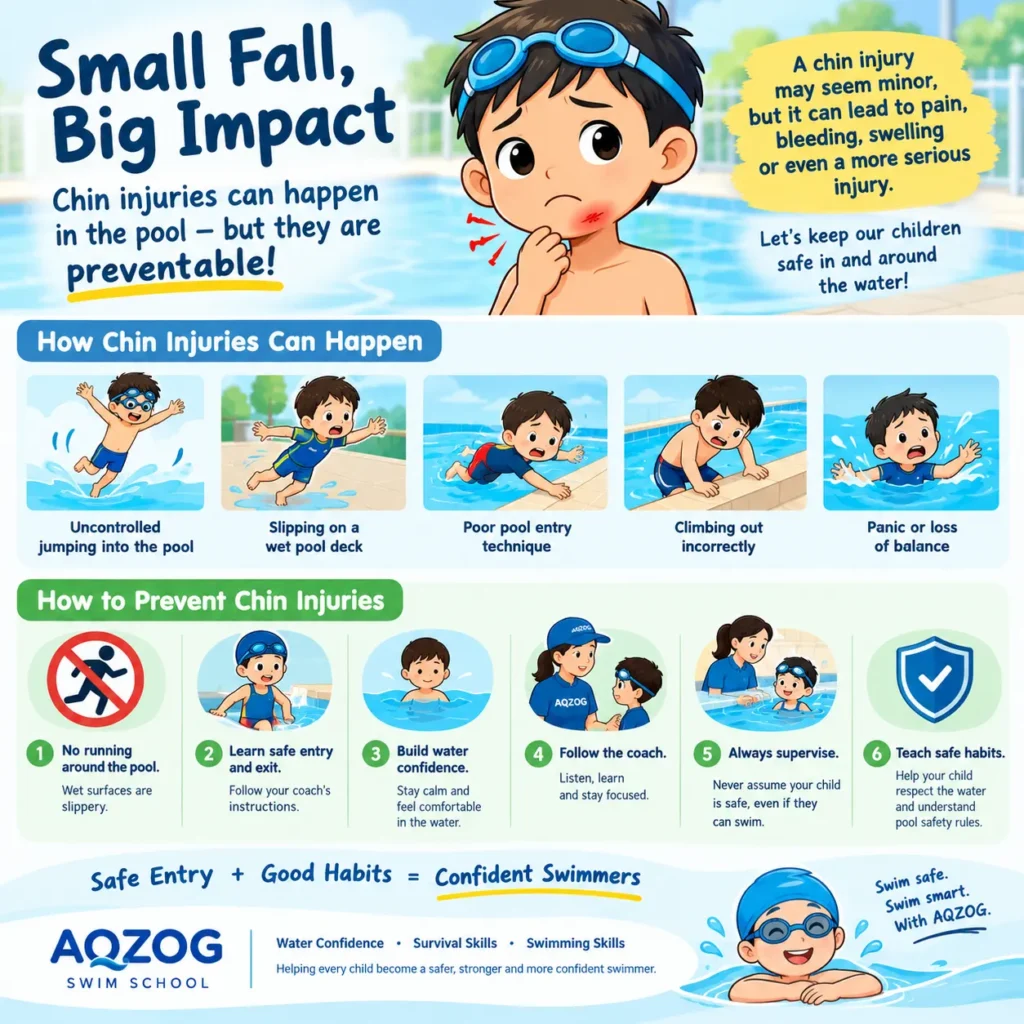
Chin Injuries in Beginner Swimmers: A Preventable Risk Every Parent Should Know
When parents think about swimming injuries, they often think about shoulder pain, knee problems or muscle strains.
But for a total beginner, there is another type of injury that deserves much more attention: chin and facial injuries around the swimming pool.
At AQZOG Swim School, we believe that swimming education should begin with safety—not simply with learning to kick, paddle or swim a certain distance.
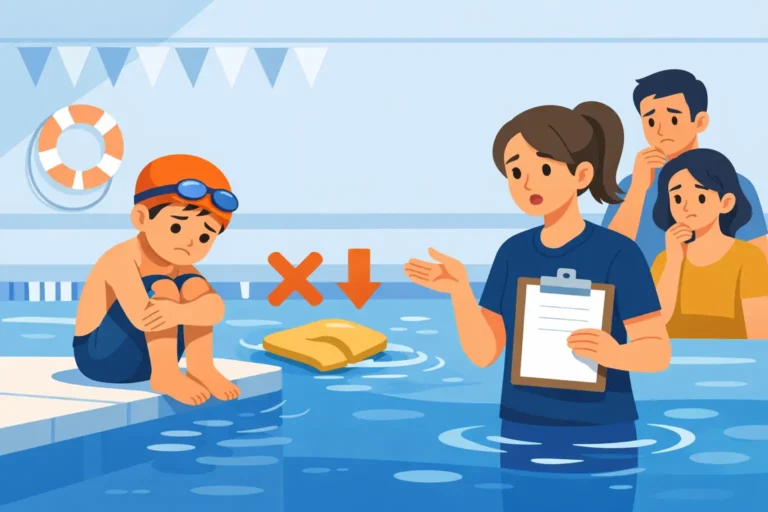
A child who is not yet comfortable in water may have difficulty controlling their body when entering the pool, standing up, moving near the pool edge or reacting when they lose balance. A sudden fall or uncontrolled movement can result in the chin striking the pool edge, pool deck or another hard surface.
The good news is that many of these situations can be prevented.
Why Can Total Beginners Hurt Their Chin?
A total beginner does not yet have the automatic water skills that an experienced swimmer takes for granted.
When a child becomes frightened or loses balance, several things can happen very quickly:
- The child may panic.
- The child may stiffen the body.
- The child may suddenly jump.
- The child may lose their balance.
- The child may attempt to climb out incorrectly.
- The child may slip near the pool.
- The child may fall forward or backward.
- The child may hit the pool wall or edge.
A young child may also have difficulty judging distance, depth and body position.
This is why AQZOG strongly believes that safe pool entry and exit should be taught as swimming skills—not treated as something a child will automatically know.
HealthHub Singapore advises parents to closely supervise children in and around swimming pools, prevent running near the pool and teach children to follow pool safety rules.
How Can a Chin Injury Happen?
There are several situations parents should be aware of.
1. Jumping Into the Pool Without Control
A beginner may jump before understanding how to control their body.
Instead of landing safely in the water, the child may lose balance and make contact with the pool edge or another hard surface.
2. Slipping at the Poolside
Wet pool decks can be slippery.
A child who runs, walks too quickly or plays near the edge may fall.
The American Academy of Pediatrics specifically warns children not to run on wet pool decks because falls can cause abrasions and bruises.
3. Poor Pool Entry Technique
Many parents assume that “getting into the pool” does not require teaching.
It does.
For a nervous beginner, a controlled entry may be safer than simply asking the child to jump.
Depending on the pool environment and the coach’s instructions, beginners can first learn controlled methods such as sitting and sliding into the water, entering feet-first, or using a supervised step entry.
A feet-first entry is widely recommended as a safer approach for beginners, particularly when water depth or conditions need to be checked first.
4. Climbing Out Incorrectly
Getting out of the pool is another important skill.
A tired child may try to pull themselves out without understanding where to place their hands or how to position their body.
A slip can result in the chin striking the pool edge.
5. Panic
This is particularly important.
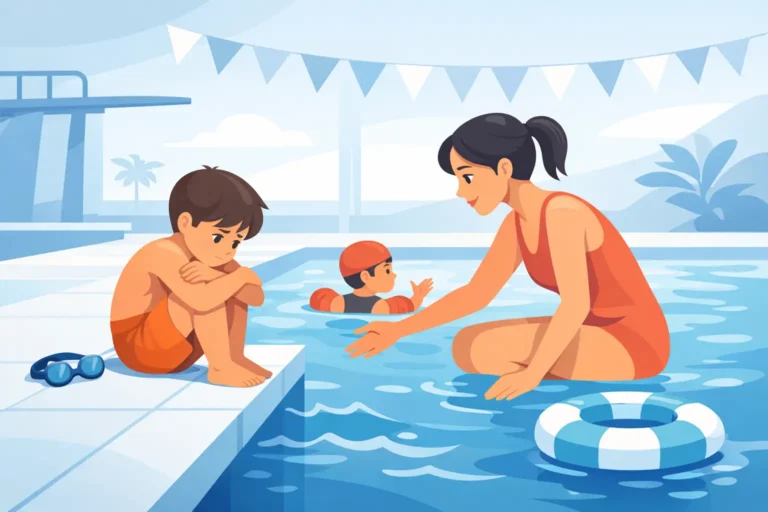
A child who is uncomfortable in water may suddenly panic.
When children panic, they may forget instructions and make uncontrolled movements.
That is why AQZOG believes water confidence must come before advanced swimming skills.
Why AQZOG Places Strong Emphasis on Prevention
At AQZOG Swim School, our philosophy is simple:
Don’t wait for a child to get hurt before teaching them how to be safe.
We want beginners to learn the correct habits from the beginning.
Swimming lessons should not simply mean:
“Kick harder.”
“Swim faster.”
“Go further.”
For a total beginner, the first questions should be:
Can the child enter the water safely?
Can the child control their breathing?
Can the child remain calm?
Can the child float?
Can the child return to the pool wall?
Can the child exit the water safely?
These foundational skills can help reduce unnecessary accidents.
AQZOG’s 3-Part Approach to Beginner Swimming
AQZOG uses a progressive approach built around:
1. Water Confidence
The child learns to become comfortable with water.
This can include:
- Water familiarisation
- Face-in-water exercises
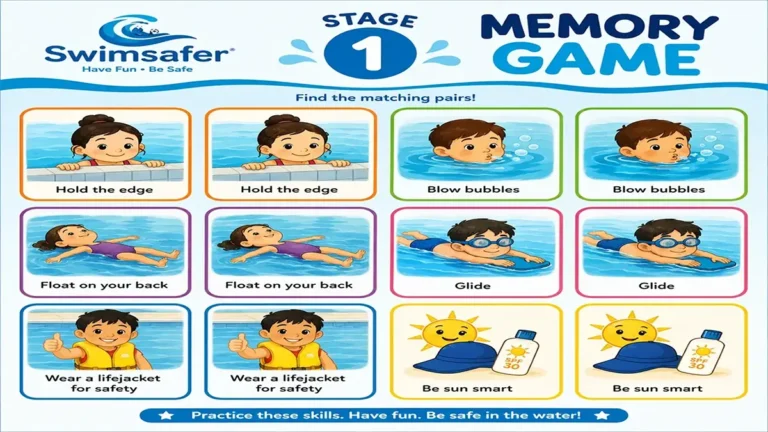
- Blowing bubbles
- Breath control
- Floating
- Submerging
- Changing body position
A child who is comfortable in water is more likely to respond calmly to instructions.
2. Survival Skills
The child learns what to do when something does not go according to plan.
This includes developing skills such as:
- Floating
- Recovering to the surface
- Moving towards the wall
- Holding the wall
- Safe entry
- Safe exit
- Basic survival techniques
3. Swimming Skills
Only after the foundations are developing do we progressively work on:
- Freestyle
- Backstroke
- Breaststroke
- Kicking
- Arm coordination
- Breathing
- Streamlining
- Stroke correction
This progression is especially important for young children who are still developing coordination and confidence.
Parents: Don’t Assume Your Child Is Safe Just Because They Can Swim
This is one of the most important messages AQZOG wants parents to understand.
Learning to swim does not make a child “drown-proof.”
The American Academy of Pediatrics states that swimming lessons do not provide drown-proofing and that supervision remains necessary even after children have learned swimming skills.
Singapore HealthHub similarly recommends close supervision whenever children are in or near water.
A child may be able to swim 25 metres but still be unable to safely deal with an unexpected situation.
Swimming ability and water safety are related—but they are not the same thing.
7 Simple Rules to Help Prevent Chin and Facial Injuries
Parents can reinforce these simple habits:
Rule 1: No running around the pool
Wet surfaces can be slippery.
Rule 2: No uncontrolled jumping
A beginner should only enter the water according to the coach’s instructions.
Rule 3: Learn safe entry
Teach children that entering the water is a skill.
Rule 4: Learn safe exit
Children should practise returning to and exiting from the pool wall safely.
Rule 5: Don’t push
Children should never push or play roughly around the pool.
Rule 6: Follow the coach
A beginner should listen carefully before entering the water.
Rule 7: Always supervise
Never assume that a child is safe simply because they have attended swimming lessons.
What Should Parents Do If Their Child Hits Their Chin?
A chin impact can range from a minor bruise or cut to a more significant injury.
Parents should assess the child and seek appropriate medical attention when there is significant pain, bleeding that does not stop, swelling, difficulty moving the jaw, loss of consciousness, vomiting, unusual drowsiness, confusion, breathing difficulty or other concerning symptoms.
If there is a significant head or facial impact, do not simply assume that the injury is minor.
When in doubt, have the child assessed by an appropriate healthcare professional.
This article provides general injury-prevention information and does not replace medical diagnosis or treatment.
Frequently Asked Questions About Chin Injuries in Beginner Swimmers
Are chin injuries common among beginner swimmers?
Chin injuries are not generally classified as the single most common swimming injury. However, chin and facial impacts are a preventable pool-safety concern, particularly when inexperienced children fall, slip or enter the water without adequate control.
AQZOG highlights the issue because prevention is better than dealing with an avoidable injury.
How can a child hurt their chin in a swimming pool?
A child can injure the chin through a fall on a wet pool deck, uncontrolled pool entry, collision with the pool edge or wall, or loss of balance while entering or exiting the water.
Can chin injuries be prevented?
Many situations can be reduced through proper supervision, safe pool-entry techniques, no-running rules, controlled movement and teaching children how to enter and exit the pool safely.
Should beginners be taught how to enter the pool?
Absolutely.
Safe entry is an important aquatic skill. Beginners should learn controlled, age-appropriate methods rather than simply being told to jump into the water.
Why is water confidence important?
A nervous child may panic when water reaches the face or when they lose their footing.
Water-confidence exercises help children become more comfortable with the aquatic environment and can support better responses to unexpected situations.
Should my child learn swimming or water safety first?
Both are important, but a beginner needs foundational water-safety and water-confidence skills alongside swimming development.
AQZOG incorporates Water Confidence, Survival Skills and Swimming Skills into its progressive teaching approach.
Can a child who has passed SwimSafer still get injured?
Yes.
Passing a swimming assessment demonstrates that a child has achieved specific skills at a particular level. It does not mean that the child is immune from accidents.
Children still require supervision and should follow pool safety rules.
Should parents supervise children who are taking swimming lessons?
Yes.
Swimming lessons are not a replacement for supervision. Parents and caregivers should continue to supervise children around water.
Is jumping into a swimming pool safe for a beginner?
It depends on the environment, water depth, entry point and the child’s ability.
Beginners should never jump or dive into water of unknown or unsuitable depth. Safe entry should be taught by a qualified instructor and follow the pool’s rules. The AAP specifically warns against diving into shallow or unknown-depth water.
What is AQZOG’s main message to parents?
Don’t wait for an accident before teaching water safety.
Teach your child how to enter safely, move safely, swim safely and exit safely.
AQZOG: Prevention Before Performance
At AQZOG Swim School, we want children to become confident, capable and safety-conscious swimmers.
For a total beginner, learning to swim is not about rushing to achieve a particular distance.
It starts with simple things:
Stay calm.
Respect the water.
Enter safely.
Control your body.
Learn to float.
Know where the wall is.
Exit safely.
Then, gradually, build stronger swimming skills.
A preventable chin injury may happen in only a few seconds. Teaching a child the correct habits can take time—but that time is worthwhile.
AQZOG believes that every child deserves to learn swimming safely, progressively and with confidence.
AQZOG Swim School
Water Confidence • Survival Skills • Swimming Skills
Helping children develop the skills they need to become safer and more confident swimmers in Singapore.