Haze Advisory for Swimming in Singapore
Haze Advisory for Swimming in Singapore: Is It Safe to Swim During Haze?
When haze affects Singapore, one of the most common questions parents and swimmers ask is:
“Is it safe to go swimming during the haze?”
Swimming is an excellent form of exercise, but swimming at an outdoor pool still means spending time outdoors and breathing more heavily during physical activity. When air quality deteriorates, swimmers, parents and coaches should therefore pay attention to the Pollutant Standards Index (PSI), PM2.5 readings, individual health conditions and the intensity of the swimming session.
At AQZOG Swim School, the health and safety of our swimmers always come first. This haze advisory for swimming is intended to help parents and swimmers make sensible decisions about swimming lessons and other aquatic activities during periods of poor air quality in Singapore.
Important: This guide provides general information and should be read together with the latest advisories issued by Singapore’s National Environment Agency (NEA), Ministry of Health (MOH) and Sport Singapore.
What Is Haze?
Haze occurs when very small particles and other pollutants are suspended in the atmosphere, reducing air quality and sometimes visibility.
Singapore experiences haze from time to time, often associated with forest and land fires in the region. Weather conditions, wind direction, dry conditions and rainfall can influence the severity of haze experienced in Singapore.
One of the pollutants of particular concern is PM2.5.
PM2.5 refers to fine particulate matter measuring 2.5 micrometres or less in diameter. Because these particles are extremely small, they can be inhaled deep into the respiratory system.
During haze periods, swimmers should therefore consider air quality before participating in prolonged or strenuous outdoor swimming.
Understanding Singapore’s PSI Levels
Singapore uses the Pollutant Standards Index (PSI) to describe air quality.
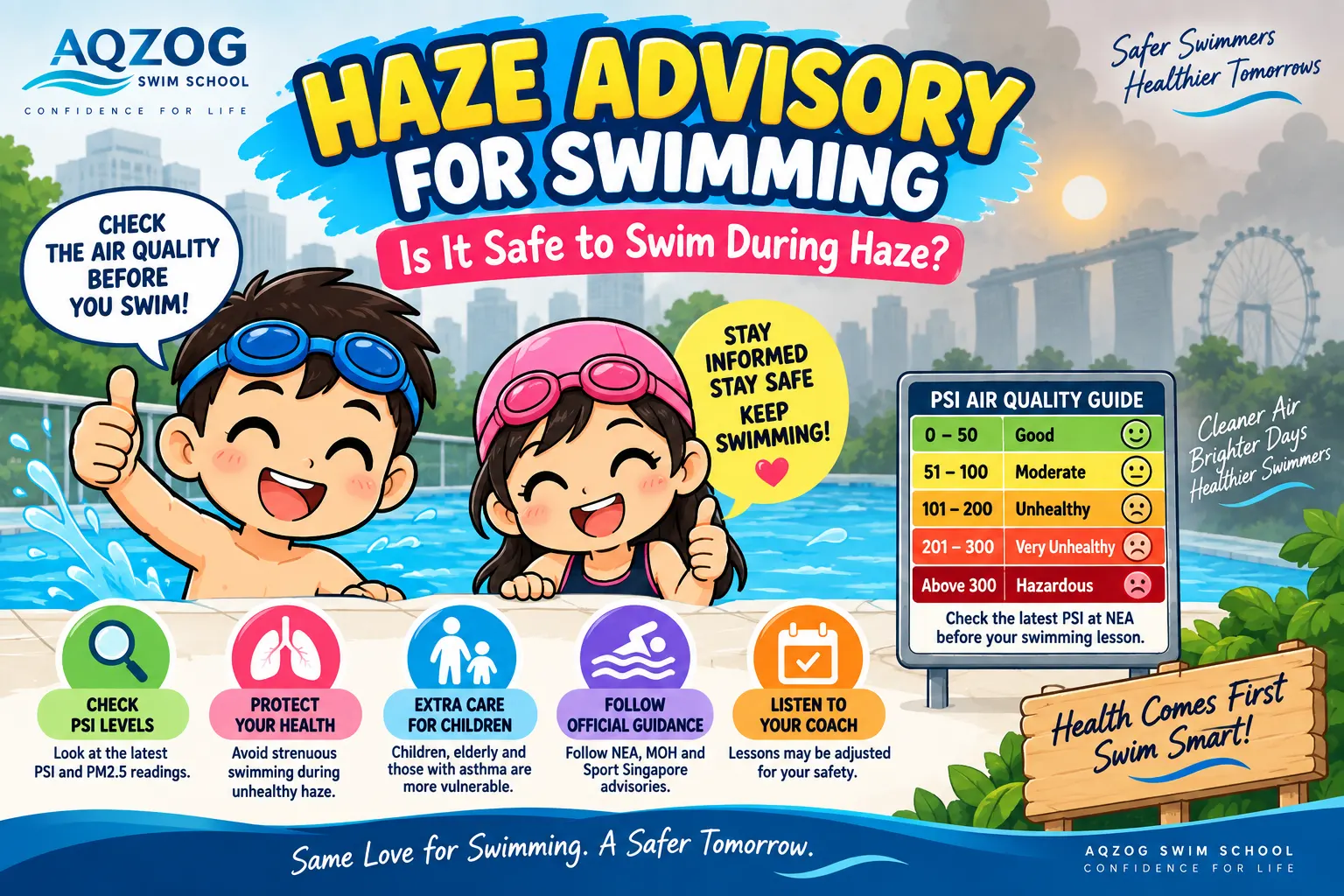
The general PSI categories are:
| 24-Hour PSI | Air Quality |
|---|---|
| 0–50 | Good |
| 51–100 | Moderate |
| 101–200 | Unhealthy |
| 201–300 | Very Unhealthy |
| Above 300 | Hazardous |
A PSI reading of 101 or higher is considered Unhealthy.
However, parents should not simply look at one number and automatically decide whether a swimming lesson should proceed.
Factors to consider include:
- The swimmer’s age
- Current health condition
- Whether the swimmer has asthma or chronic heart/lung conditions
- Duration of the swimming lesson
- Intensity of training
- Current air quality
- Expected air quality during the lesson
- Whether the swimming pool is indoors or outdoors
- Whether the swimmer develops symptoms during exercise
Can You Swim When the PSI Is Below 100?
When the 24-hour PSI is 100 or below (Good or Moderate), normal activities are generally permitted under Singapore’s health advisory.
For most healthy swimmers, regular swimming lessons can therefore normally continue.
However, parents should still consider their child’s individual health.
If a child is coughing, wheezing, experiencing eye irritation, having difficulty breathing or simply feeling unwell, it may be sensible to stop physical activity even if the PSI remains within the Moderate range.
The PSI number should never replace common sense and observation of the swimmer.
Swimming When PSI Is 101–200: Unhealthy
Once the 24-hour PSI enters the Unhealthy range of 101–200, additional precautions become important.
For healthy persons, Singapore’s health advisory recommends reducing prolonged or strenuous outdoor physical exertion.
For children, elderly persons and pregnant women, the recommendation is to minimise prolonged or strenuous outdoor physical exertion.
People with chronic heart or lung disease should avoid prolonged or strenuous outdoor physical exertion.
Swimming can range enormously in intensity.
A relaxed beginner lesson with frequent rests is very different from:
- Competitive swim training
- Repeated sprint sets
- Long-distance swimming
- Intensive SwimSafer preparation
- Timed swimming
- Water polo conditioning
- Triathlon swim training
- Continuous endurance sets
Parents and coaches should therefore consider both duration and intensity, rather than treating every swimming activity as equivalent.
Swimming When PSI Is 201–300: Very Unhealthy
A 24-hour PSI between 201 and 300 is classified as Very Unhealthy.
At this level, healthy people are advised to avoid prolonged or strenuous outdoor physical exertion.
Children, elderly persons and pregnant women should minimise outdoor activity, while people with chronic heart or lung disease should avoid outdoor activity.
For a swim school, coach or parent, this represents a significant change in risk management.
Even though a swimming facility may remain physically open, that does not automatically mean strenuous outdoor swimming is appropriate.
Sport Singapore advises participants and sports organisers to monitor air quality and follow the relevant government health advisories. Organisers are expected to conduct their own risk assessment when deciding whether sporting activities should proceed.
AQZOG recommends placing health considerations ahead of completing a particular training programme or swimming lesson.
A missed lesson can be rearranged. A swimmer’s health should not be unnecessarily compromised.
Swimming When PSI Is Above 300: Hazardous
A PSI reading above 300 is Hazardous.
At this level:
Healthy people should minimise outdoor activity.
Children, elderly persons and pregnant women should avoid outdoor activity.
People with chronic heart or lung disease should avoid outdoor activity.
Outdoor swimming lessons and intensive aquatic training should therefore be reconsidered carefully in accordance with the prevailing official health and facility advisories.
Parents should check for announcements from the relevant swimming facility, Sport Singapore, NEA and their swimming school before travelling to the pool.
Why Haze Can Affect Swimmers Differently
A swimmer may breathe much faster during training than while sitting or walking.
Consider a swimmer completing repeated freestyle laps.
The swimmer may be:
- Breathing heavily
- Increasing respiratory rate
- Exercising continuously
- Training for 45–90 minutes
- Recovering briefly before beginning another set
This means the intensity of the swimming activity matters.
A 20-minute low-intensity water familiarisation lesson cannot necessarily be compared with a 90-minute competitive swimming session.
This is why Singapore’s health advisories refer to both prolonged and strenuous physical exertion.
Children May Need Extra Precaution During Haze
AQZOG conducts many swimming programmes for children, including beginner swimming and SwimSafer preparation.
Children are among the groups identified as more sensitive to the effects of haze.
Parents should pay particular attention if their child:
- Has asthma
- Has chronic respiratory problems
- Has an existing heart or lung condition
- Is recovering from an illness
- Is coughing before the lesson
- Experiences unusual breathlessness
- Complains of throat irritation
- Has irritated or watery eyes
- Feels dizzy or unusually tired
Never pressure a child to complete a swimming lesson simply because he or she has already arrived at the pool.
If something does not look right, inform the coach immediately.
Haze and SwimSafer Training
SwimSafer lessons can involve different levels of physical intensity depending on the stage and components being practised.
For example, swimmers preparing for higher SwimSafer stages may practise:
- Continuous swimming
- Timed swimming
- Survival strokes
- Treading water
- Underwater swimming
- Entries and exits
- Rescue skills
- Survival sequences
Some of these components can require greater physical exertion than basic water familiarisation.
During haze conditions, coaches may need to modify the programme by reducing intensity, increasing rest periods, shortening repetitive sets or postponing demanding components depending on the prevailing conditions and health advisory.
Passing a SwimSafer assessment is important, but swimmer safety comes first.
Should Swimmers Wear an N95 Mask?
An N95 mask should never be worn while swimming.
A mask becomes wet in the water and is not suitable for use during swimming.
Singapore’s MOH also states that N95 masks are generally not needed for short-term exposure such as travelling from home to work or school, or while indoors.
During severe haze conditions, follow current MOH recommendations regarding masks when travelling outdoors before and after swimming.
Check Both PSI and PM2.5
Another important point for parents is understanding the difference between the 24-hour PSI and 1-hour PM2.5 reading.
A simple way to remember this is:
Planning tomorrow’s swimming lesson?
Check the 24-hour PSI forecast and accompanying health advisory.
Deciding whether to go swimming right now?
Check the 1-hour PM2.5 reading as well as current official advice.
The 1-hour PM2.5 reading can help people make more immediate decisions because air quality can change during the day.
Parents should check official information shortly before leaving home rather than relying on a screenshot or PSI reading from several hours earlier.
AQZOG Haze Safety Checklist Before Swimming
Before sending your child for an outdoor swimming lesson during haze conditions, consider these questions:
1. What is the current air quality?
Check official NEA information.
2. What is the 24-hour PSI forecast?
This helps with advance planning.
3. What is the current 1-hour PM2.5 reading?
This can help with immediate activity decisions.
4. Is my child healthy today?
A swimmer who is already coughing or unwell may respond differently from a healthy swimmer.
5. Does my child have asthma or another respiratory condition?
Follow medical advice and ensure prescribed medication is available where appropriate.
6. How strenuous will today’s lesson be?
Competitive training and endurance swimming may require considerably more exertion than a beginner lesson.
7. Has the swimming facility issued an announcement?
Check before travelling.
8. Has AQZOG or your swimming coach issued an update?
Operational decisions may change as conditions develop.
What Symptoms Should Swimmers Watch For?
Short-term haze exposure can cause irritation of the:
- Eyes
- Nose
- Throat
Some people may also experience respiratory discomfort.
Stop exercising and inform the coach if a swimmer develops unusual symptoms such as significant coughing, wheezing, chest discomfort, breathing difficulty, dizziness or feeling unusually unwell.
People who experience breathing difficulties or significant symptoms should seek appropriate medical attention.
AQZOG’s Approach to Swimming During Haze
At AQZOG Swim School, we believe good swimming instruction involves much more than teaching freestyle, breaststroke, backstroke or SwimSafer components.
Safety awareness is part of learning to swim.
Coaches and parents should work together when environmental conditions change.
During periods of haze, decisions may take into consideration:
- Official NEA air-quality information
- MOH health advisories
- Sport Singapore recommendations
- Swimming facility instructions
- Age and health of swimmers
- Lesson intensity
- Duration of exposure
- Changes in conditions during the lesson
Parents should also inform their coach if their child has relevant health concerns that may affect participation.
Frequently Asked Questions About Swimming During Haze in Singapore
1. Is it safe to swim during haze in Singapore?
It depends on the air quality, swimmer’s health, age, length of exposure and intensity of the activity. When PSI is 100 or below, normal activities are generally allowed. As PSI enters Unhealthy or higher ranges, increasingly strong precautions apply to prolonged or strenuous outdoor activity.
2. Can children swim when PSI is above 100?
Children are considered a more sensitive group. At PSI 101–200, Singapore’s health advisory recommends that children minimise prolonged or strenuous outdoor physical exertion. Parents should consider the intensity of the lesson and their child’s health.
3. What PSI is considered unhealthy in Singapore?
A 24-hour PSI of 101–200 is classified as Unhealthy. PSI 201–300 is Very Unhealthy, while readings above 300 are Hazardous.
4. Should swimming lessons stop when PSI reaches 100?
Not automatically. PSI up to 100 falls within Good or Moderate air quality, for which normal activities generally apply. Once PSI exceeds 100, official recommendations vary according to the person’s health and the intensity and duration of outdoor exercise.
5. Does being in water protect swimmers from haze?
No. Being in a swimming pool does not isolate a swimmer from outdoor air. At an outdoor swimming pool, swimmers continue breathing the surrounding air.
6. Is indoor swimming better during haze?
A properly enclosed indoor environment may reduce exposure compared with an outdoor pool, but conditions vary considerably between facilities. Parents should follow the facility’s instructions and prevailing official health advice.
7. Should my child wear an N95 mask while swimming?
No. Never swim while wearing an N95 or other face mask. Masks are not designed to be worn in water.
8. My child has asthma. Can he or she swim during haze?
Children with asthma or other chronic respiratory conditions require additional consideration. Singapore’s health guidance places people with chronic lung disease among the more vulnerable groups. Parents should follow their child’s doctor’s advice and prevailing MOH recommendations.
9. Should competitive swimmers continue training during haze?
Competitive training can be strenuous. When the PSI reaches the Unhealthy range, healthy persons are advised to reduce prolonged or strenuous outdoor physical exertion. Training plans may therefore need to be modified according to prevailing conditions.
10. What should I check before going to the swimming pool?
Check the latest 24-hour PSI, 24-hour PSI forecast, 1-hour PM2.5 readings, NEA/MOH health advisory and any Sport Singapore or swimming facility announcements.
11. Can haze conditions change quickly?
Yes. Air quality can change as weather and wind conditions change. This is why swimmers should check updated information rather than relying only on a reading taken much earlier in the day.
12. Should a swimmer continue if he feels uncomfortable even when PSI is below 100?
No swimmer should be forced to continue exercising when experiencing significant discomfort. Stop the activity, rest and assess the situation. Seek medical attention when appropriate.
13. Where can I check Singapore’s official haze information?
Use official information from Singapore’s National Environment Agency (NEA) and Ministry of Health (MOH). Sport Singapore also publishes haze-management information relating to sports and sporting facilities.
Final Reminder: Safety Comes Before the Swimming Lesson
Haze is an environmental condition that swimmers and coaches cannot control, but we can control how we respond to it.
The key message for parents is simple:
Check the air quality. Consider your child’s health. Consider the intensity of the lesson. Follow official advisories. Never force a swimmer to continue when he or she feels unwell.
At AQZOG Swim School, we want children to become confident, capable and safety-conscious swimmers. Learning when conditions are unsuitable for strenuous outdoor activity is part of that wider approach to water and sporting safety.
When Singapore experiences haze, parents are encouraged to monitor official updates before travelling to the swimming pool and communicate with their AQZOG coach if they have concerns.
Swim smart. Stay informed. Put safety first.