Adult Beginner Swimming Guide for Safe Progress
The hardest part of learning to swim as an adult is often not the first kick or arm stroke. It is placing your face in the water when your body has spent years treating that feeling as a warning sign. This adult beginner swimming guide starts where real progress starts: with safety, calm breathing, and a clear sequence of skills that gives you control before asking you to swim farther.
Adult learners bring different needs to the pool. Some want to supervise children safely. Some are preparing for a vacation, fitness routine, triathlon, or a water-based career path. Others have avoided pools for decades after one frightening experience. The goal may differ, but the early pathway should be the same: build confidence through repeatable water-safety skills, then develop efficient movement.
Start With Water Confidence, Not Full Laps
A common mistake is judging progress by whether you can swim a full length right away. For a beginner, that target can create tension, rushed breathing, and poor technique. A stronger first benchmark is being able to enter shallow water calmly, recover to a standing position, and put your face in the water without panic.
Water confidence is not pretending you are unafraid. It is learning what to do when you feel uncertain. This includes holding the pool edge, moving safely in chest-deep water, floating with support, turning from front to back, and knowing how to regain your footing. These skills reduce the fear of being unable to recover.
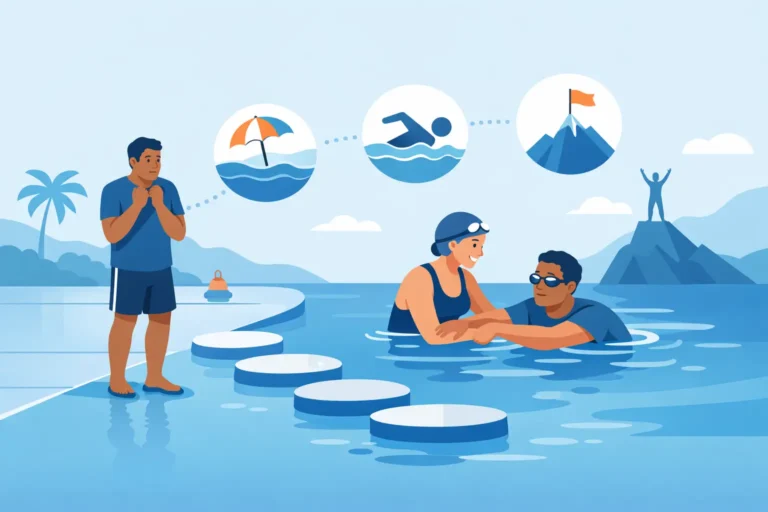
If deep water makes you anxious, do not force yourself into it in the first lesson. Begin where you can stand comfortably, then progress in small, supervised steps. Confidence grows when the challenge is manageable and repeated successfully, not when you are pushed past your current control.
Breathing Is the First Technical Skill
Many adults try to lift their head every time they need air. That instinct is understandable, but it drops the hips, creates resistance, and makes the body feel as if it is sinking. Effective swimming begins with learning to exhale into the water.
Practice by standing near the wall, taking a gentle breath through your mouth, placing your face in the water, and blowing a steady stream of bubbles. Lift your head only after you have exhaled. The purpose is not to hold your breath for a long time. It is to establish a calm rhythm: breathe in above water, breathe out below water.
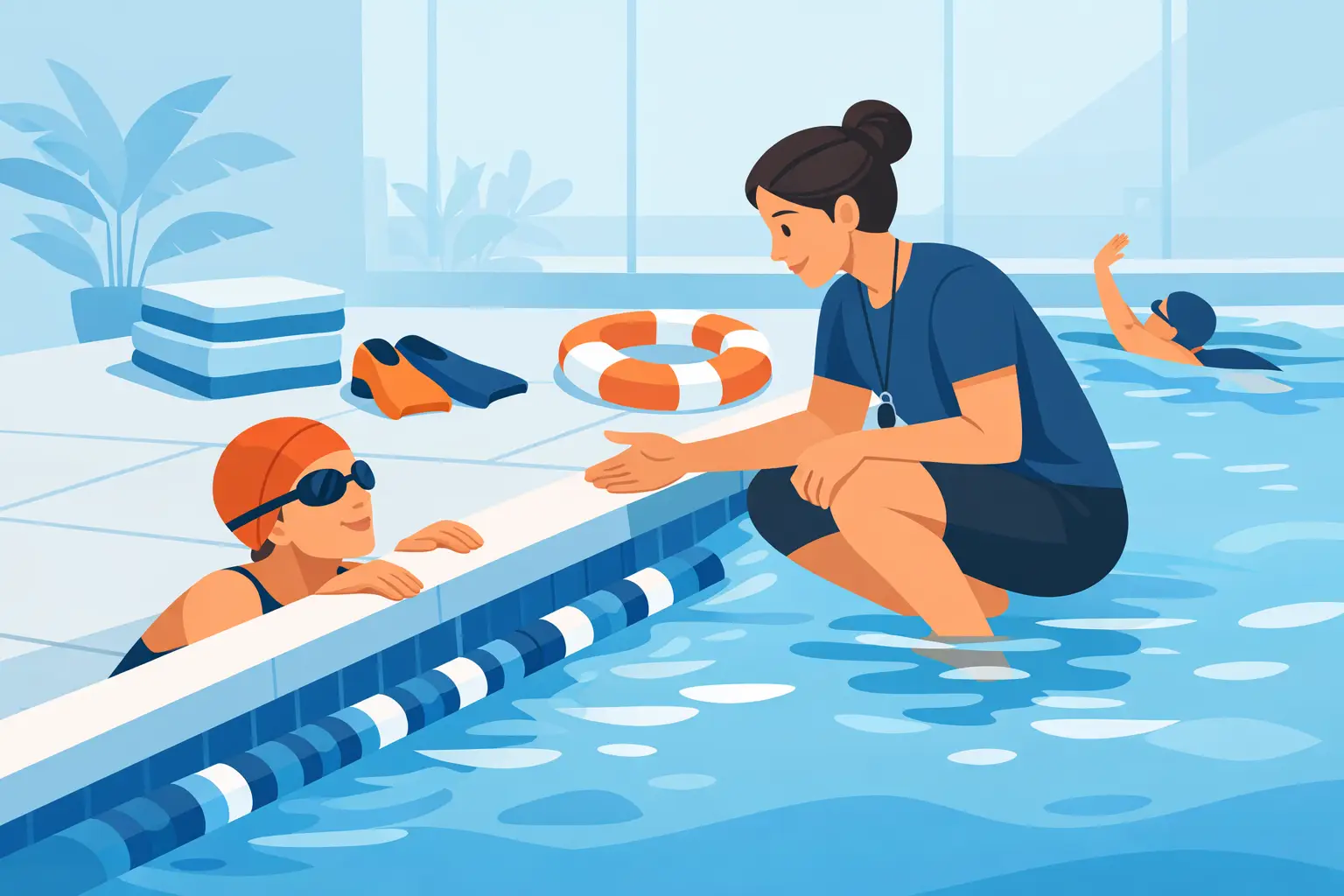
This may feel awkward at first, especially for adults who dislike water around the nose. A coach can provide gradual drills and appropriate support, but the key is patience. Ten relaxed repetitions are more useful than one tense attempt.
The Adult Beginner Swimming Guide to Core Skills
A structured beginner program should teach skills in an order that supports safety and progression. Each skill prepares the body and mind for the next one.
Floating and Body Position
Floating teaches an essential truth: water can support you when your body is relaxed and positioned well. Beginners usually start with supported front and back floats. On the front, look down rather than forward. On the back, keep your ears in the water, eyes upward, and hips close to the surface.
Stiffness is the main obstacle. When the neck, shoulders, or hips tense up, the legs often sink. A qualified instructor can give light support while you learn to lengthen your body, then reduce that support as your balance improves.
Kicking With Purpose
Kicking is not about splashing as hard as possible. A productive freestyle kick begins from the hips with long, relaxed legs and small movements. The ankles should remain loose. Large bicycle-style kicks use too much energy and can make it harder to stay level in the water.
Use a kickboard only when it supports the lesson objective. It can help a beginner focus on leg action, but holding a board too high may encourage an upright body position. Sometimes streamlined kicking with hands on the wall, or supported kicking on the back, is a better first drill.
Gliding and Streamlining
A glide is the bridge between standing still and swimming. Push gently from the wall with both feet, extend your arms in front of you, keep your head in line with your spine, and let the body travel forward. The push should be controlled, not explosive.
Gliding shows why body position matters. When the body is long and balanced, it moves with less effort. When the head lifts or the knees bend, momentum disappears quickly. This is one reason technique should come before speed.
Coordinating Freestyle
Freestyle is usually the first stroke taught because it is practical, efficient, and useful for fitness. Still, beginners should not try to perfect arms, kicking, breathing, and timing all at once. Start with short distances and focused drills, such as kicking with one arm extended or taking one side breath at a time.
A simple progression is face-down glide, gentle kick, one or two arm pulls, then a controlled breath. As this becomes steady, add more strokes. Short repeats allow you to reset posture and breathing before fatigue causes rushed habits.
Prepare Well for Your First Lesson
You do not need expensive equipment or prior fitness to begin. You do need a safe environment, a realistic mindset, and clothing that allows comfortable movement. Bring a well-fitting swimsuit, goggles that seal without excessive pressure, a towel, and drinking water.
Before entering the pool, tell your instructor about any fear of water, past injuries, medical concerns, or goals. This information is useful, not embarrassing. A learner who wants water survival skills needs a different emphasis than someone preparing for a 500-yard fitness swim.
For your first few sessions, keep these expectations in mind:
- You may feel tired sooner than expected because water resistance is demanding.
- Goggles may leak or feel unfamiliar until adjusted correctly.
- Breathing drills can be emotionally challenging before they become routine.
- Progress is often uneven, with a skill feeling difficult one day and natural the next.
Adults often improve quickly once they attend consistently. One lesson can introduce a skill, but regular practice helps your body remember it. If you can safely practice between sessions, repeat only the drills your instructor has taught and approved.
Choose Instruction That Matches Your Starting Point
The right class format depends on your confidence level, learning style, and schedule. Group lessons can be motivating and cost-effective when swimmers are grouped by ability. They also help adults see that nervousness and early mistakes are normal.
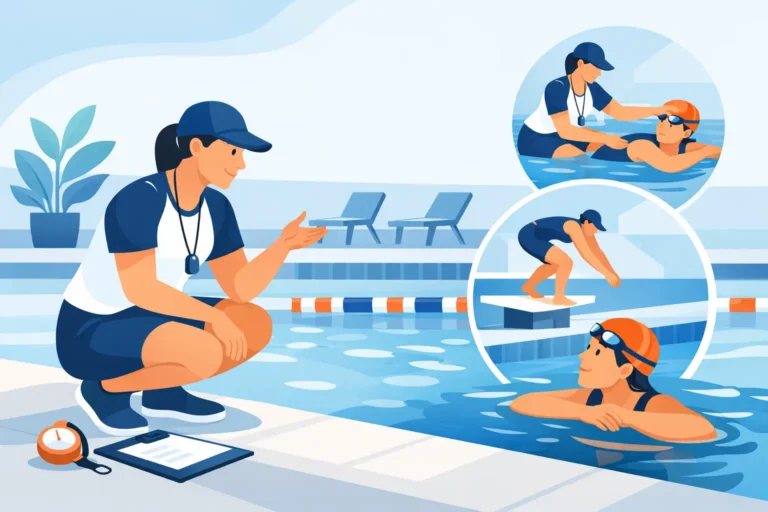
Private lessons can be especially valuable for learners with strong water fear, a specific deadline, or a need for individual attention. They allow the instructor to adjust the pace, provide more repetitions, and focus on barriers that may not be shared by the rest of a class. Semi-private lessons can work well for partners or friends at a similar level, provided neither person feels pressured to keep up.
Look for instruction that includes active supervision, clear safety rules, skill-based progression, and measurable outcomes. A good beginner program should be able to explain what you will learn first, how readiness is assessed, and what comes after basic freestyle. Safety and water survival should remain part of the plan even when your main goal is fitness.
What Progress Should Look Like
Early success may look quieter than a dramatic lap across the pool. You may notice that you no longer grip the wall tightly, that you can blow bubbles without closing your eyes, or that a back float feels calmer. These are meaningful indicators that your nervous system is learning to trust the water.
After the foundation is established, many adults move into longer freestyle distances, backstroke, treading water, deeper-water confidence, and endurance training. The timeline depends on attendance, comfort level, prior experience, and how much practice you complete. Someone who is comfortable putting their face in the water may progress faster than someone managing a long-standing fear, but both can achieve safe, capable swimming with structured instruction.
Avoid comparing your pace with a stronger swimmer in the next lane. The useful question is whether you have more control than you did last week. Can you breathe more calmly, float longer, or recover more independently? Those improvements are the building blocks of lasting skill.
Swimming is a life skill with a physical payoff, but its first reward is confidence. Each calm breath, controlled float, and safe return to the wall gives you evidence that the water is a place you can learn to manage, one purposeful lesson at a time.