Adult Beginner Swimming Progress Example in 12 Weeks
The first visible win for a new swimmer is often not a full lap. It may be placing the face in the water without panic, exhaling steadily, or moving away from the pool wall with control. This adult beginner swimming progress example shows what meaningful improvement can look like over 12 weeks when lessons follow a safe, structured sequence rather than rushing toward distance.
For adults, progress is rarely a straight line. A learner who is physically fit may need extra time to manage breathing. Another adult may be comfortable floating but need focused practice to coordinate kicks and arm movements. The right target is not to copy another swimmer’s timeline. It is to build reliable water survival skills, confidence, and efficient technique that can be repeated independently.
What Real Beginner Progress Looks Like
A complete beginner should first learn to remain calm and make sound decisions in water. Before freestyle distance becomes the priority, the swimmer needs to enter and exit safely, regain a standing position, control breathing, float on the front and back, and travel a short distance with balance.
These foundations matter because most adult swimming setbacks come from one of two issues: fear that has not been properly addressed or technique taught before the body is ready for it. A swimmer who lifts the head to breathe, for example, may sink the hips and tire quickly. Correcting that pattern begins with comfortable face immersion and rhythmic exhalation, not simply telling the swimmer to kick harder.
In a structured program, each skill is checked before the next one is added. That gives adults clear evidence of progress and prevents the common experience of feeling busy in the pool without knowing whether they are actually improving.
Adult Beginner Swimming Progress Example: Weeks 1 to 12
Weeks 1 to 3: Water Familiarity and Safe Recovery
The opening lessons focus on comfort, orientation, and control. A beginner learns how water affects balance, how to hold the pool edge safely, and how to recover from a front or back float into a standing position. Breathing drills are usually kept short and repeatable: inhale above water, place the face in, then exhale slowly through the nose or mouth.
By the end of this phase, a realistic learner may be able to submerge the face willingly, blow bubbles continuously, float with light support, and travel several feet using a wall push or basic kick. For a water-fear adult, these are major milestones. The goal is calm repetition, not forcing a long swim too early.
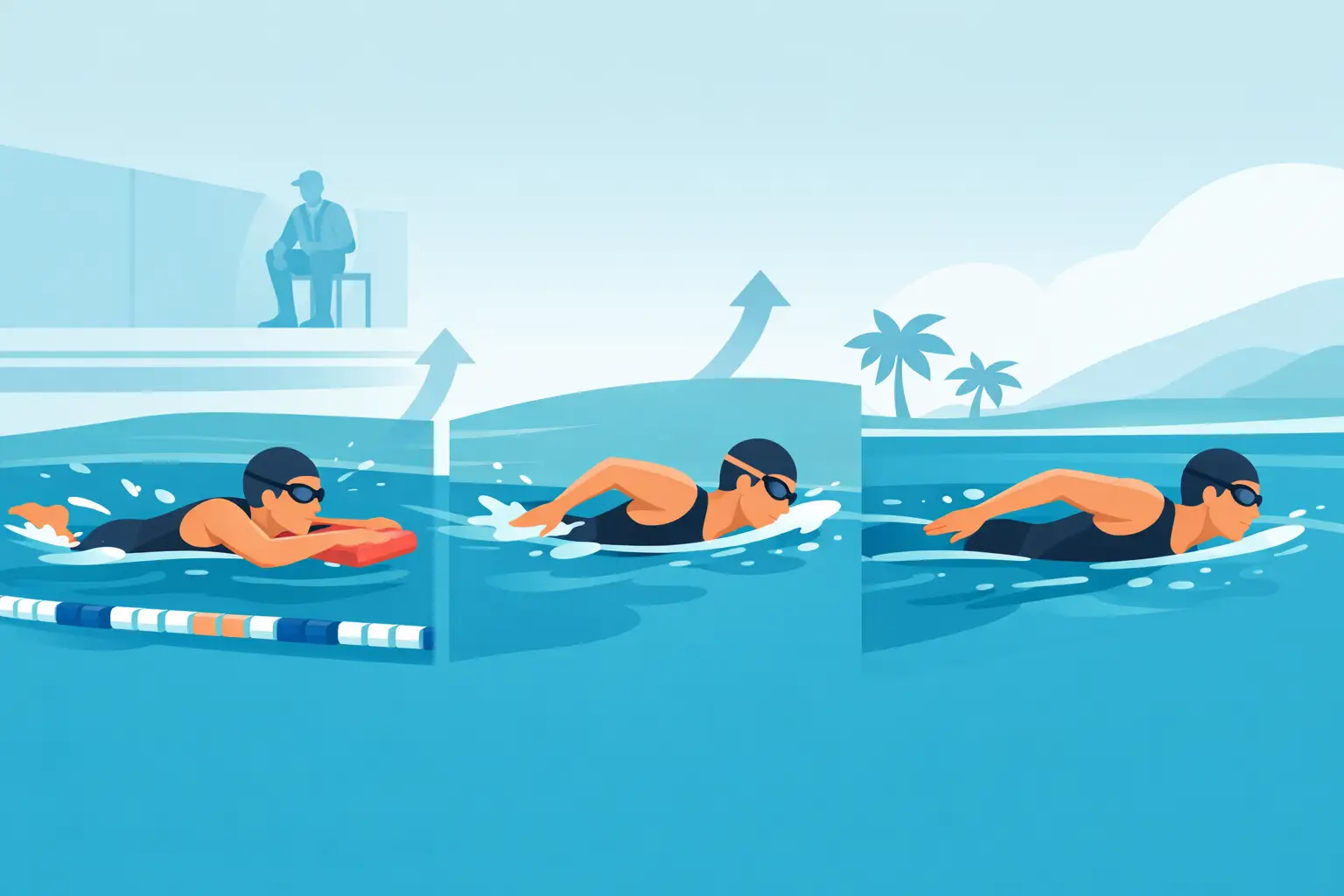
Weeks 4 to 6: Floating, Kicking, and Independent Movement
Once the swimmer can recover safely, lessons can introduce stronger body alignment. The coach works on a long, relaxed position in the water, with the head neutral and the legs closer to the surface. Kicking is taught as a steady movement from the hips, not large knee bends that create fatigue with little forward motion.
At this point, many adults begin combining a front float, gentle kick, and arm-supported glide. They may also practice back floating, which is an especially valuable water safety skill because it allows the swimmer to breathe and rest. Some learners can move 10 to 15 yards independently by the sixth week. Others may cover less distance but show better control, which is equally valid progress.
A coach should continue to assess whether the swimmer can stop, stand, and recover without assistance. Distance only counts as useful progress when it is performed safely and with enough composure to repeat it.
Weeks 7 to 9: Introducing Freestyle Coordination
Freestyle becomes more practical once the swimmer can maintain a horizontal body position and exhale underwater. Early stroke work is usually broken into manageable parts: glide, kick, one arm movement, then a side-breathing drill. This approach reduces overload and helps adults understand why breathing timing affects the entire stroke.
A typical milestone in this phase is swimming 15 to 25 yards with pauses or light correction. The swimmer may still need to stop after one length, and the stroke may not look polished. That is normal. The stronger sign of progress is that the swimmer can return to the wall without panic, breathe with more rhythm, and identify what to correct on the next attempt.
Adults who attend only once a week often benefit from brief independent practice between lessons, provided they stay in a safe depth and do not rehearse poor technique for long periods. Even 15 to 20 minutes of focused floating, kicking, and breathing practice can improve retention.
Weeks 10 to 12: Building a Repeatable Lap
During the final phase of this example, the focus shifts from isolated drills to a repeatable short swim. The learner practices pushing off with control, maintaining a relaxed kick, taking a limited number of strokes, turning to breathe, and reaching the wall without losing balance.
A realistic 12-week outcome for many adult beginners is one 25-yard or 25-meter length of basic freestyle, sometimes with a pause before repeating it. A more confident learner may complete two to four lengths with rest. A learner overcoming deep water anxiety may still be developing distance, yet have achieved an equally significant result: the ability to float, tread briefly, move independently, and recover calmly.
The outcome depends on attendance, prior water experience, fitness, pool conditions, and the level of fear at the start. Fast results are possible, but they should never come at the expense of sound technique or water safety.
How Coaches Measure More Than Distance
Distance is easy to see, but it is not the only measure that matters. A reliable assessment looks at whether the swimmer can enter water safely, put the face in without hesitation, exhale consistently, float on both front and back, and move with controlled breathing. Coaches also observe body position, kick efficiency, arm timing, and recovery after a mistake.
For adult learners who want fitness swimming, triathlon preparation, or a future lifesaving pathway, these early skills create the base for later endurance and stroke development. For learners whose first goal is simply to feel safe during family pool time or travel, the ability to remain calm and return to a stable position is already a practical achievement.
AQZOG uses structured progression so adults can understand what they have achieved, what needs more practice, and what skill comes next. That clarity is particularly helpful for learners who have spent years avoiding the water because they were embarrassed to start.
Group Lessons or Private Coaching?
Group lessons are a strong option for adults who benefit from regular structure, shared encouragement, and consistent weekly practice. They can also help normalize the learning process. Many adults discover that other beginners have the same concerns about breathing, floating, or being watched.
Private coaching may be the better fit for a swimmer with significant water fear, an urgent timeline, an irregular schedule, or a highly specific goal such as passing a practical assessment. One-to-one instruction allows the coach to adjust pacing immediately and spend more time on the swimmer’s exact technical barrier.
Neither format replaces patient practice. A motivated adult in a group can make excellent progress, while a private learner may need more than 12 weeks if confidence is the main challenge. The best program is the one that provides safe instruction, clear milestones, and enough consistency for skills to become automatic.
Your first successful length does not need to be graceful or fast. It needs to be controlled, safe, and repeatable. From there, every calm breath and every confident return to the wall gives you a stronger foundation for the swimmer you want to become.