How to Overcome Fear of Water Adults
The first sign is usually not panic. It is tension. Your shoulders rise, your breathing gets shallow, and the moment water reaches your chest, your body says, not today. If you are searching for how to overcome fear of water adults often carry for years, the good news is this: fear of water is learned, and with the right coaching approach, it can be unlearned.
For many adults, the fear is not really about swimming technique. It is about losing control. Some had a bad experience as a child. Some never learned and now feel embarrassed starting late. Others are comfortable near a pool but freeze when they cannot feel the floor. Whatever the cause, progress starts when you stop treating fear like a personality trait and start treating it like a skill barrier that can be trained through safely.
Why adults develop fear of water
Adult water fear usually has a story behind it. Sometimes it is obvious, such as slipping into deep water, swallowing water, or being pushed into a pool before feeling ready. Sometimes it is quieter. A parent who was anxious around water, years of avoiding lessons, or one humiliating school session can create a lasting reaction.
Adults also think differently from children. A child may step in, resist briefly, and then adapt. An adult is more likely to anticipate what could go wrong. That anticipation increases muscle tension, and tense bodies do not float or move well. Then the water feels less stable, which seems to confirm the fear. It becomes a cycle.
That is why confidence building in water should never begin with “just relax.” Most fearful adults cannot relax on command. They need structure, control, and repeated success in small stages.
How to overcome fear of water adults experience most often
The most effective method is gradual exposure with clear milestones. In practical terms, that means starting where your nervous system can still function and building from there. If chest-deep water already feels overwhelming, there is no value in forcing deep-end practice on day one.
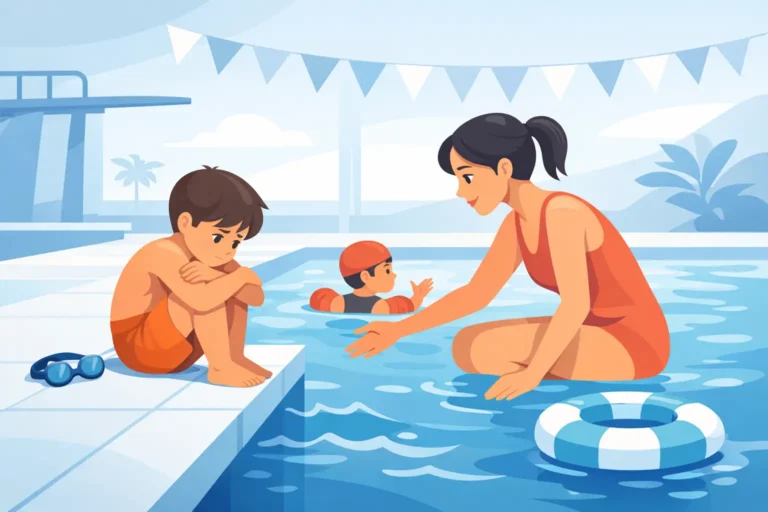
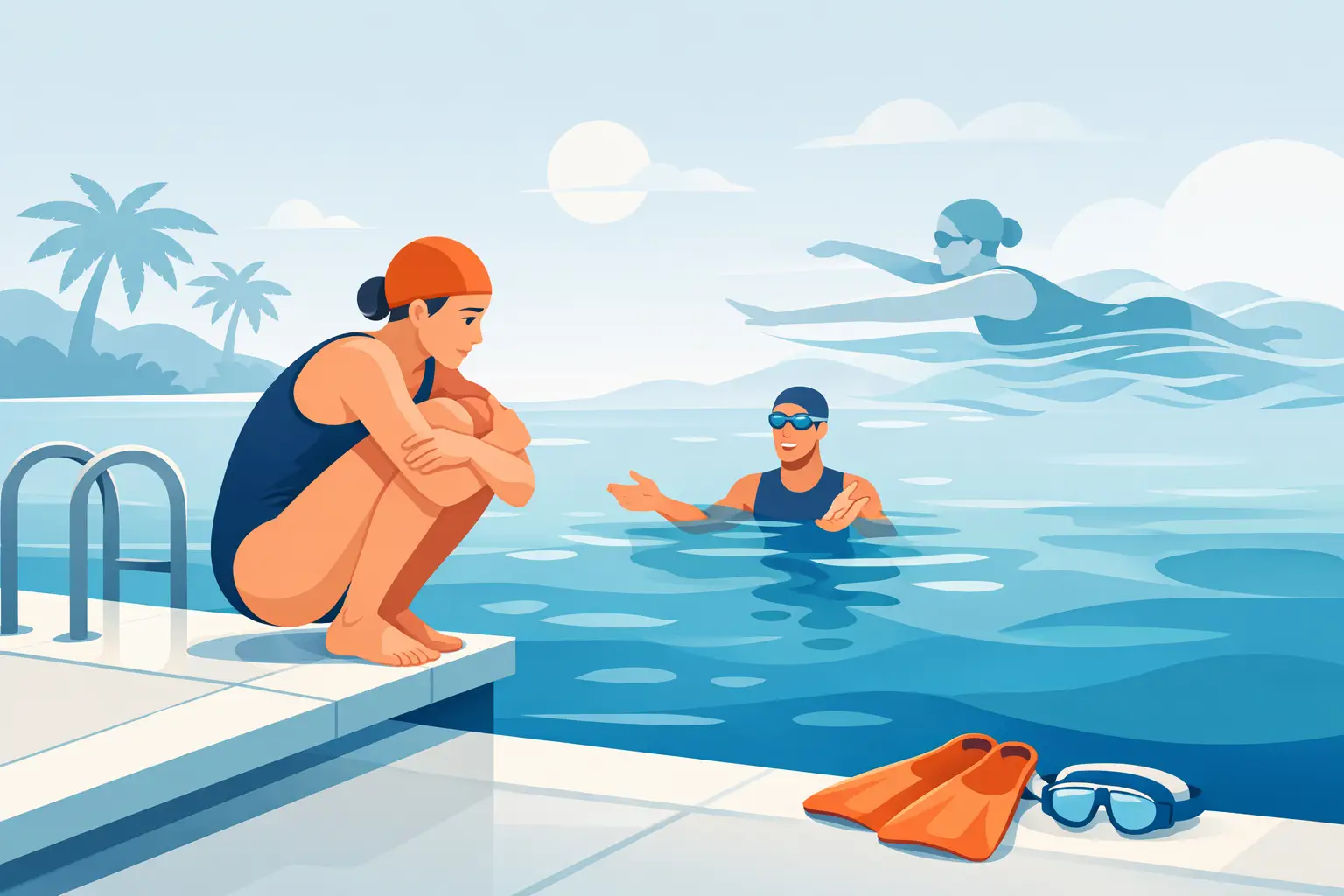
A structured progression often starts with poolside orientation. This can include sitting on the edge, feeling water on the arms and face, and practicing calm breathing before even entering fully. After that, the learner may stand in shallow water, hold the pool wall, and work on exhaling into the water. Only when breathing becomes more controlled should the lesson move into floating, gliding, and unsupported movement.
This matters because fear reduction is not about dramatic breakthroughs. It is about teaching your brain that water contact does not equal danger. Each successful repetition lowers the alarm response.
Start with breathing, not strokes
Many adults assume they need to learn freestyle immediately. In reality, breathing control is the foundation. Panic often begins when the face gets wet, water enters the nose, or the learner feels unable to breathe on demand.
Start by standing in shallow water and practicing a simple rhythm: inhale above the surface, exhale slowly with your mouth or nose in the water. Keep it short at first. A few seconds is enough. The goal is not endurance. The goal is to prove that you can manage your breath instead of reacting to the water.
Once this improves, putting the face in the water becomes less threatening. From there, floating becomes easier because you are no longer bracing against every splash.
Build trust in buoyancy
A common fear among adults is, “I will sink if no one holds me.” This belief creates stiffness. Unfortunately, stiffness makes floating harder.
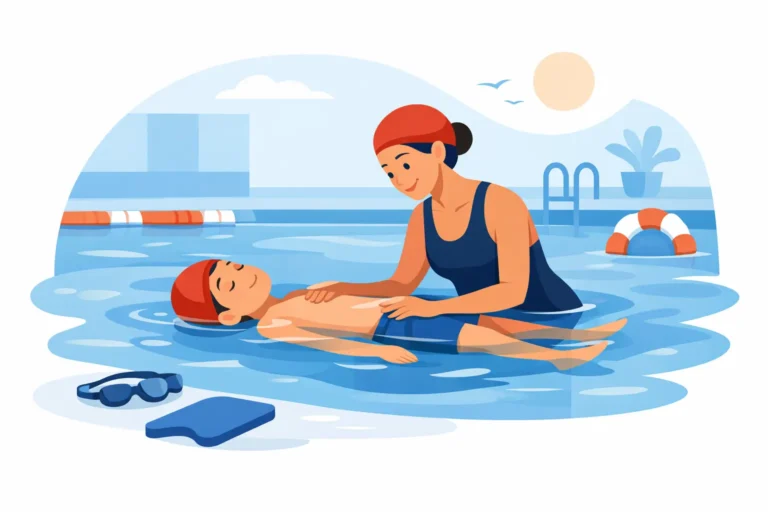
Buoyancy drills should be introduced in a supported way. Back floating with the instructor assisting the head and upper back can help the body experience support from the water. Front floating with hands on the pool edge can do the same. The key is repetition without rushing.
Some adults adapt quickly once they feel their body can stay up. Others need several sessions before that trust develops. Both are normal. Fear does not follow a fixed schedule.
Use depth progression carefully
Depth can be emotional, even for adults who are physically safe. Someone may manage well in waist-deep water and then tense up immediately when moving to an area where the floor feels farther away.
The solution is not to avoid depth forever, but to introduce it with preparation. Before going deeper, the learner should already have reliable breathing control, comfortable wall holds, and basic float recovery. That way, the new challenge is depth only, not depth plus five other unknowns.
A good instructor will also explain what to do if anxiety spikes: return to standing depth, regain breathing rhythm, hold the wall, and reset. Knowing there is a recovery plan reduces panic before it starts.
What slows progress for fearful adult learners
The biggest problem is rushing. Adults often feel they are behind and want to catch up fast. That pressure can backfire. If a lesson moves beyond your current tolerance too soon, your body remembers the fear more strongly than the skill.
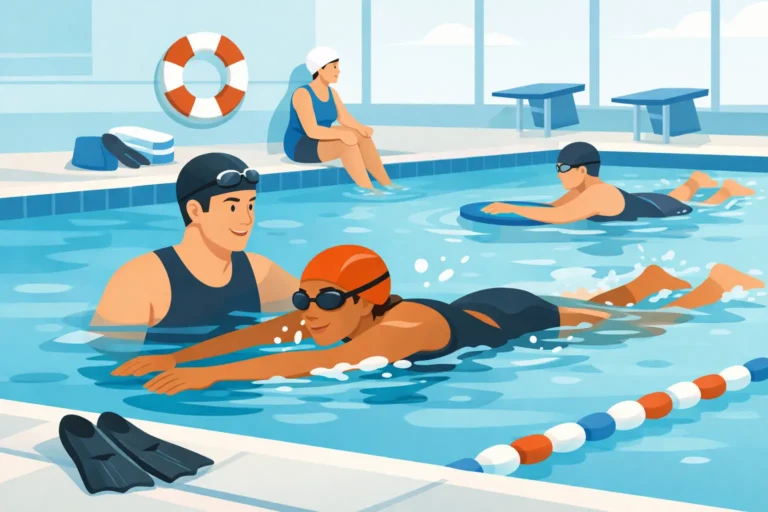
Another issue is learning in the wrong setting. A large class may work well for confident beginners, but a fearful adult may need more direct supervision and a slower pace. Private or small-group instruction is often the better fit at the start because the coach can adjust every step, repeat drills as needed, and respond before anxiety escalates.
Shame also gets in the way. Many adults apologize for being scared, as if fear is a lack of effort. It is not. Fear is a stress response. Once it is treated properly, improvement becomes much more consistent.
Choosing the right lesson approach
If you want lasting results, look for a program that treats water confidence as part of skill progression, not as an afterthought. The instructor should be comfortable teaching complete beginners and water-fear learners, not only stroke correction for existing swimmers.
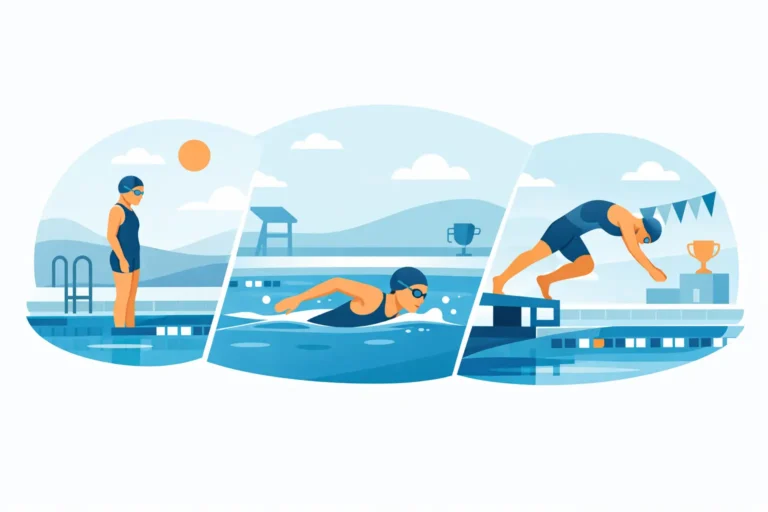
Ask how the lessons are structured. A strong program will describe a clear pathway: water entry, breathing control, submersion confidence, floating, kicking, recovery skills, and then stroke development. That sequence matters. Safety and control come before speed or style.
It also helps to learn in a familiar, accessible pool environment. For working adults especially, convenience affects consistency. Consistency affects confidence. One calm session every week is more useful than one intense session followed by a month of avoidance.
At AQZOG, adult learners are typically guided through progressive water confidence training rather than being pushed straight into full-stroke swimming. That approach tends to produce better control, better safety habits, and more durable confidence.
Small wins that matter more than they seem
Adults often underestimate progress because they are comparing themselves to swimmers. A better comparison is with your starting point. If last week you would not put your face in the water and this week you can exhale three times calmly, that is real progress. If you can float for five seconds without grabbing immediately, that counts. If you can walk into the pool without your heart racing, that matters too.
These steps are not separate from swimming. They are swimming readiness. Without them, technique has no stable base.
Practice between lessons without overwhelming yourself
If you have access to a pool, keep practice short and specific. Do not try to recreate the entire lesson. Pick one task, such as controlled exhalation, wall-supported floating, or calm water entry. Ten focused minutes can be enough.
What you want is familiarity, not exhaustion. Stop while you still feel successful. That helps the nervous system store the session as manageable rather than threatening.
If you do not have regular pool access, mental rehearsal can still help. Visualize the steps in order: entering the pool, holding the wall, breathing out into the water, returning to standing. It sounds simple, but repeated mental practice can reduce anticipatory stress before the next lesson.
When fear is severe
Some adults experience intense panic, dizziness, or a strong trauma response around water. In those cases, swim lessons may still help, but the pace must be slower and the coach should know what triggers the reaction. Sometimes combining instruction with support from a mental health professional is the smartest option.
That does not mean the goal is out of reach. It just means the pathway needs more care. Safety-first progression is still the right model, but patience becomes even more important.
Confidence comes after control
Many people wait to feel brave before starting. In swimming, it usually works the other way around. You gain confidence after repeated moments of control. You learn how to breathe when water touches your face. You learn how to float instead of fight. You learn what to do when you feel unsettled.
That is what changes the experience of water for adults. Not pressure. Not embarrassment. Not being thrown into the deep end, literally or emotionally. Just a clear process, practiced enough times that fear stops running the session.
If you have avoided learning for years, you are not too late and you are not the only one. Start small, train safely, and let progress be measured by control. The water usually becomes less frightening long before it becomes easy, and that is often the moment real learning begins.