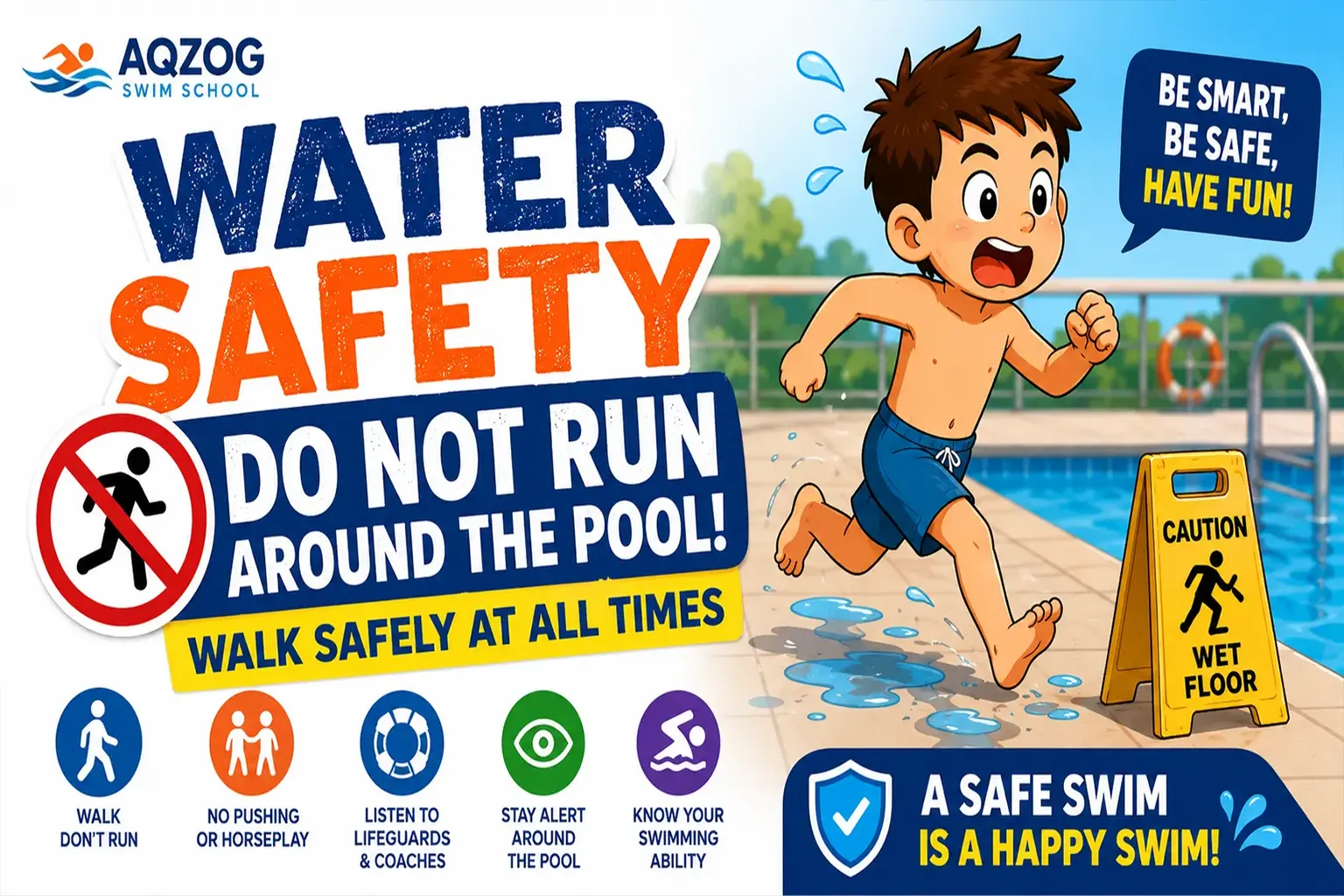
Water Safety: Do Not Run Around the Pool
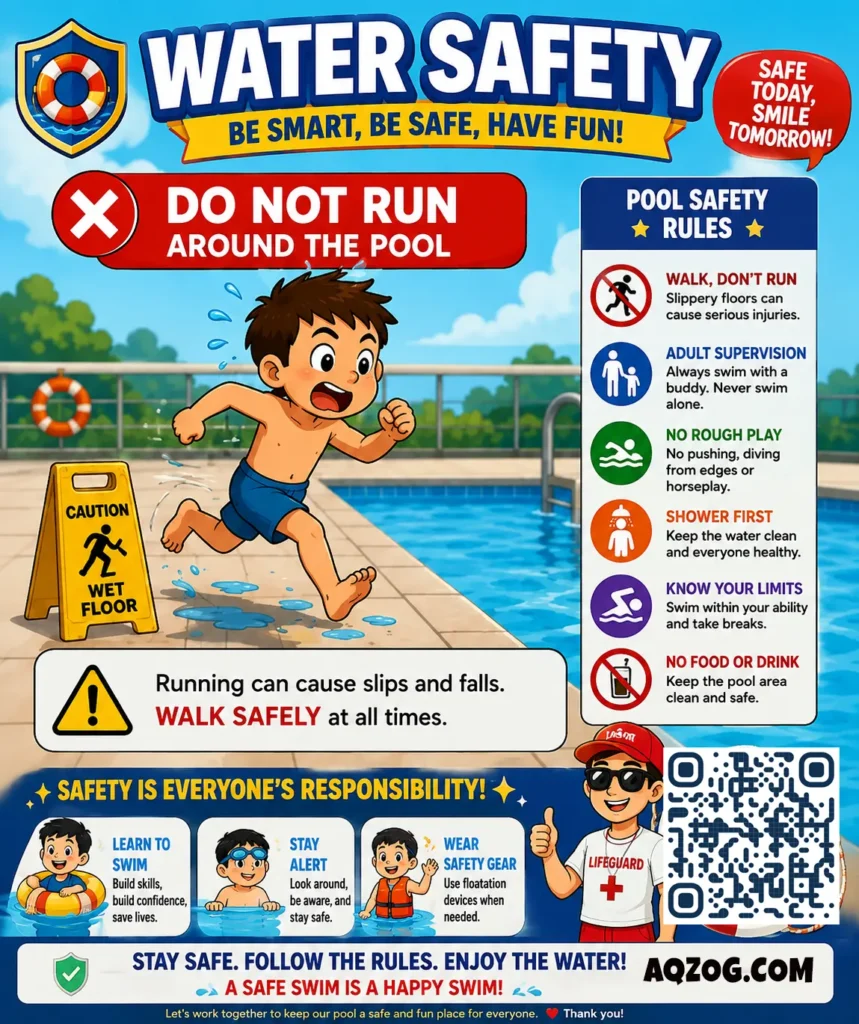
Water Safety: Do Not Run Around the Pool – A Simple Rule That Can Prevent Serious Injuries
Swimming pools are places for children to learn, exercise, build confidence and have fun. However, the area around a swimming pool can also become dangerous very quickly when basic safety rules are ignored.
At AQZOG Swim School, one of the simplest and most important water-safety messages we teach children is:
DO NOT RUN AROUND THE POOL — WALK SAFELY AT ALL TIMES
It sounds like an easy rule. Yet children are naturally energetic. They may become excited when they arrive for swimming lessons, see their friends, finish a race or spot their parents waiting nearby. Their first instinct may be to run.
Unfortunately, a wet swimming-pool deck is very different from a normal playground or running track. Water splashed from the pool can make tiles slippery, and a child who loses their footing may have very little time to protect themselves.
A few seconds of running can therefore result in a painful fall or potentially serious injury.
That is why AQZOG believes pool safety education should start before a child even enters the water.
Why Is Running Around a Swimming Pool Dangerous?
The most obvious danger is slipping.
Swimming pools naturally have wet surroundings. Swimmers climb out of the water, children splash during lessons, people walk to showers and water drips from wet swimming costumes.
Even when a pool deck looks relatively dry, a small wet patch can be enough for someone running quickly to lose their footing.
A child who slips may fall forward, backward or sideways. Unlike falling on a softer surface, pool surroundings are commonly made from hard materials. There may also be walls, steps, starting blocks, drains, ladders and pool edges nearby.
Possible injuries can include:
- Cuts and abrasions
- Bruising
- Sprained wrists or ankles
- Knee injuries
- Broken teeth
- Facial injuries
- Head injuries
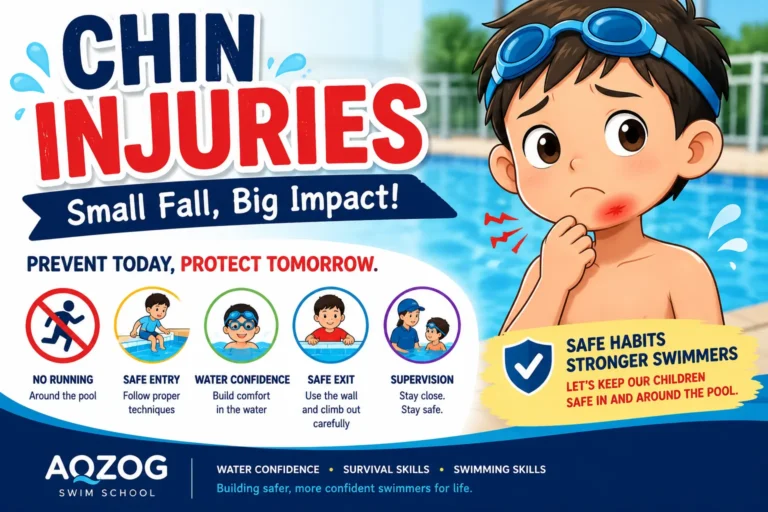
- Chin injuries
- Fractures
- Falling unexpectedly into the swimming pool
The danger isn’t only to the person who is running. A running child can also collide with another swimmer, a younger child, an elderly pool user, a coach or someone carrying equipment.
Walking instead of running is therefore one of the easiest ways to make the swimming pool safer for everyone.
WALK, DON’T RUN
Parents often tell children, “Don’t run!”
At AQZOG Swim School, we prefer children to understand the reason behind the instruction.
The message should become:
Wet Floor + Running = Higher Risk of Slipping
and:
Wet Floor + Careful Walking = Safer Movement
When children understand why a rule exists, they are more likely to remember and practise it independently.
This is an important part of developing genuine water-safety awareness.
Water safety is not simply about memorising instructions. It is about learning to recognise hazards and making safer decisions.
Pool Safety Begins Outside the Water
Many parents understandably associate swimming safety with what happens inside the pool.
Can my child float?
Can my child swim?
Can my child tread water?
Can my child perform survival skills?
These are important questions, but water safety begins much earlier.
A child should also learn how to behave when approaching, entering and leaving a swimming pool.
At AQZOG Swim School, we want children to develop good habits such as walking carefully on the pool deck, listening to coaches and lifeguards, entering the water appropriately, respecting other swimmers and recognising potentially dangerous situations.
Swimming ability and safety awareness should develop together.
A strong swimmer who behaves recklessly can still get injured.
Why Children Are Particularly Likely to Run
Children may know the rule but still forget it.
Imagine a child arriving for swimming lessons and seeing a best friend across the pool.
The child becomes excited and starts running.
Or perhaps the coach announces a fun activity and several children rush towards the lesson area.
Another common situation occurs after class. A child sees a parent waiting and immediately runs towards them.
None of these children intends to behave dangerously. They are simply excited.
That is why pool-safety rules require repetition.
Parents, swimming coaches and pool operators should consistently reinforce the same message:
Slow down. Walk carefully. The floor may be wet.
Eventually, walking around the pool can become an automatic habit.
Beware of the Pool Edge
The edge of a swimming pool deserves particular attention.
Running close to the water increases the possibility of a child slipping and falling either onto the deck or into the pool.
A fall near a hard edge can potentially result in injuries to the face, mouth or chin.
AQZOG Swim School places particular emphasis on preventing avoidable poolside injuries. Children should learn to maintain control of their movements rather than rushing, jumping or engaging in horseplay near the pool edge.
Parents can reinforce a simple principle:
Poolside = Walking Zone
The moment a child enters the pool area, running stops.
Never Push or Chase Friends Around the Pool
Running sometimes develops into chasing.
One child runs.
Another child chases.
Someone pushes another child jokingly.
Within seconds, what started as harmless play can become dangerous.
Children should understand that a swimming pool is not the place for chasing, pushing, wrestling or horseplay.
A push that seems funny to one child may cause another child to lose balance.
Even worse, a person could be pushed unexpectedly into deeper water.
Fun should never come at the expense of another person’s safety.
Look Where You Are Walking
Walking safely means more than simply moving slowly.
Children should also pay attention to their surroundings.
Pool decks may contain drainage channels, bags, swimming equipment, kickboards, fins or other obstacles. Swimmers may also be entering or leaving the water.
Children should be encouraged to:
Walk — Look — Stay Alert.
Avoid walking while staring at a phone or becoming distracted by friends.
Good situational awareness is an important life skill as well as a pool-safety skill.
Listen to Lifeguards, Coaches and Pool Staff
Lifeguards and swimming coaches are there to help create a safer environment.
If a lifeguard says:
“Please walk.”
Children should stop running immediately.
It should never be treated as an unnecessary instruction.
Likewise, parents can support coaches and lifeguards by reinforcing safety messages rather than dismissing them.
When children receive the same message from parents, coaches and lifeguards, good safety habits become much easier to establish.
Parents Play an Important Role in Pool Safety
Swimming lessons help children develop skills, but parents remain an important part of water-safety education.
Before visiting a swimming pool, parents can remind children of several simple rules:
Walk around the pool. Never push anyone. Listen to the lifeguard and coach. Enter the water only when permitted. Stay within your swimming ability.
Most importantly, young children should have appropriate adult supervision around water.
Swimming lessons are an important layer of safety, but learning to swim should never be considered a replacement for responsible supervision.
Learn to Swim and Build Water Confidence
One of the best things parents can do is help children develop appropriate swimming and water-safety skills.
A quality swimming programme should teach more than simply moving from one end of the pool to another.
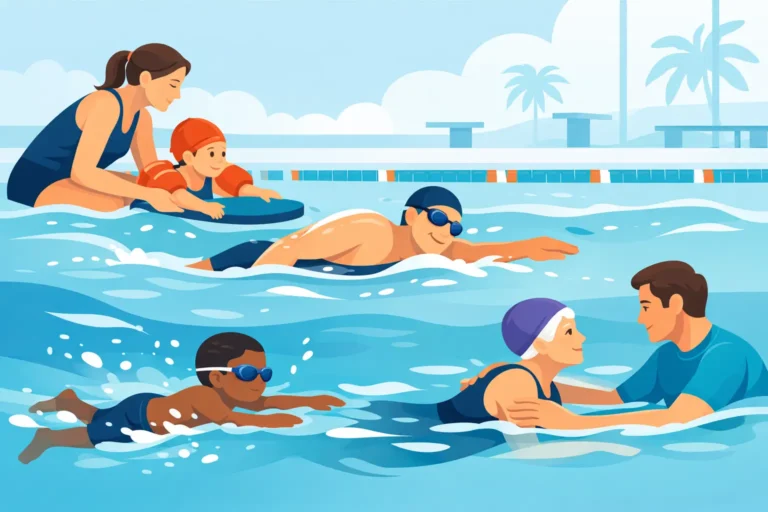
Children can gradually develop skills such as floating, controlled breathing, safe entries, safe exits, basic survival techniques, water confidence and awareness of hazards.
At AQZOG Swim School, we believe children should become not only better swimmers, but also safer and more responsible swimmers.
That distinction matters.
What Should You Do If You See a Wet or Slippery Area?
Children should be taught not to ignore hazards.
If they notice an unusually slippery area, obstruction or unsafe situation, they should avoid rushing through it and inform an appropriate adult, coach, lifeguard or pool staff member.
Safety is everyone’s responsibility.
Teaching children to recognise and report hazards helps them move from simply following rules to actively thinking about safety.
That is a valuable lesson both inside and outside the swimming pool.
Make “Walk Around the Pool” a Lifelong Habit
Water safety doesn’t need to be frightening.
The objective isn’t to make children afraid of swimming pools.
Instead, we want them to understand that enjoyable activities can have sensible boundaries.
Swimming can be exciting.
Swimming lessons can be fun.
Playing with friends can be fun.
Learning new skills can be fun.
But safety comes first.
A child who learns to automatically slow down and walk when entering a swimming-pool environment has developed a simple habit that may protect them for years.
Walk safely. Swim safely. Have fun safely.
AQZOG Swim School’s Water Safety Message
At AQZOG Swim School, we encourage parents, children and swimmers to remember:
DO NOT RUN AROUND THE POOL.
WALK SAFELY AT ALL TIMES.
NO PUSHING OR HORSEPLAY.
LISTEN TO YOUR COACH AND LIFEGUARD.
KNOW YOUR SWIMMING ABILITY.
LEARN TO SWIM AND DEVELOP WATER-SAFETY SKILLS.
STAY ALERT AROUND WATER.
A swimming pool should be a positive place where children develop confidence, fitness and lifelong aquatic skills.
Creating that environment requires cooperation between swimmers, parents, coaches, lifeguards and pool operators.
Sometimes the most effective safety lessons are also the simplest.
Wet floors can be slippery. Don’t run.
Frequently Asked Questions About Running and Pool Safety
1. Why should children not run around a swimming pool?
Swimming-pool decks are frequently wet and may become slippery. Running increases the likelihood of losing balance, slipping, colliding with someone or falling onto a hard surface. Children should walk carefully around the pool.
2. What injuries can happen when someone runs around a pool?
Falls can potentially result in cuts, bruises, sprains, dental injuries, chin or facial injuries, head injuries and fractures. The exact severity depends on how and where the person falls.
3. Is it safe to run if the pool floor looks dry?
It is still better to walk. Water can be difficult to see, and swimmers may drip water onto the deck at any time. Pool areas should generally be treated as walking zones.
4. Why does AQZOG emphasise “Walk, Don’t Run”?
It is a simple rule children can understand and remember. Developing the habit of walking around pools can reduce unnecessary risk and encourages children to think about their surroundings.
5. Should children run to their coach when a lesson starts?
No. Even if they are excited or late for class, children should walk carefully to their coach or designated lesson area.
6. What should parents do if their child keeps running around the pool?
Use consistent reminders and explain why running is unsafe. Instead of only saying “Don’t run,” try reinforcing: “The floor is wet. Please walk safely.” Consistency helps the behaviour become habitual.
7. Is pushing friends into the swimming pool dangerous?
Yes. A person who is pushed unexpectedly may fall awkwardly, strike an object or enter water before being prepared. Pushing and rough horseplay should not be encouraged around swimming pools.
8. Should children listen when a lifeguard tells them to stop running?
Yes. Children should follow instructions from lifeguards, coaches and authorised pool staff. These instructions are intended to maintain a safer environment for everyone.
9. Does learning to swim mean my child is completely safe around water?
No. Swimming ability is an important safety layer, but it does not eliminate risk. Appropriate supervision, safe behaviour, awareness of surroundings and respect for pool rules remain important.
10. What should my child do after getting out of the swimming pool?
Exit carefully, regain balance and walk away from the pool edge. Children should avoid immediately running towards their parents, changing rooms or friends.
11. What other pool-safety rules should children learn?
Children should learn not to push or engage in rough play, follow instructions, use appropriate entries, recognise their swimming limits, stay alert and understand the importance of adult supervision.
12. How can swimming lessons improve water safety?
Swimming lessons can help children develop water confidence, movement skills and safer aquatic behaviours. A comprehensive programme should combine swimming development with age-appropriate safety education.
13. At what age should children start learning pool-safety rules?
Basic safety messages can begin from a young age. Instructions should be simple and repeated consistently, such as “Hold my hand,” “Wait for the coach,” and “Walk around the pool.”
14. What is the easiest pool-safety message for children to remember?
Try this:
“At the pool, we WALK — we don’t RUN.”
It is short, positive and easy for young swimmers to understand.
15. What is AQZOG Swim School’s main message to parents and children?
Enjoy swimming, but make safety part of every visit to the pool. Good swimmers should also become safe, aware and responsible swimmers.
Remember: A Safe Swim Is a Happy Swim!
Every swimming lesson is an opportunity to teach more than strokes. It is an opportunity to develop habits that children can carry with them throughout their lives.
Before your child jumps into the water, teach one of the most important poolside rules:
🚫 DO NOT RUN AROUND THE POOL
🚶 WALK SAFELY AT ALL TIMES
👀 STAY ALERT
🛟 FOLLOW POOL-SAFETY RULES
🏊 LEARN TO SWIM SAFELY
AQZOG Swim School — Building Better Swimmers and Safer Swimmers.