Adult Lessons vs Self Taught Swimming Compared
A crowded lap pool can make swimming look simple: people move from one end to the other, breathing every few strokes. For an adult beginner, the reality is often different. You may be holding your breath, fighting to keep your legs up, or avoiding deeper water altogether. The choice between adult lessons vs self taught swimming affects more than stroke appearance. It affects safety, confidence, how quickly you improve, and whether you build skills that hold up when you are tired or out of your comfort zone.
Self-learning can work for some adults, especially those with prior water confidence and clear fitness goals. But it is rarely the fastest route for a true beginner, an anxious swimmer, or anyone who wants reliable technique. A structured program gives each session a purpose and turns a vague goal like “learn to swim” into measurable progress.
Adult Lessons vs Self Taught Swimming: The Core Difference
The main difference is feedback. When you teach yourself, you must identify what is going wrong, know how to fix it, and judge whether the correction is actually working. That is difficult in water, where a small change in head position, breathing timing, or kick can completely change how the body moves.
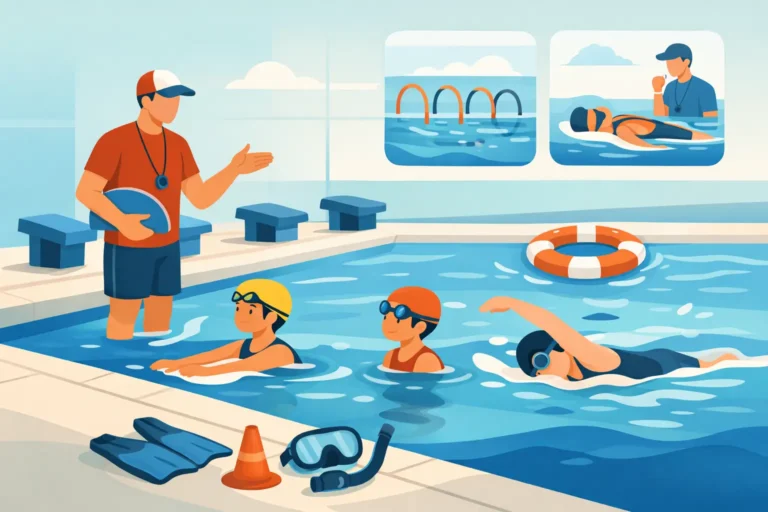
An experienced instructor observes what you cannot easily see. For example, an adult may believe they are kicking hard but are actually bending their knees and creating drag. Another may be able to float only when looking straight up, then lose balance as soon as they try to breathe during freestyle. A coach can isolate the issue, select the right drill, and progress the swimmer only when the foundation is stable.
This does not mean every adult needs private coaching forever. It means the early learning stage benefits greatly from qualified instruction. Once you have safe habits and a usable stroke, independent practice becomes much more productive.
Why Adults Often Struggle When Teaching Themselves
Children are often willing to splash, experiment, and make mistakes without overthinking. Adults tend to carry stronger expectations and, sometimes, a memory of a frightening experience in water. They may feel embarrassed about starting later in life or frustrated when their fitness on land does not immediately transfer to the pool.
The most common problem is trying to learn a full stroke before developing comfort in the water. Adults may watch a video, copy the arm movement, and start swimming laps while still unable to exhale calmly underwater. This creates a cycle of breath-holding, panic, fatigue, and poor body position.
Another challenge is false progress. A swimmer might manage one length by pushing hard, lifting the head high, and rushing their strokes. That can feel like success, but it is difficult to repeat and unsafe in deeper water. Structured adult lessons focus first on skills that transfer: controlled breathing, buoyancy, balance, rotation, propulsion, deep-water confidence, and safe recovery.
The Safety Case for Structured Adult Lessons
Swimming is a life skill, not simply a workout. A person who can move across a calm pool is not necessarily prepared to respond if they lose their goggles, inhale water, become tired, or cannot touch the bottom.
A good adult program teaches practical water safety alongside technique. Learners should understand how to enter and exit safely, recover from an unexpected loss of balance, float or tread water to rest, and regain control after a disrupted breath. These are especially valuable for adults who want to swim with their children, travel, join open-water activities, or prepare for lifesaving-related pathways.
Self-taught swimmers can learn safety skills, but they need to practice them deliberately. Simply swimming repeated laps does not automatically teach recovery or survival skills. In lessons, these skills are introduced in a controlled order, with supervision and adjustments based on the learner’s confidence level.
Technique: Efficiency Matters More Than Effort
Adults often assume that swimming difficulty comes from a lack of strength. In most beginner cases, the bigger issue is efficiency. Water rewards balance, timing, and relaxation far more than force.
Consider freestyle. If your hips sink, every stroke becomes harder because you are pushing against unnecessary resistance. If you hold your breath, your body becomes tense and your breathing pattern breaks down. If you pull with a dropped elbow, you may work hard without moving efficiently. None of these issues are solved simply by doing more laps.
In adult lessons, technique is usually built in manageable parts. You may first learn to float and glide, then practice exhaling underwater, then add a kick, side balance, and short-arm movements before swimming continuously. This can feel slower than jumping straight into full strokes, but it usually produces faster, more reliable results over several weeks.
For a confident swimmer who already completes laps, self-practice can be highly useful. Video review, timed sets, and focused drills can improve endurance and speed. Even then, occasional coaching feedback can prevent a small technical habit from becoming a permanent limitation.
Confidence Is a Skill, Not a Personality Trait
Many adults say, “I am just not confident in water.” Confidence is not something an instructor can give through encouragement alone. It is built through repeated evidence: you enter the water, complete a skill, recover calmly, and realize you can do it again.
That is why progression matters. A well-designed lesson does not force a nervous learner into the deep end before they are ready, nor does it keep them in the shallow end forever. It builds from supported floating to independent floating, from holding the wall to short unsupported movement, and from short distances to sustained swimming.
Self-teaching may suit an adult who enjoys trial and error and has access to a safe pool environment. However, it can be discouraging for someone with water fear because there is no clear benchmark for what to practice next. The learner may repeat comfortable exercises for months while avoiding the very skills needed to progress.
When Self-Taught Swimming Can Make Sense
Self-teaching is not automatically the wrong choice. It can be a sensible supplement for adults who have already learned basic safety and stroke foundations. Regular independent pool time helps reinforce what was taught in class, improve fitness, and increase comfort through repetition.
It may also work for experienced swimmers returning after a break. If you once swam confidently, understand pool safety, and only need to rebuild endurance, a structured personal training plan may be enough. Still, a technique check can be worthwhile if shoulder discomfort, breathlessness, or inefficient strokes are holding you back.
The risk is assuming that online videos can replace individualized instruction. Videos are useful references, but they cannot tell you whether your body position is correct or whether you are practicing a drill in a way that reinforces the wrong movement.
Choosing the Right Adult Learning Path
The right option depends on your starting point and your goal. If you cannot float comfortably, fear deep water, have never learned a formal stroke, or want structured safety skills, begin with lessons. A group class can provide a supportive, cost-effective environment, while private coaching offers more individualized pacing and attention.
If you can already swim but want to improve for fitness, lap swimming, a triathlon, or a formal assessment, choose coaching that matches the target. Ask whether the program includes technique correction, endurance development, deep-water skills, and clear progress markers. Adults improve best when they know what success looks like at each stage.
At AQZOG, adult swimming instruction is designed around that progression: water confidence first, then sound technique, safety awareness, and goal-specific advancement. The aim is not to rush learners through a checklist. It is to develop swimmers who can perform with control and confidence.
Make Practice Work for You
Lessons provide direction, but practice turns instruction into ability. After a class, repeat only the drills you understand and can perform safely. Short, focused practice sessions are often better than exhausting yourself with poorly executed laps.
Notice how you feel in the water. Are you exhaling continuously? Can you pause and recover without grabbing the wall? Does your body feel long and balanced rather than tense and rushed? These questions build awareness and help you bring useful feedback to your next lesson.
The best path is often not adult lessons or self-teaching alone. It is professional guidance at the stage when technique and safety matter most, followed by consistent practice that makes each new skill your own. Start where you are, progress at a pace you can repeat, and let every successful length build the confidence for the next one.