Guide to Swimming Test Preparation
The week before a swim test is when small mistakes show up clearly. A child who can swim the distance may still panic during a timed sequence. An adult learner who performs well in class may lose rhythm when asked to demonstrate skills in order. That is exactly why a proper guide to swimming test preparation matters. Test readiness is not only about swimming harder. It is about practicing the right skills, in the right format, with enough repetition that confidence holds up under pressure.
For most swimmers, preparation improves fastest when it is structured around the actual test demands. That means understanding what will be assessed, how the swimmer is expected to perform, and where weak points usually appear. In a SwimSafer pathway, for example, exam results often depend on more than front crawl or breaststroke. Water confidence, treading water, safe entries, exits, basic survival skills, and following instructions all affect performance. For adults, the same principle applies whether the goal is a school requirement, club assessment, or progression benchmark. Strong swimmers still need test discipline.
What a good guide to swimming test preparation should focus on
The first step is clarity. Many swimmers prepare too broadly. They spend full sessions doing general laps without checking whether those laps match the test format. That can build fitness, but it does not always improve scores. A better approach is to break preparation into four areas: technical execution, endurance, water safety, and test familiarity.
Technical execution means strokes must be consistent enough to meet the standard being assessed. A swimmer does not need to look perfect, but kicks, breathing, body position, and arm recovery should be stable. Endurance matters because technique often drops once fatigue sets in. Water safety remains essential because many swim tests assess survival competence, not just speed. Test familiarity reduces hesitation. When swimmers know the sequence, commands, and expected distances, they usually perform more calmly.
This is where parents and adult learners sometimes need to adjust expectations. It is common to assume that a swimmer who looks comfortable in the pool is automatically ready. In practice, readiness depends on whether the swimmer can reproduce the exact skills on demand. A child who swims well during play may still struggle with a formal jump-in and recovery sequence. An adult who swims recreationally may not be ready for timed or skill-based assessment without focused practice.
Start with the actual test standard
Before increasing training volume, confirm the assessment criteria. What strokes are required? What distance? Is there a timing component? Are there safety skills such as floating, underwater confidence, or treading water? Are there theory elements or verbal instructions to follow?
Once those details are clear, training becomes more efficient. Instead of asking a swimmer to “practice everything,” assign sessions around test components. If the test includes a 50-meter swim, a jump entry, a recovery float, and coordinated breathing, each of those should appear regularly in practice. This sounds simple, but it is often the difference between general swimming and targeted preparation.
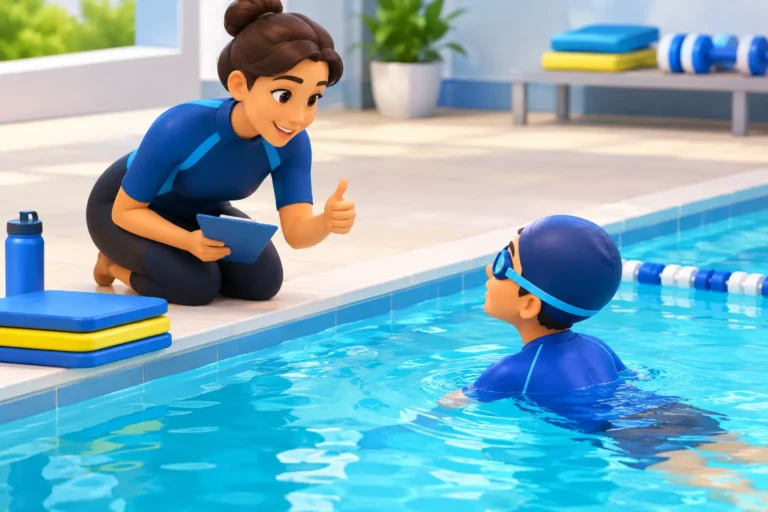
For children, parents should also ask how the swimmer performs when corrected. A coachable child progresses faster because test preparation depends on adjustment. For adults, honest self-assessment matters more than pride. If bilateral breathing, pacing, or deep-water confidence is weak, that weakness should be trained directly rather than avoided.
Build skills under realistic conditions
One of the most effective ways to prepare is to practice in the same order and environment as the test. A swimmer may complete each skill separately but still struggle when asked to link them together. That is why mock assessments are so useful. They expose transition problems, hesitation, and mental fatigue.
A realistic practice set might include the exact entry, the required swim distance, a turn if needed, followed by floating or treading water. If the swimmer usually trains with rests between tasks, remove some of those breaks. If the test will be held in a public pool with distractions, do not assume quiet practice sessions are enough.
There is a trade-off here. Full mock tests are excellent for readiness, but doing them too often can lead to rushed habits. Early in preparation, it is better to isolate weak skills and clean them up. Closer to the test date, complete more full-sequence practice runs. This balance helps swimmers improve quality before focusing on consistency.
Stroke correction matters more than extra laps
When swimmers struggle in tests, the cause is often technical inefficiency rather than a lack of effort. A dropped elbow in freestyle, late breathing, wide breaststroke kick, or poor streamline can drain energy quickly. The swimmer then reaches the final portion of the test tired and loses control.
That is why targeted correction is usually more valuable than simply adding distance. Short sets with clear technical goals often produce better results than long, unfocused training. For example, a swimmer preparing for a front crawl assessment may improve faster by practicing breathing rhythm and body alignment over 25-meter repeats than by forcing continuous distance with poor form.
Children respond best to one or two technical focus points at a time. Too many instructions can create confusion. Adults can usually handle more detailed feedback, but they also tend to overthink. In both cases, simple and repeatable cues work best.
Do not neglect survival and confidence skills
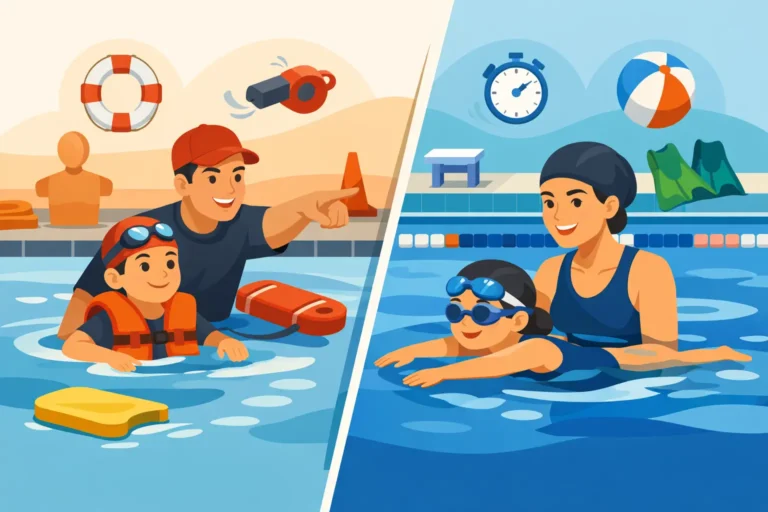
A strong guide to swimming test preparation should never treat water survival as secondary. In structured programs, safety skills are part of progression for a reason. They show whether a swimmer can stay composed, recover control, and make safe decisions in the water.
Practice should include floating comfortably on front and back, changing position without panic, treading water with economy, and recovering after entries. These are not filler drills. They support overall confidence and improve test performance because they reduce fear when the swimmer is temporarily out of rhythm.
This is especially important for younger children and cautious adults. Some swimmers can complete the required distance but become anxious in deep water or after submersion. If that anxiety is ignored, it often surfaces on test day. Confidence is built through repeated success in controlled progression, not by forcing a swimmer into difficult tasks too early.
The final week: sharpen, do not overload
In the last seven days, preparation should become more specific and slightly lighter. This is not the time for exhausting sessions. The goal is to preserve energy, reinforce technique, and reduce uncertainty.
A swimmer should complete at least one full mock assessment, but not so many that every session feels like an exam. Use the remaining practices to review starts, turns, breathing patterns, and safety sequences. Keep instructions consistent. Last-minute changes to stroke mechanics can create doubt.
Parents can help by keeping routines steady. Extra pressure rarely improves performance. Calm reminders about listening carefully, following the sequence, and finishing each task with control are more effective. Adult learners should take the same approach with themselves. A test is a measure of current ability, not a judgment of potential.
Test-day habits that improve results
Good preparation includes practical habits outside the water. Arrive early enough to settle in. Check goggles, swimwear, cap, and any required items before leaving home. Eat lightly if needed, hydrate sensibly, and avoid rushing onto the pool deck flustered.
Warm up if allowed. Even a brief mobility routine and a few easy laps can improve body awareness. During the test, listen to instructions fully before moving. Many unnecessary mistakes happen because swimmers start early or miss part of the command.
If one section does not feel perfect, move on mentally. A single weak moment does not always determine the result. Controlled recovery is part of good performance. This is where structured coaching makes a difference. Swimmers who train with progression-based methods usually know how to reset and continue.
For families and learners who want a clear pathway, AQZOG emphasizes exactly this kind of structured preparation – skill progression, mock practice, safety habits, and measurable readiness rather than guesswork.
When extra coaching is the right decision
Some swimmers improve well in weekly classes alone. Others need short-term intensive support before an assessment. Extra coaching is worth considering when the swimmer is close to the standard but inconsistent, when fear is interfering with performance, or when the test date is fixed and there is little room for trial and error.
Private or small-group preparation can be especially useful for correcting specific weaknesses quickly. The key is not just more pool time. It is more relevant pool time, with feedback linked directly to the test standard.
The best results usually come from steady practice, realistic expectations, and coaching that treats swimming as a life skill as well as a certification goal. A swimmer who prepares in that way is not only more likely to pass. They are more likely to leave the test safer, calmer, and genuinely stronger in the water.
The most reliable confidence comes from knowing you have practiced the exact skills that matter, enough times to trust yourself when it counts.