
SwimSafer Stage 2 Singapore: Test Criteria, Skills & Requirements
A critical milestone in Singapore’s national swimming education framework. Stage 2 builds water confidence, controlled swimming skills, and basic survival awareness in deeper water — the bridge from Stage 1’s shallow-water confidence to structured swimming competency.
What Is SwimSafer Stage 2?
SwimSafer Stage 2 is part of Singapore’s national water safety programme, developed by the National Water Safety Council (NWSC) and endorsed by Sport Singapore and Singapore Aquatics, aligned to the MOE Primary School swimming curriculum under the SwimSafer 2.0 framework.
At Stage 2, swimmers transition from shallow-water confidence (Stage 1) to performing structured skills in deeper water, up to 1.8m — learning to move safely and independently in a full-size pool and respond calmly in an unexpected water entry situation.
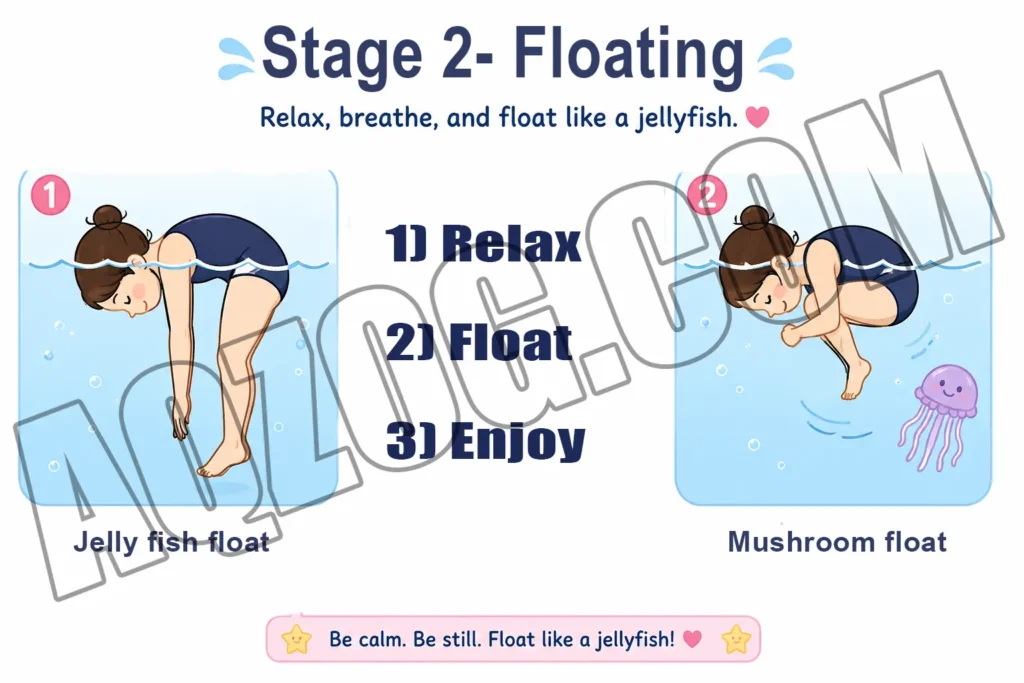
The mushroom float and jellyfish float are the two front-float positions taught from Lesson 1.
SwimSafer Stage 2 Requirements: All Assessed Skills at a Glance
Four assessed components make up the SwimSafer Stage 2 test.
| # | Skill | Distance/Duration | Component |
|---|---|---|---|
| 1 | Step-in entry (unassisted) | — | Swimming Skills / Seq. 2A |
| 2 | Front swim (any stroke) | 25m | Swimming Skills |
| 3 | Back swim | 15m | Swimming Skills |
| 4 | Front float (no goggles) | 10 sec | Survival Seq. 2A |
| 5 | Swim front 5m then roll to back | 5m + rollover | Survival Seq. 2A |
| 6 | Back float (no goggles) | 10 sec | Survival Seq. 2A |
| 7 | Swim back 5m | 5m | Survival Seq. 2A |
| 8 | Scull / float / tread water | 30 sec | Survival Seq. 2A |
| 9 | Object recovery (chest-deep water) | 1 object | Survival Seq. 2A |
| 10 | Resurface and pool exit | — | Survival Seq. 2A |
| 11 | Clothed survival stroke swim | 15m | Survival Seq. 2B |
| 12 | Fit PFD, jump entry (min. 1.4m) | — | Survival Seq. 2B |
| 13 | Swim 25m with PFD, exit & remove | 25m | Survival Seq. 2B |
| 14 | SwimSafer online theory quiz | Online | Theory |
Full 16-Lesson SwimSafer Stage 2 Plan & Milestones
Designed for 30-minute weekly group lessons. Each lesson builds sequentially — tap any lesson to expand.
1Water Entry, Orientation & Confidence ReviewIntroductory
- Warm-up: supervised free movement, bob 10 times, blow bubbles to pool floor
- Step-in entry from pool deck — bent knees, eyes on entry point, controlled foot placement
- Front float review: mushroom/jellyfish float, 10 seconds
- Back float review: ears submerged, hips up, 10 seconds
- Pool exit practice: ladder and wall exit, two-hand grip
2Front Kick Development & Breath ControlFoundation
- Kick on wall: 2×30 sec flutter kick, exhale through nose and mouth
- Kickboard laps: 3×15m, breathing every 4 kicks
- Catch-up arm drill across width
- Target: full 25m front swim attempt, any stroke
3Back Swimming — Kick & Arm CoordinationFoundation
- Back kick drill: hold gutter, 30 sec, toes pointed up
- Back glide with kick: 10m from wall push-off
- Back arm drill: high recovery, pinky-first entry
- Combined: 3×15m back swim, flat hips, ears submerged
4Sculling Introduction & Body RotationCore Skill
- Sculling drill (shallow): figure-of-eight motion, palms angled down
- Sculling in deep water with noodle support
- Treading water: eggbeater/flutter kick, target 30 sec
- Rollover drill: swim 5m front, roll to back on command
5No-Goggle Practice Begins & Front Float RefinementNo Goggles
- Eyes-open drill: blow bubbles, open eyes underwater
- Front float (no goggles): 10 sec, relaxed body
- Back float (no goggles): 10 sec, stable hips-up
- Front swim (no goggles): 3×10m, sighting every 4 strokes
6Survival Sequence 2A — Full Run-Through (First Attempt)Assessment Prep
- Step-in entry → front float 10s → swim 5m & roll to back → back float 10s → swim 5m back → scull/tread 30s → recover object → resurface & exit
- Post the sequence on a whiteboard for reference
7Object Recovery & Deep-Water ConfidenceCore Skill
- Shallow dive: touch pool floor with hands, retrieve sinker toy
- Feet-first dive to pool floor from treading position
- Object recovery drill: 5 repetitions
- Combo drill: mini Sequence 2A (last 3 steps)
825m Front Swim & 15m Back Swim — Assessment Build-UpDistance Target
- Warm-up: 4×10m front kick on noodle, no goggles
- 25m front swim attempt (no goggles), continuous
- 15m back swim (no goggles) ×2 attempts
- Cool down: back float 30 sec
9Survival Sequence 2A — No Goggles, ContinuousAssessment Prep
- Full sequence run-through, no goggles, no breaks, coach observes only
- Debrief on any steps that were unsteady
- Individual drilling on weak step(s), 3–5 reps
- Second full run of the sequence
10Clothed Swimming Introduction (Seq. 2B Part 1)Clothed Lesson
- Awareness discussion: wet clothes increase drag and weight
- Entry clothed: step-in entry while dressed
- Clothed float: front 10s, back 10s
- Clothed swim: 2×10m survival stroke, face clear of water
11PFD Fitting & Jump Entry PracticePFD Lesson
- PFD on land: correct fit, zipper closed, two-finger strap test
- PFD in water: float in recovery position for 60 sec
- Swim with PFD: 2×15m, any stroke
- Jump entry (min. 1.4m pool): compact jump, arms crossed over PFD
- PFD removal at poolside
12Survival Sequence 2B — Full Run-Through (Clothed)Clothed + PFD
- Swim 15m survival stroke, exit pool safely
- Fit PFD correctly on pool deck
- Jump into deep water (min. 1.4m), resurface calmly
- Swim 25m with PFD on
- Climb out, remove PFD
13Mock Assessment 1 — Swimming Skills & Sequence 2AMock Test
- 25m front swim (no goggles, no stopping, no wall touch)
- 15m back swim (no goggles, no stopping)
- Full Survival Sequence 2A without goggles or breaks
- Written feedback to parents on readiness
14Mock Assessment 2 — Sequence 2B & Theory Quiz PrepMock Test
- Full Survival Sequence 2B in clothed conditions, assessor-style observation
- Theory quiz walkthrough: 5–10 sample questions as a group
- Remind parents to complete the online quiz before assessment day
15Consolidation & Individual Weak PointsRefinement
- Ready swimmers: 25m no-goggle swim + full Sequence 2A at assessment pace
- Developing swimmers: repeat specific weak step(s), 5–8 reps
16Final Readiness Assessment & CertificationAssessment Day
- 25m front swim + 15m back swim
- Survival Sequence 2A (no goggles)
- Survival Sequence 2B (clothed + PFD)
- Online theory quiz (confirmed completed)
- Conducted by a certified Sport Singapore / Singapore Aquatics assessor
Survival Sequences 2A & 2B Explained
🌊 Survival Sequence 2A — Without Goggles
Simulates an unexpected fall into the water. The swimmer must stabilise, stay calm, and exit safely — all without goggles.
- Step-in entry — controlled step from pool deck, look at entry point, knees slightly flexed, legs relaxed on impact
- Front float (10 seconds) — stable face-down float, mushroom or jellyfish position, relaxed limbs
- Swim 5m front, then roll to back — any front stroke for 5m, then roll starting from head and shoulders, hips follow
- Back float (10 seconds) — stable, ears submerged, hips at surface, arms out for balance
- Swim 5m on back — any back stroke
- Scull, float, or tread water (30 seconds) — swimmer’s choice, chin above water throughout
- Recover object — dive to retrieve a weighted object from chest-deep water floor, resurface
- Safe exit — swim to pool wall, use ladder or gutter, climb out cleanly
👤 Survival Sequence 2B — Clothed
Simulates accidental entry while dressed. The swimmer must remain calm, use survival skills, and operate a PFD. Calmness in deep water is specifically assessed.
- Clothed survival stroke swim — 15m — swimwear + shorts + t-shirt, face clears the water at all times, exits pool safely after 15m
- Fit PFD correctly — zip closed, straps tightened to a snug two-finger fit
- Jump entry into deep water (min. 1.4m) — compact upright jump, arms crossed on PFD, resurface and float calmly
- Swim 25m with PFD — any stroke, working with the buoyancy
- Climb out and remove PFD — exit pool from deep end, remove PFD at poolside
Why clothed swimming? Unexpected falls into water almost always happen while dressed. Swimming in wet clothes teaches children to manage extra drag, conserve energy, and remain calm.
SwimSafer Stage 2 Test Criteria for Each Component
The key “must-see criteria” assessors look for, based on the SwimSafer 2.0 assessor framework.
Step-In Entry
- Confident, controlled entry (not a jump)
- Eyes looking at the point of entry
- Knees slightly flexed on entry
- Legs relaxed when feet reach pool floor
Front Float (10s)
- Stable face-down position
- Face fully in water
- Limbs relaxed, not moving
- Held for full 10 seconds
Back Float (10s)
- Ears submerged
- Hips at or near surface
- Arms out for lateral stability
- Held for full 10 seconds
Front-to-Back Rollover
- Roll initiated from head and shoulders
- Hips follow in one smooth motion
- Complete within 2–3 body lengths
- Stable back float achieved after
Sculling / Treading (30s)
- Chin consistently above water
- Controlled, rhythmic motion
- No panic or erratic movement
- Sustained for full 30 seconds
Survival Stroke (15m clothed)
- Face above water at all times
- Calm demeanour maintained
- Continuous 15m without stopping
- Safe exit from pool
PFD Fitting
- Correctly sized PFD selected
- Zipper fully closed
- All straps tightened snug
- Worn correctly (not upside down)
25m Front Swim
- Continuous, no stopping or wall holds
- Alternating or simultaneous arm/leg action
- Head position appropriate for stroke
- No goggle use during assessment
SwimSafer Stage 2 Online Theory Quiz
Mandatory — certification cannot be awarded until the quiz is completed, regardless of practical performance.
Accessed online via the official SwimSafer portal. Most children complete it in 10–15 minutes. A missed quiz is the most common avoidable reason for delayed certification.
Why Choose AQZOG for Stage 2?
Common Mistakes & Tips for Faster Progress
Why children repeat Stage 2, and how to avoid it.
Frequently Asked Questions
How many lessons does SwimSafer Stage 2 take?
Most children complete Stage 2 in 12 to 20 group lessons at once weekly — roughly 3 to 6 months. Twice-weekly attendance can reduce this to 6–10 weeks. Progress is skill-based, not time-based.
What skills are tested in SwimSafer Stage 2?
Four components: (1) Swimming Skills – 25m front swim and 15m back swim; (2) Survival Sequence 2A without goggles; (3) Survival Sequence 2B clothed; (4) the SwimSafer online theory quiz.
What age is SwimSafer Stage 2 for?
Most children are 6–10 years old, though there’s no strict age limit. Entry is based on ability and completion of Stage 1 skills.
Does my child need to wear clothes for SwimSafer Stage 2?
Yes, for Survival Sequence 2B only — swimwear, shorts, and a t-shirt to simulate an accidental water entry. This is a core, non-skippable part of the assessment.
What if my child fails part of the Stage 2 assessment?
Children can retake individual components without redoing the entire assessment. Your coach identifies which component(s) need more training.
Can my child skip Stage 2 and go straight to Stage 3?
Generally no. Each stage builds specific skills needed for the next; skipping Stage 2 leaves gaps in survival floating and deeper-water confidence. Coaches assess bypass eligibility case-by-case.
What pool depth is needed for SwimSafer Stage 2?
Most skills need 1.2–1.5m depth. The PFD jump entry for Sequence 2B requires at least 1.4m — condo pools that don’t meet this may need an ActiveSG session.
Is the SwimSafer Stage 2 certificate recognised by MOE schools?
Yes. SwimSafer 2.0 is the national standard endorsed by Sport Singapore and aligned with MOE’s school swimming curriculum, recognised across all Singapore primary schools and ActiveSG pools.
Ready to Start SwimSafer Stage 2?
AQZOG certified coaches run small-group SwimSafer classes across Singapore’s ActiveSG pools. Our structured 16-lesson programme gives your child the best chance of passing first time.