Pool Survival Skills Checklist for Beginners
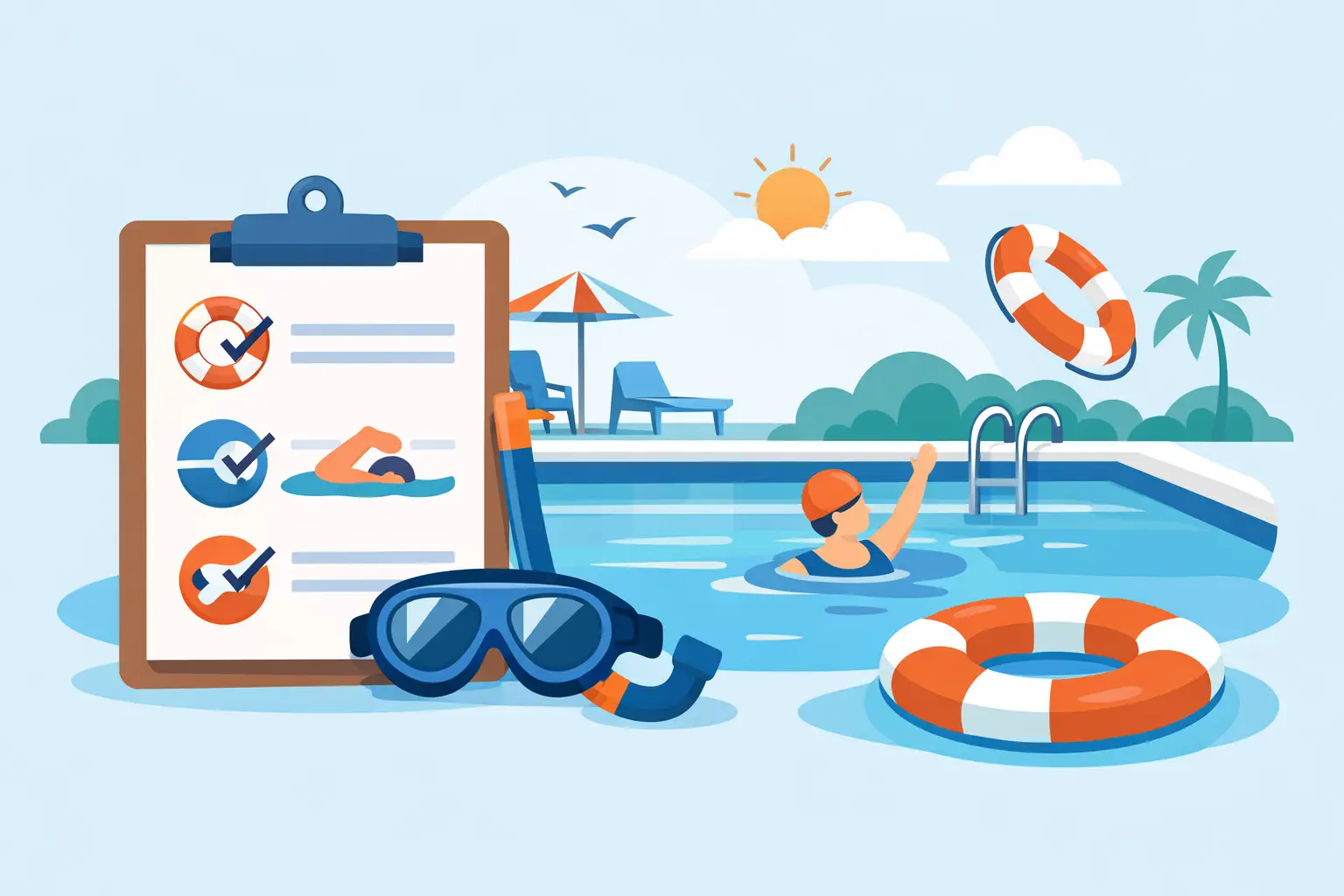
A child who can splash happily in the shallow end may still panic when their feet lose contact with the floor. An adult who feels fine holding the wall may still struggle to recover after one mouthful of water. That is why a pool survival skills checklist matters. It shifts the focus from looking comfortable in the water to proving real, repeatable safety skills.
For parents, this checklist helps you see whether your child is building true water competence, not just pool confidence. For adult learners, it gives you a clear standard for progress. Survival skills are not advanced skills. They are the minimum abilities a swimmer should develop to stay calmer, make safer decisions, and recover in common pool situations.
What a pool survival skills checklist should measure
A useful checklist does not start with perfect strokes or long-distance swimming. It starts with whether the swimmer can control breathing, stay afloat, change body position, and return to safety. Those are the skills that matter first when something goes wrong.
This is where many families get misled. A child may move forward using a rough dog paddle and look independent for a few seconds. But if that child cannot roll onto the back, float, or recover after submersion, the risk is still high. The same applies to adults who can complete one lap but tense up badly in deeper water.
A strong checklist measures performance under simple but meaningful conditions. Can the swimmer do the skill without grabbing someone? Can they repeat it when slightly tired or surprised? Can they stay composed enough to follow instructions? Survival is not about elegance. It is about control.
Pool survival skills checklist: the core abilities
The first item is safe water entry. A swimmer should know how to enter the pool in a controlled way, whether by steps, ladder, seated entry, or compact jump when appropriate. Rushing in without orientation often leads to immediate disorganization.
The second is breath control. This sounds basic, but it is one of the most important foundations. A swimmer should be able to inhale above water, submerge the face, and exhale in a controlled way. If breath control is weak, nearly every other skill becomes harder.
The third is submersion recovery. After going underwater, the swimmer should be able to return to the surface without panic, clear the face, and resume breathing. Young children especially need repeated practice here because surprise submersion is often what triggers distress.
The fourth is front floating and back floating. Both matter. Front floating helps with body awareness and breath timing. Back floating is often the more valuable survival position because it allows breathing and a brief recovery period. Some swimmers resist back floating at first because it feels unstable, but with proper coaching it becomes a major confidence builder.
The fifth is changing position in the water. A swimmer should be able to move from front to back and back to front with control. This skill is often more useful than people realize. In a real moment of stress, the ability to roll onto the back and breathe can prevent panic from escalating.
The sixth is treading or vertical survival movement. This does not need to look polished in the early stages. The goal is to keep the airway above water for a short period while staying calm enough to look around, call for help, or move toward the wall.
The seventh is forward propulsion. The swimmer should be able to move a short distance intentionally, not just splash in place. This may begin with a basic paddle, kick with arm support, or short freestyle movement depending on age and stage. The key question is simple: can they get somewhere safer?
The eighth is direction change and return to wall. Many beginners can move forward a little but cannot turn and head back once they realize they are tired. A reliable swimmer should be able to orient, change direction, and travel to the nearest edge.
The ninth is wall recovery. Reaching the wall is not enough if the swimmer cannot hold it, move along it, or exit safely. Children should practice grabbing the edge, keeping the mouth clear, and using the wall to recover before climbing out.
The tenth is basic safety awareness. This includes waiting for permission to enter, recognizing depth changes, understanding no-running rules, and knowing not to jump toward another swimmer. Survival skills are physical, but judgment matters too.
What this looks like by age and stage
For toddlers and very young children, the checklist is naturally shorter and more assisted. The focus should be water comfort, face wetting, supported breath control, assisted floating, and learning to return to an adult or wall. At this age, no skill removes the need for close supervision. That point should never be softened.
For school-age beginners, expectations can increase. They should work toward independent floating, short-distance movement, submersion recovery, and returning to the wall without physical help. This is also the stage where structured progression matters most, because children often gain confidence faster than actual survival ability.
For teens and adults, the emotional side can be more pronounced. Adults may understand the skill but freeze when attempting it. In those cases, the checklist should still be the same, but the teaching pace may differ. Confidence without skill is risky, but skill without calm repetition is fragile.
Common gaps parents and adult learners miss
One common gap is overreliance on flotation devices. These tools can support learning in the right setting, but they can also hide weak balance and poor breathing habits. If a child appears capable only while wearing aids, the actual survival level may be much lower than expected.
Another gap is confusing stroke progress with survival readiness. A swimmer may learn arm movements early but still lack floating control or deep-water recovery. Formal strokes are valuable, especially for long-term progression, but they should not replace core safety skills.
A third gap is assuming shallow-water performance transfers to all environments. It often does not. Water depth changes behavior. So does fatigue, cold water, crowding, and the stress of an unexpected splash to the face. That is why skills should be practiced progressively and under supervision in varied but controlled conditions.
How to use the checklist in a practical way
Use the checklist as an assessment tool, not a pass-fail label. If a swimmer can perform a skill once but not consistently, treat it as in progress. Consistency is the real standard. Families often feel encouraged by one successful attempt, but safety comes from repeatable performance.
It also helps to observe how the skill happens. Is the swimmer calm, or barely coping? Do they recover smoothly, or grab desperately at the wall? Technical success and emotional control should improve together.
For parents, this means asking better questions after class. Not just, did my child swim today, but can my child float independently, recover from submersion, and return to safety? For adults, it means tracking comfort in deep water, breath management, and self-rescue ability, not just lap count.
Why structured instruction makes a difference
A proper pool survival skills checklist is only useful if training follows a sequence. Random practice creates random results. Swimmers need a progression that builds one skill on top of another, with enough repetition to create dependable habits.
That is where experienced coaching matters. A qualified instructor can spot whether a swimmer is truly balanced, whether panic is driving the movement, and whether a skill will hold up without support. In structured programs such as those used by AQZOG, survival ability is developed alongside confidence and measurable progress, which is especially important for families preparing for SwimSafer stages or adults returning to the water after years away.
There is also a trade-off to manage. Fast progress feels good, but rushed progression can create false confidence. On the other hand, moving too slowly can keep a learner dependent for longer than necessary. Good instruction finds the middle ground – safe challenge, clear milestones, and regular skill checks.
When a swimmer is ready to move beyond the checklist
The checklist is the starting line, not the final goal. Once a swimmer can breathe well, float, recover, tread, and return to safety, then stroke development becomes more meaningful. Freestyle, backstroke, endurance, and certification pathways all benefit from a stronger survival base.
For children, this foundation supports safer participation in school programs and public pool settings. For adults, it opens the door to fitness swimming, open-water preparation, or simply feeling at ease around water with family. The point is not just to swim farther. It is to become more capable when conditions are less than ideal.
If you are evaluating a child or your own current ability, be honest but not alarmed. Missing items on a checklist is not failure. It is direction. The right next step is focused practice with clear supervision, because every swimmer becomes safer when survival skills are trained on purpose, not left to chance.
The most reassuring swimmer at any age is not the one who looks flashy in the water. It is the one who can stay calm, recover quickly, and get back to safety when something unexpected happens.