A Guide to Choosing Swim Class Format
A child who cries at the poolside, an adult who can kick but not breathe comfortably, a student rushing toward a SwimSafer assessment – these swimmers do not need the same lesson setup. A good guide to choosing swim class format starts with one simple point: the right format affects safety, confidence, speed of progress, and whether a swimmer stays committed long enough to improve.
Many families and adult learners focus first on price or convenience. Those matter, but they should not be the only deciding factors. The better question is this: which class format gives the swimmer the best chance to learn correctly, progress steadily, and stay safe in the water?
Why swim class format matters more than many expect
Swimming is a technical skill built on timing, body position, breath control, and confidence. If the lesson format does not match the swimmer, progress can stall even with a capable coach. A timid beginner in a large group may feel overwhelmed. A confident child in private lessons may progress well, but might miss the motivation and pacing that can come from learning with peers.
Format also shapes how much individual correction a swimmer receives. That matters for beginners learning basics, toddlers developing water comfort, and test-focused learners preparing for formal assessments. It matters just as much for adults who want efficient instruction and do not have time to spend months correcting the wrong habits.
Guide to choosing swim class format by swimmer profile
The best format depends on age, goals, confidence level, learning style, and timeline. There is no single best option for everyone.
Group classes for steady progression and routine
Weekly group classes work well for many children and beginners because they create structure. Swimmers learn in a consistent setting, follow a planned progression, and build familiarity with water skills over time. For school-age children, group lessons often support discipline and independence. They also help swimmers observe others, which can reduce anxiety and reinforce learning.
This format is usually a strong fit when the child is ready to follow instructions, wait for turns, and learn alongside peers. It is also practical for families who want ongoing instruction rather than short-term crash courses.
The trade-off is pace. In a group, the coach manages several swimmers at once, so the lesson cannot revolve around one learner only. That is not a weakness when the swimmer is coping well, but it can slow progress for those with stronger fear, weaker coordination, or urgent assessment goals.
Private lessons for fast correction and focused coaching
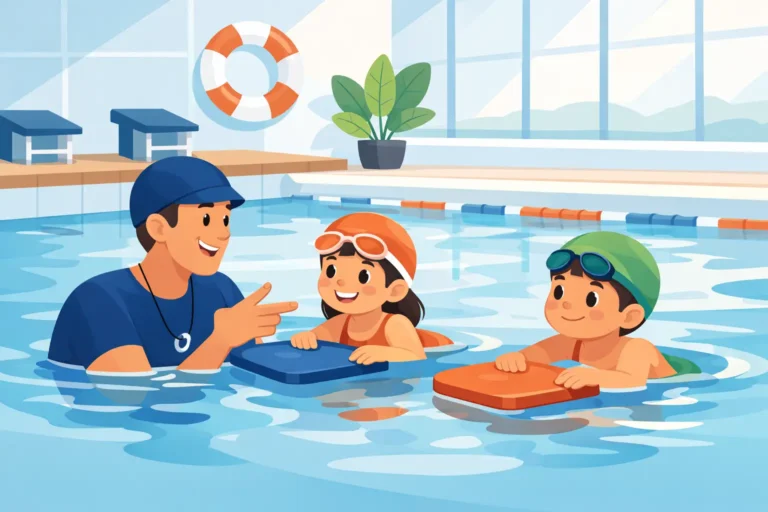
Private one-to-one coaching suits swimmers who need individual attention. This includes adults with water fear, children who need more reassurance, learners with uneven skill development, and those preparing for an assessment within a shorter timeframe.
The biggest advantage is targeted correction. The coach can adjust every drill, pace the lesson according to the swimmer’s response, and spend more time on weak areas such as breathing, floating, or stroke coordination. For test-focused learners, private lessons can sharpen technique and improve readiness more efficiently.
The trade-off is cost. Private lessons usually require a higher investment, and some children respond better when they can learn with other swimmers rather than receiving constant attention. For confident learners, private coaching may be more than they actually need.
Semi-private classes for balance
Semi-private lessons sit between group and private formats. They are useful when two swimmers are at a similar level and can benefit from shared instruction with more personalized feedback than a standard group class provides.
This format often works well for siblings, friends, or adults training together. It keeps the coaching more focused while preserving some peer interaction. That can be helpful for motivation, especially when one swimmer feels less alone seeing another person work through the same skill.
The key condition is matching. If one swimmer is far more advanced or far more anxious than the other, the lesson can become uneven. Semi-private lessons are most effective when both learners have compatible goals and pace.
Toddler water introduction for comfort and safety foundations
Toddlers are not miniature school-age learners. Their lessons should focus on comfort, safe movement in water, body awareness, and positive exposure rather than formal stroke perfection.
Parents choosing for toddlers should not ask which format teaches freestyle fastest. A better question is which format builds trust, water familiarity, and safe habits in a calm, developmentally appropriate way. At this age, the learning environment and the coach’s ability to manage early childhood behavior matter as much as the actual drills.
A toddler who becomes relaxed and responsive in water is building the right foundation. Rushing technique too early can create resistance instead of confidence.
Intensive programs for concentrated progress
Holiday intensives and short-term focused programs can be highly effective when a swimmer needs repeated exposure in a shorter period. This is useful for children who plateau in weekly lessons, students preparing for school-related aquatic benchmarks, or families trying to make productive use of school breaks.
Intensives can accelerate familiarity and reduce the stop-start pattern that happens when lessons are spread too far apart. Still, they are not ideal for every swimmer. A very anxious beginner may need more gradual pacing, not a compressed schedule. Intensive formats work best when the swimmer is ready for regular repetition and can recover well between sessions.
How to choose based on learning goal
A practical guide to choosing swim class format should always return to purpose. Why is the swimmer enrolling now?
If the goal is basic water safety, the best format is the one that allows consistent practice of floating, breathing, movement, and safe pool behavior. For many children, that means structured weekly lessons. For fearful adults or hesitant beginners, it may mean private coaching first, then a transition into group classes later.
If the goal is SwimSafer progression or test readiness, lesson format should support measurable outcomes. In that case, class choice should reflect the swimmer’s current standard, the timeline before assessment, and how much correction is needed. A learner who is nearly ready may do well in a structured group with mock practice, while a learner with gaps in core skills may need private coaching to close them faster.
If the goal is stroke improvement, fitness, or triathlon-related swimming, the swimmer often benefits from a format with technical feedback and repeat correction. Adults especially tend to value efficiency. They usually improve faster when the lesson directly targets their stroke mechanics instead of following a general beginner plan.
Factors parents and adults should weigh carefully
Convenience matters because consistency matters. A perfectly designed class that is difficult to attend will not produce results. Choose a format and schedule that the swimmer can sustain over months, not just for two enthusiastic weeks.
Coach experience matters just as much. A good format under the wrong instruction will not solve the problem. Parents should look for structured progression, clear standards, and coaches who know how to teach safety, not just swimming strokes.
Class size matters too, but context matters more. A small group is not automatically better if the program lacks progression. A larger group is not automatically worse if the swimmers are well managed and the coaching is systematic.
Readiness is another factor people often miss. Some swimmers are not yet suited to group learning, and that is fine. Starting in private lessons does not mean they must stay there forever. Many swimmers do best with a staged pathway: private lessons for confidence and fundamentals, then group classes for continued progression and independence.
When to switch formats
Choosing once does not mean choosing forever. A swimmer may outgrow the format that served them well at the beginning.
If progress has slowed despite regular attendance, if the swimmer has become too comfortable and needs greater challenge, or if test preparation has become more urgent, it may be time to switch. Likewise, if a child started in private lessons because of fear but now follows instructions well and enjoys learning with others, a structured group class may be the next sensible step.
The strongest programs do not treat format as fixed. They treat it as part of a learning pathway.
The best choice is the one that fits now
The right class format is not the cheapest option, the most premium option, or the one another family happened to choose. It is the one that matches the swimmer’s current confidence, skill level, goals, and pace of learning.
That is why experienced swim schools look beyond registration labels and focus on progression. At AQZOG, that means helping swimmers move toward safer water habits, stronger technique, and clearer readiness for the next stage. Choose the format that gives the swimmer the best chance to learn well now – then let progress guide what comes next.