Breaststroke Swimming Skills Technique Tips
A swimmer who can freestyle a full lap often struggles the moment breaststroke starts to feel rushed, wide, or tiring. That is because breaststroke swimming skills technique depends less on brute effort and more on timing, body position, and control. When the stroke is taught properly, it becomes one of the most useful skills for confidence, survival, and steady progression in the water.
For children, breaststroke helps build awareness of rhythm and leg coordination. For adults, it often feels more approachable because the face comes out of the water regularly. But it is also one of the easiest strokes to perform inefficiently. Many swimmers work harder than necessary because their pull is too big, their kick is mistimed, or their body line collapses between strokes.
Why breaststroke technique matters
Breaststroke is often seen as a “gentler” stroke, but that can be misleading. Poor technique places extra strain on the knees, hips, neck, and lower back. It also slows the swimmer down quickly. A swimmer may feel busy in the water without actually moving forward well.
Good technique changes that. When the stroke is organized in the right sequence, the swimmer gets better distance per stroke, calmer breathing, and stronger control in deeper water. This matters for young learners building fundamental coordination and for adults who want efficiency, fitness, or better test performance.
In structured swim instruction, breaststroke is not just about getting across the pool. It teaches patience, timing, and body control. These are transferable skills that support overall water safety and progression.
The foundation of breaststroke swimming skills technique
Breaststroke works best when the body stays long and balanced. The common mistake is treating it like a fast cycle of pull, kick, pull, kick. In reality, the stroke should feel more like pull, breathe, kick, glide. That small difference matters a lot.
The body should stay as flat and streamlined as possible during the glide. The head should not remain high for the whole stroke. When swimmers keep the chin lifted, the hips and legs sink, and the kick becomes less effective. A better position is to lift only enough to inhale, then return the face forward and down as the body stretches long.
The stroke also relies on symmetry. Unlike freestyle, where the body rotates side to side, breaststroke asks both arms and both legs to work together. If one side pulls wider or kicks later, the stroke loses balance immediately.
Body position first, speed second
A swimmer who tries to rush breaststroke usually shortens the glide and lifts the shoulders too high. This creates drag. Before trying to go faster, it is better to build a consistent line in the water. The chest should press slightly forward, the hips should stay near the surface, and the recovery should happen with as little resistance as possible.
For newer swimmers, this often means slowing down on purpose. A slower, cleaner stroke usually travels farther than a rushed one.
The arm pull should stay compact
One of the biggest technical errors in breaststroke is an oversized pull. Swimmers often sweep the hands too far back, sometimes all the way past the shoulders. That may feel powerful, but it usually stalls the stroke.
A more effective pull starts with the hands extended forward. The hands angle outward slightly, then sweep out and in to form a compact catch. The elbows stay relatively high, and the hands recover back to the front quickly. The goal is not a dramatic arm movement. The goal is to create enough lift to breathe and enough support to set up the kick.
If the arms pull too deep or too wide, the swimmer loses the forward line and wastes energy recovering.
The kick drives the stroke
In breaststroke, the kick is the main source of propulsion. This is why leg technique deserves extra attention. Many learners bend from the hips too much or separate the knees too widely. Others point the toes down and try to push water backward with the tops of the feet. Neither creates a strong whip kick.
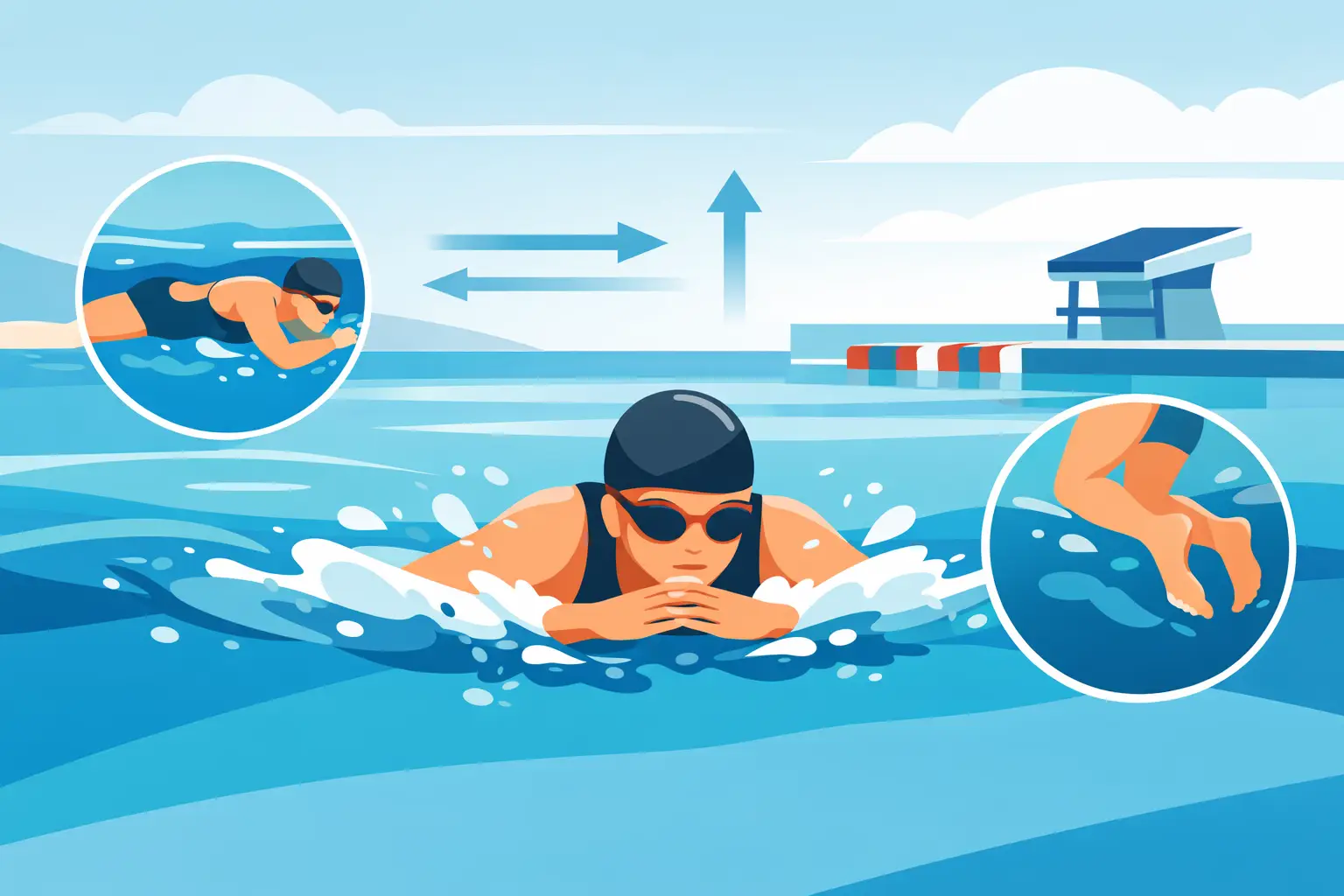
A proper breaststroke kick begins with the heels drawing up toward the hips in a controlled way. The knees bend, but they should not open excessively. Then the feet turn outward, and the legs sweep back and together in a circular whip. At the end of the kick, the legs finish straight and close together in a streamlined position.
The closing snap matters. That final squeeze helps the swimmer finish long and reduce drag.
Timing is what makes the stroke work
A swimmer can have a decent pull and a decent kick and still struggle if the timing is off. Breaststroke is a stroke of sequence. Pull too late, and the breath becomes rushed. Kick too early, and the body has no line to press into. Skip the glide, and every cycle feels tiring.
The simplest timing cue is this: pull and breathe, then kick and glide. The inhale happens during the arm action. The kick happens as the hands shoot forward. The glide follows when the body is straight again.
This is where many children and adult beginners need coaching feedback. Without it, they often pull and kick at the same time. That creates effort, but not efficiency. When the timing improves, the stroke immediately looks smoother and feels easier.
Breathing should support the stroke, not interrupt it
Because breaststroke allows regular breathing, swimmers sometimes overuse that advantage by lifting too high for air. A large head lift pushes the body downward and makes the recovery heavy.
A better breath is small and quick. The shoulders rise just enough with the pull, the mouth clears the surface, and the inhale happens naturally. As the hands extend forward, the head returns in line with the body.
For nervous swimmers, this breathing pattern often feels reassuring because there is a predictable place to inhale every stroke. For competitive or fitness-focused swimmers, a lower breath helps preserve speed.
Common problems and what they usually mean
If a swimmer feels stuck in the water, the issue is often drag rather than lack of effort. Legs that stay apart after the kick, arms that recover slowly, or a head that stays up too long can all create resistance.
If the knees hurt, the kick may be too wide or twisted. Breaststroke should not feel like forcing the joints open. The movement should stay controlled, with the feet turning out only as needed.
If the swimmer gets tired after a short distance, the stroke may be missing the glide. Breaststroke rewards patience. A brief streamlined pause after each kick helps the body travel.
If the swimmer feels out of breath, the pull may be too late or too aggressive. A calm, well-timed breath is more sustainable than a big lift for air every cycle.
Drills that build better breaststroke technique
Drills work best when they target one part of the stroke at a time. For younger swimmers, short repeats with clear cues are usually more effective than long laps. For adults, drills help correct habits that have been repeated for years.
One useful drill is kick with a board, focusing only on heel recovery, foot turnout, and a clean snap together. This isolates the main propulsive part of the stroke. Another is pull-breathe-glide with a light buoy support, which helps swimmers feel the sequence without rushing the kick.
Glide count is also effective. The swimmer takes one full stroke, finishes the kick, and counts a short glide before starting again. This teaches patience and distance per stroke. Sculling drills can help with the feel of the water during the catch, especially for swimmers whose arm movements are too wide.
In structured lessons, these drills are most effective when paired with immediate correction. Small details matter in breaststroke, and technical habits are easier to fix early than later.
Breaststroke for children and adult learners
Children often need time to develop the leg coordination for breaststroke. That is normal. The movement pattern is less natural than a flutter kick, and some learners need repeated practice before the whip action becomes consistent. The key is structured progression rather than rushing to full-stroke laps too early.
Adult beginners often prefer breaststroke because it feels more controlled and allows regular breathing. That can build confidence quickly. At the same time, adults may bring stiffness in the ankles, hips, or knees, so technique should be adjusted carefully. A strong coach will watch not just what the swimmer is doing, but whether the body can perform the movement safely.
This is where experienced instruction makes a real difference. AQZOG places strong emphasis on progression, safety, and measurable skill development because strokes improve faster when technique is taught in the right order.
What better breaststroke should feel like
Good breaststroke does not feel frantic. It feels organized. The pull is compact, the breath is calm, the kick finishes with purpose, and the glide carries the body forward. The swimmer is not fighting the water on every stroke.
That is the standard to aim for, whether the goal is water confidence, formal progression, test readiness, or simply swimming with less effort. Breaststroke improves when swimmers stop trying to force speed and start respecting sequence, shape, and control.
A clean stroke is not built in one session, but each correction adds up. When timing and technique begin to click, breaststroke becomes more than a school requirement or a fitness stroke. It becomes a reliable skill that supports confidence every time the swimmer enters the water.