Guide to Adult Swimming Progression for Beginners
The first achievement for an adult beginner is not swimming a fast lap. It is standing in chest-deep water, breathing steadily, and knowing you can return to the wall when you need to. This guide to adult swimming progression sets out the practical path from first water confidence to efficient, safe swimming. The goal is measurable improvement without rushing the skills that keep you safe.
Adult learners arrive with very different starting points. Some can float but panic when water reaches their face. Some learned a rough breaststroke years ago and now want fitness or triathlon readiness. Others need structured coaching after avoiding pools for most of their lives. A good progression respects that starting point while maintaining clear standards for each next step.
Why Adult Swimming Progression Should Be Structured
Swimming is a life skill built in layers. Trying to learn freestyle before you can exhale calmly underwater often creates tension, fatigue, and fear. Trying to add speed before you can maintain body position leads to inefficient strokes and frustration.
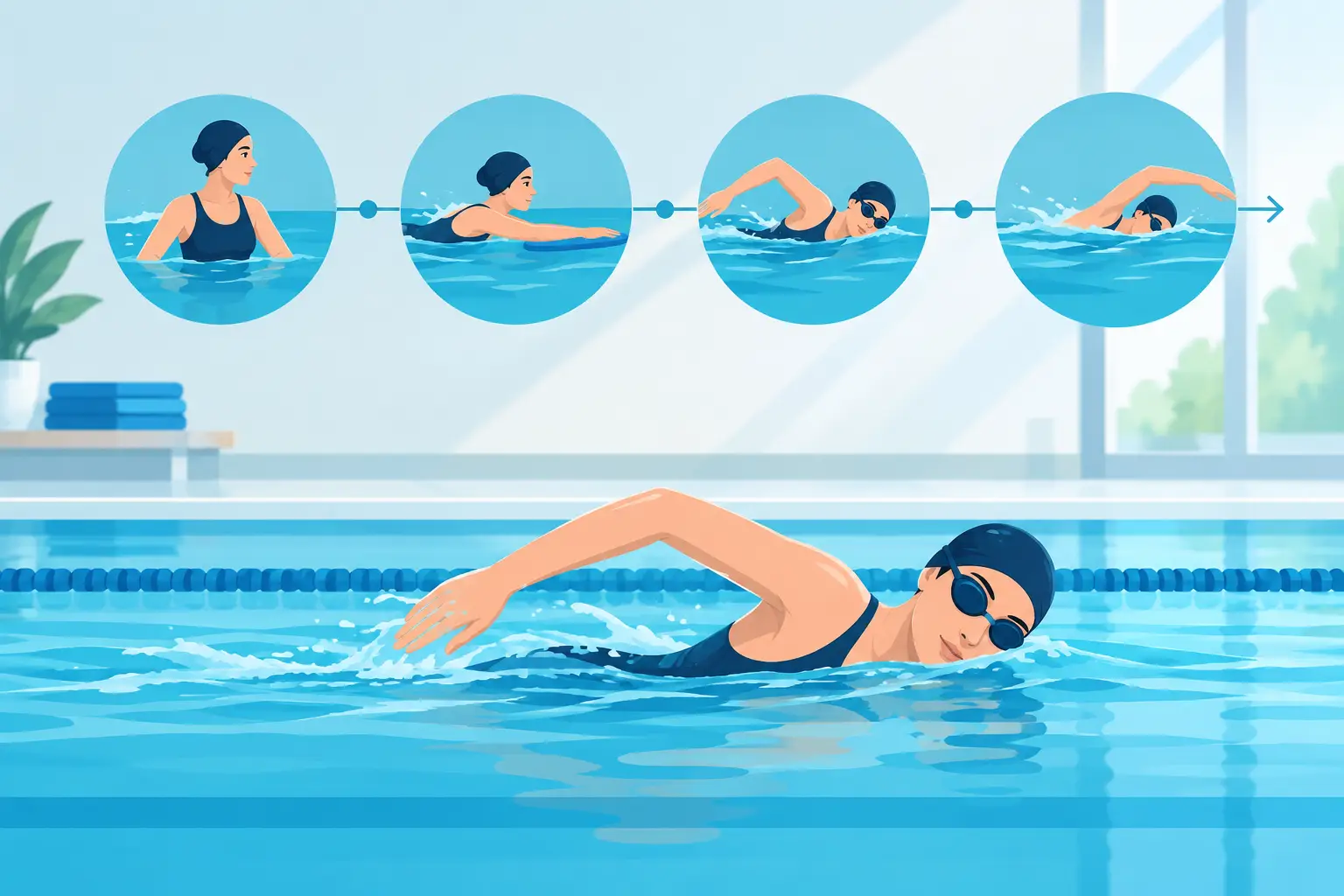
Structured progression gives every lesson a purpose. You first develop water orientation and recovery skills, then balance, propulsion, coordinated strokes, and finally endurance or performance skills. Each level gives you evidence that you are ready to move forward, rather than relying on guesswork or comparing yourself with experienced swimmers in the next lane.
For adults, confidence matters as much as technique. Confidence is not pretending fear is absent. It is knowing what to do when goggles leak, when you lose your rhythm, or when you need a break halfway across the pool. Those responses should be practiced early and often.
Stage 1: Build Water Confidence and Survival Skills
A complete beginner should start in water where they can stand comfortably. The first sessions focus on becoming familiar with buoyancy, breathing, and movement rather than forcing a full stroke.
Learn Calm Breathing First
Many adult swimming difficulties begin with holding the breath. When swimmers hold air in, their body stiffens and they rush to lift their head for a large breath. This quickly disrupts balance.
Start by placing your face in the water and blowing a steady stream of bubbles. Practice lifting your face only long enough to inhale, then returning it to the water. The skill sounds simple, but it is the foundation of relaxed freestyle, breaststroke timing, and efficient floating.
Practice Floating and Recovery
Front and back floats teach you that water can support your body when you are relaxed. A coach may begin with support, then reduce it as you learn to extend your body and look in the right direction.
Recovery is equally important. You should be able to move from a float to a standing position, roll from front to back, and reach the pool wall safely. These are not beginner-only drills. They are core water-safety habits that remain relevant at every level.
Become Comfortable With Short Glides
A streamlined glide from the wall introduces balance without the pressure of continuous swimming. Keep the body long, the head neutral, and the eyes directed downward. The aim is not distance at first. It is to feel how a horizontal body position reduces effort.
Stage 2: Create Balance Before Adding Power
Once you can breathe out underwater, float, and recover independently, the next task is body position. This is where many adults make their greatest technical gains.
A swimmer who rides high and level in the water can move forward with less effort. A swimmer whose hips drop will often kick harder, lift the head, and tire sooner. More effort is not always the answer. Better balance usually comes first.
Front kicking and back kicking are useful at this stage because they isolate alignment. On the front, keep your face down between breaths and use a light, compact kick from the hips. On the back, keep your ears in the water and allow the hips to stay close to the surface. If kicking creates knee pain or rapid exhaustion, technique needs attention before distance increases.
Adults sometimes feel impatient with drills because they want to “just swim.” However, a few well-coached repetitions can prevent weeks of practicing an inefficient movement pattern. This is one reason small-group or private lessons can accelerate progress for learners who need frequent feedback.
Stage 3: Develop a Reliable Freestyle Stroke
Freestyle is often the first continuous stroke adults learn because it can become efficient over longer distances. It is also demanding when breathing and body rotation are not yet coordinated.
Begin with short, repeatable swims. A strong early benchmark might be swimming several short lengths with controlled breathing and a safe stop at the wall, rather than attempting one exhausting long swim. Rest is part of skill learning. It allows you to reset technique instead of rehearsing poor form while tired.
Focus on Three Freestyle Priorities
Keep your head stable and look mostly down, allowing the hips to remain near the surface. Rotate the body gently from side to side rather than swimming flat. Then breathe to the side by turning with that rotation, not by lifting the head forward.
Your arms should enter in line with the shoulder, extend forward, and pull water backward with a controlled catch. A wide, sweeping pull may feel powerful but often wastes energy. Your kick supports balance and rhythm. It does not need to be large or forceful for recreational swimming.
Bilateral breathing, or breathing to both sides, can be useful for balance and open-water awareness. It is not mandatory for every beginner. If breathing comfortably to one side helps you build a consistent stroke, establish that first. The right choice depends on your goals, comfort, and current mobility.
Stage 4: Add Backstroke and Breaststroke With Purpose
Learning more than one stroke gives adults options. Backstroke provides a clear airway and can build confidence for swimmers who still dislike face-down breathing. Breaststroke is practical for recreational swimming and allows swimmers to look forward periodically, but it demands careful timing and knee-friendly technique.
In backstroke, maintain a long body line, keep the head still, and avoid sitting in the water. The arms should move continuously and the kick should remain narrow. Because you cannot see where you are going, practice awareness of lane position and distance to the wall.
In breaststroke, the sequence matters: pull, breathe, kick, glide. Pulling too wide, kicking before the breath, or lifting the head throughout the stroke creates resistance. Adults with previous knee concerns should progress cautiously with the breaststroke kick. A coach can adjust the range of motion and identify whether another stroke is more suitable while strength and mobility improve.
Stage 5: Build Endurance Without Losing Technique
Endurance comes after you can repeat sound movement. A swimmer who can complete one length but finishes breathless may need more technique practice, not a dramatic increase in distance.
Increase workload gradually. For example, swim several controlled short repeats with rest, then reduce rest or add a repeat over time. This approach builds aerobic fitness while protecting form. Track simple milestones: the distance you can swim continuously, the number of lengths completed with consistent breathing, and how quickly you recover between efforts.
For general fitness, two to three swims per week can produce steady results when sessions include technique work as well as laps. For triathlon or open-water goals, training should later include sustained pacing, sighting practice, efficient turns, and confidence in deeper water. Pool skills remain the base, but the next demands are different.
How to Know You Are Ready to Progress
Progression should be based on control, not a single lucky length. You are usually ready for the next level when you can demonstrate the current skill repeatedly, stay calm after a small mistake, and recover safely without needing immediate assistance.
Useful adult swimming milestones include entering and exiting safely, floating on front and back, recovering to standing or the wall, swimming a controlled short distance with rhythmic breathing, and completing repeated lengths with stable technique. Your coach may assess additional skills depending on whether your goal is water safety, fitness, stroke correction, certification readiness, or lifesaving development.
Avoid measuring progress only by speed. A swimmer who takes longer but keeps a level body position and relaxed breath control is often progressing more effectively than someone who races through a length with their head raised and legs sinking.
Common Setbacks and What to Do Instead
Fear can return after a mouthful of water, a missed breath, or time away from lessons. Treat that moment as information, not failure. Return to a simpler drill, practice the recovery response, and rebuild from a successful repetition.
Plateaus are also normal. If you keep getting tired after the same distance, review your breathing, head position, and kick before adding more laps. If one stroke feels uncomfortable, work on another while the issue is addressed. Consistent, focused practice usually outperforms occasional hard sessions.
Adults often progress fastest when lessons have a clear plan, realistic milestones, and coaching that corrects the details early. A structured program turns vague goals like “I want to be less afraid of water” into specific abilities you can demonstrate in the pool.
The next useful step is simple: begin at the level that matches your current comfort, practice your recovery skills as seriously as your strokes, and let each calm, controlled length earn the next one.