Floating Skills for Nervous Child Swimmers
A child who grips the pool wall, lifts their chin high, and says they do not want to let go is not being difficult. They are telling you exactly where their confidence stops. That is why floating skills for nervous child swimmers should never be taught as a quick trick. Floating is a safety skill, but for an anxious child, it is also a trust skill, a breathing skill, and a body-control skill.
For many parents, floating looks simple from the outside. The child lies back, stays still, and the water holds them up. In practice, nervous swimmers often do the opposite. They stiffen their neck, bicycle their legs, grab for support, and hold their breath. The result is not failure. It is a normal fear response, and it needs a structured teaching approach.
Why floating feels hard for anxious children
A nervous child is usually not afraid of floating itself. They are afraid of what they think floating means. To them, lying back may feel like losing control, getting water in the ears, sinking, or not being able to stand up quickly. Even strong land confidence does not always transfer to the pool.
This is why experienced coaches do not force the position first and hope confidence follows later. We build the foundations that make the position feel safe. A child must feel supported, understand how to breathe calmly, and learn that the water can hold their body when they stop fighting it.
There is also an important trade-off to understand. Some children progress faster when they are gently challenged. Others shut down if pushed too soon. Good instruction is not just about what skill comes next. It is about when the child is ready to absorb it.
The core floating skills for nervous child swimmers
When parents hear the word floating, they often picture one final skill. In structured swim teaching, floating is made up of smaller parts. That is good news for nervous swimmers because smaller parts feel achievable.
Breath control comes first
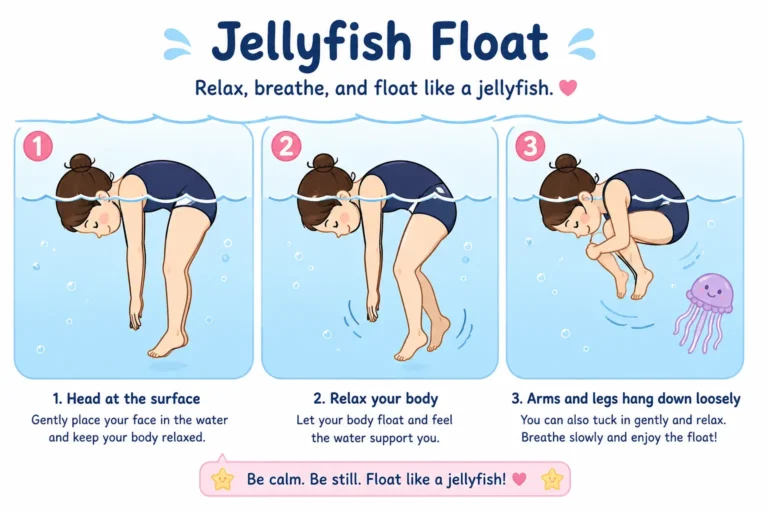
A child who cannot regulate breathing will struggle to float calmly. Anxiety causes shallow breathing, chin lifting, and full-body tension. Before back float work becomes successful, many children need simple breathing practice in the water. That may include blowing bubbles, humming with the mouth in the water, or learning to take a relaxed breath before leaning back.
Without this step, floating practice often turns into a cycle of panic and resistance. With it, the child starts to feel that water is manageable rather than threatening.
Head and neck position matter more than parents expect
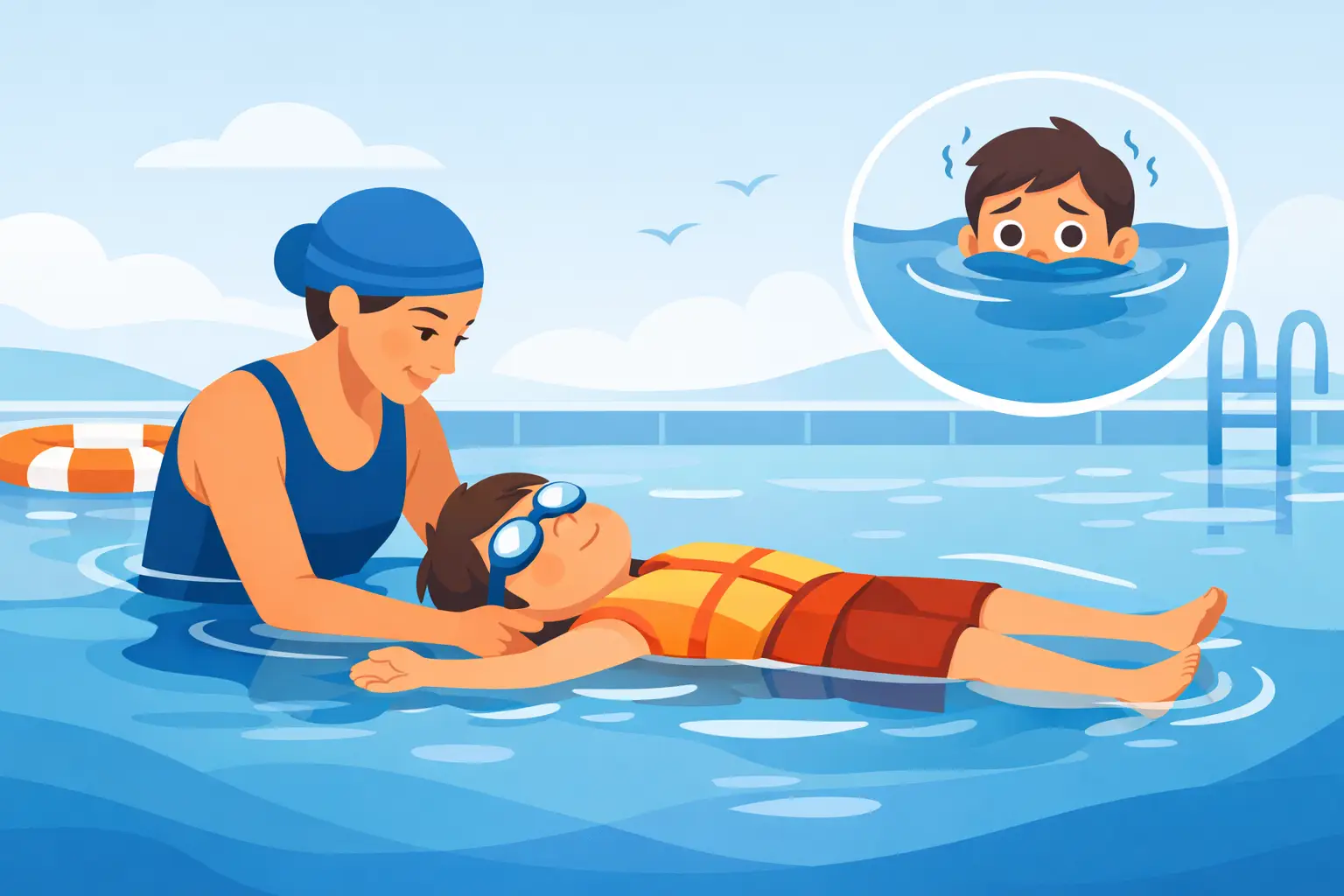
Nervous children often try to sit up in the water. They drive the chin forward, tense the neck, and look for the nearest adult. Unfortunately, that posture makes floating harder. A more effective position is a quiet head, relaxed neck, and eyes looking upward.
This is one reason verbal instruction alone rarely works with beginners. Telling a child to “relax” is not enough. They need physical support, repetition, and time to feel what a supported floating posture actually is.
Stillness is a learned skill
Many anxious swimmers kick harder when they feel unstable. It is an understandable reaction, but constant movement can make the body less balanced. Floating often improves when the child learns controlled stillness for short periods.
At first, this may only be one or two seconds. That is still progress. In structured lessons, short successful attempts usually build confidence faster than long attempts that end in fear.
How to teach floating without increasing fear
The safest path is gradual. A nervous child does not need to “just try it.” They need a predictable sequence that turns the unknown into something familiar.
Start where the child can already succeed. If they are comfortable standing in shallow water, begin there. If they trust holding the pool edge, use that security. If they only tolerate support from a coach or parent, accept that starting point and build from it.
A common progression is assisted back support with the child’s ears near the water, followed by brief supported floats, then reduced support over time. For some children, front floating with face support or noodle-assisted positioning may feel easier first. It depends on the child’s fear pattern. A child who dislikes water near the face may resist front floating. A child who fears leaning backward may prefer front support at the start.
Language matters as much as technique. Clear, calm instructions work better than too many words. Nervous children respond well to short cues such as “head back,” “big breath,” and “I’ve got you.” When adults talk too much, children often focus on the pressure instead of the task.
Mistakes that slow down floating progress
Parents usually mean well, but a few common habits can make floating harder.
The first is rushing to independence. If support is removed too early, the child learns that floating is unsafe. Rebuilding trust after that can take longer than a patient first progression.
The second is praising bravery while ignoring technique. Encouragement matters, but it should connect to a specific action. Saying “good job keeping your head still” or “nice calm breathing” teaches the child what success looks like.
The third is comparing siblings or classmates. Nervous swimmers already feel behind. Comparison increases tension, and tension works against buoyancy and control.
The fourth is practicing only when the child is already upset. Floating skills improve best when the child is regulated, warm, and mentally ready. If a child is crying, shivering, or overloaded, it may be better to step back to a simpler skill that restores confidence.
What progress really looks like
Parents often expect a clear breakthrough moment. Sometimes that happens. More often, confidence builds in layers.
One lesson might produce a child who allows ear contact with the water. The next might bring a three-second supported float. A later lesson might be the first time the child keeps the body quiet without grabbing. These small changes matter because they show that the nervous system is learning safety in the water.
This is especially important for children in formal swim pathways. Floating is not an isolated beginner task. It supports recovery position, body awareness, breathing control, and later water survival skills. In a structured program, those early floating gains help children progress more effectively into gliding, kicking, deep-water confidence, and test-based requirements.
When group lessons help and when private support is better
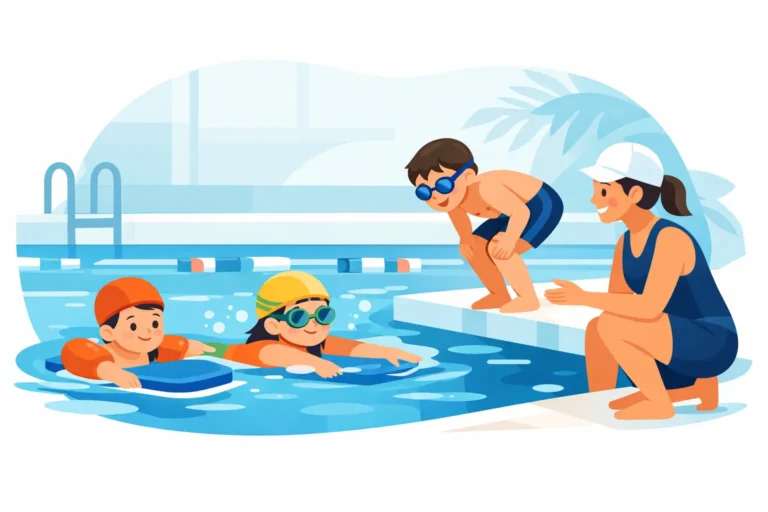
There is no single answer for every child. Group lessons can be excellent for nervous swimmers who benefit from routine, peer modeling, and regular repetition. Seeing other children practice calmly can reduce uncertainty. A well-structured class also creates consistency, which many anxious learners need.
Private lessons may be the better option when fear is strong, progress has stalled, or the child needs more individualized pacing. Some children simply require more time on pre-floating foundations than a group setting can provide. That is not a setback. It is targeted support.
This is where an experienced swim school makes a real difference. AQZOG, for example, builds progression through structured teaching rather than pressure, which is especially important for children who need confidence before independence.
What parents can do between lessons
Support at home starts with expectations. Do not frame floating as something the child must master immediately. Frame it as a skill they are learning step by step.
Use calm language before class. Avoid saying things like “Today you must float by yourself.” A better approach is, “Today, let’s practice being calm in the water.” That reduces performance pressure and keeps the focus on progress.
After class, ask specific questions that reinforce learning. Instead of “Why were you scared?” try “What part felt easier today?” This helps children notice improvement, even when it seems small.
If you practice outside of lessons, keep sessions short and successful. End on a positive repetition rather than waiting until the child becomes tired or frustrated. Confidence grows when the child remembers success, not struggle.
The bigger goal behind floating
Floating is often taught as a beginner milestone, but for nervous children it means much more. It teaches that stillness can be safe, that breathing can stay controlled, and that water does not always need to feel urgent. Those lessons carry forward into every other stage of swimming.
A child who learns to float with trust and control is not just completing a basic skill. They are building the base for safer decisions in the water, stronger learning in future lessons, and real confidence that lasts beyond one class.
If your child is hesitant, slow progress does not mean poor progress. In swimming, the strongest foundations are often built quietly. Give the skill time, keep the teaching structured, and let confidence grow at the pace your child can truly hold.