Children Swimming Progression Chart Explained
A child who can jump in happily is not always a child who is ready to swim independently. That is why a children swimming progression chart matters. It gives parents a clearer way to measure real development – not just comfort in the water, but safety skills, stroke control, breathing, and readiness for formal benchmarks such as SwimSafer.
Many parents ask the same question after a few lessons: Is my child progressing at the right pace? The honest answer is that progress is never perfectly linear. Some children learn to kick quickly but struggle with breathing. Others gain confidence slowly, then improve rapidly once they trust the coach and understand body position. A good chart does not force every child into the same timeline. It shows the order of skill development that leads to safe, strong swimming.
What a children swimming progression chart should actually measure
The most useful chart is not based on age alone. Age helps, especially for attention span, coordination, and emotional readiness, but swimming ability should be tracked by observable skills. Parents should look for progression in four areas: water confidence, survival ability, movement control, and formal stroke development.
Water confidence is the foundation. This includes entering the pool calmly, wetting the face, blowing bubbles, submerging, floating with support, and moving short distances without panic. A child who still fears water in the eyes or ears is not behind. That child simply needs more foundation work before advanced skills can hold.
Survival ability comes next. This is where swimming becomes a life skill rather than an activity. A proper progression chart should include safe entry, resurfacing after submersion, back float recovery, turning to the wall, and basic propulsion to safety. These skills matter more than whether freestyle arms look polished.
Movement control is the stage where children begin coordinating kicking, breathing, streamline position, and directional movement. They learn how to travel with purpose instead of splashing forward. This is often the point where parents start to see clear improvement from week to week.
Formal stroke development comes later. Freestyle, backstroke, breaststroke, and butterfly should be introduced only when the child has enough control, balance, and breathing ability to learn proper mechanics. Pushing strokes too early often creates bad habits that take longer to correct.
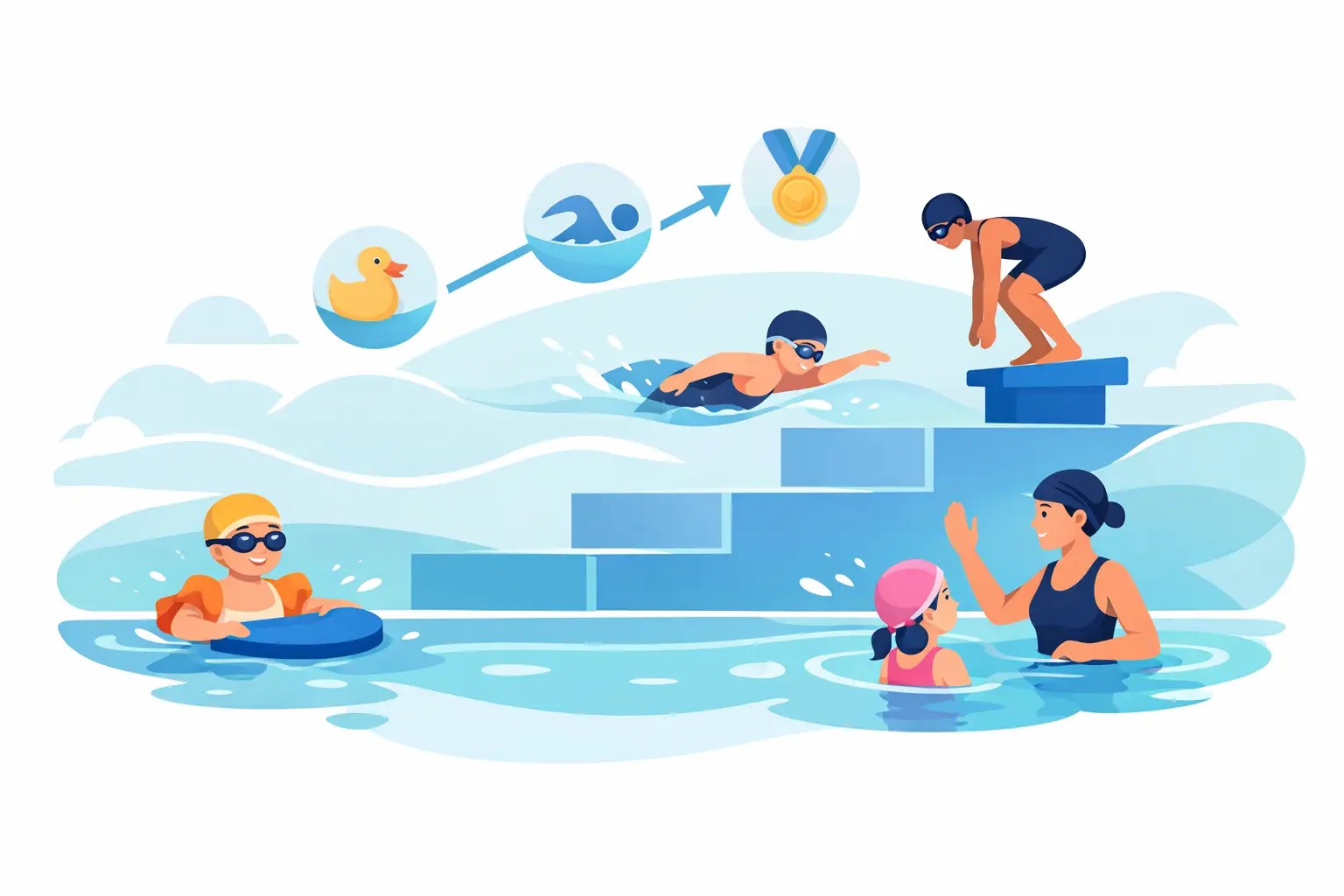
A practical children swimming progression chart by stage
Stage 1: Water adjustment
At this stage, the goal is trust. The child learns to enter the water safely, hold the poolside, move with assistance, kick while supported, and put the face in the water. Breathing control usually begins with bubbles and simple submersion games.
This stage may look basic to adults, but it is essential. Without it, later skills become inconsistent because the child is still managing fear. For toddlers and younger beginners, this phase can take longer, and that is normal.
Stage 2: Independent water confidence
Here, the child begins to float with help, glide short distances, and move through the water with less physical support. They may practice front float, back float, simple kicking on the front and back, and standing up after a glide.
A key marker in this stage is recovery. If a child loses balance in the water, can they regain it calmly? That matters more than how far they can travel. Confidence is not just willingness. It is the ability to respond safely.
Stage 3: Basic survival and propulsion
This is one of the most important stages on any progression chart. The child learns to push off, kick forward independently, roll or recover to breathe, and return to the wall or a safe point. Jumping in and turning back to safety often appears here too.
For many parents, this is the point where swimming starts to feel functional. The child is no longer just participating in lessons. The child is developing real safety responses.
Stage 4: Stroke foundations
Once survival skills are reliable, coaches can build more structured movement. The child works on streamline, flutter kick, back kick, side breathing, arm recovery, and timing. Backstroke and freestyle usually develop first because they build on earlier floating and propulsion skills.
This stage requires patience. Children often improve one part at a time. Strong kicking with poor breathing is common. So is good arm movement with weak body alignment. A structured coach corrects the sequence instead of trying to fix everything at once.
Stage 5: Stroke development and endurance
Now the child begins swimming longer distances with better technique and less assistance. Freestyle and backstroke become more consistent. Breaststroke timing may be introduced, followed later by more advanced coordination work.
Endurance starts to matter here, but quality still comes before distance. A child who can swim 25 yards with control is in a better place than a child who covers more distance with poor breathing and sinking hips.
Stage 6: Test readiness and formal progression
At this stage, the swimmer is preparing for structured assessments such as SwimSafer benchmarks. Skills are no longer taught in isolation. They are combined into a clear progression pathway that includes entries, recoveries, stroke distance, water safety knowledge, and task completion under test conditions.
This is where experienced instruction makes a major difference. Test readiness is not only about passing. It is about performing skills consistently, under supervision, with correct standards.
Why children move through the chart at different speeds
Parents often compare progress between siblings, classmates, or friends from school. That comparison rarely helps. Swimming progression depends on water exposure, confidence level, body coordination, listening skills, attendance consistency, and coaching quality.
A child attending weekly lessons with regular practice usually progresses faster than a child with irregular attendance. A child who is physically confident may glide early but need more time with breathing. Another child may be cautious at first and then advance quickly once the foundation clicks.
This is why the best swim programs do not promote progress by age alone. They teach by readiness and skill mastery. That approach protects technique and improves long-term results.
What parents should look for beyond distance
Distance is easy to notice, so it often becomes the default measure. But distance can be misleading. A child may move across the pool using inefficient kicking, poor breathing, and a rushed stroke pattern. That looks impressive for a moment, yet it does not always translate into safe or sustainable swimming.
Parents should also watch for calm breathing, body balance, ability to recover after a mistake, and willingness to repeat a skill correctly. These are stronger signs of genuine development. A structured program should be able to explain exactly what your child is working on now and what comes next.
If progress seems slow, ask whether the child is consolidating a key skill. Plateaus are common before breakthroughs. A short period focused on floating or breathing may be what allows proper stroke learning later.
How a progression chart supports SwimSafer success
In Singapore, many families want lessons that lead naturally into SwimSafer stages. That only works when the child has already built the right sequence of foundations. A progression chart helps coaches identify whether the swimmer is truly ready for entries, survival sequences, stroke requirements, and assessment tasks.
When progression is structured, there are fewer gaps. The child does not reach test preparation still struggling with submersion or body position. Instead, each stage supports the next one. That creates better confidence, cleaner technique, and stronger test performance.
This is also why schools like AQZOG place so much emphasis on step-by-step instruction. Fast results are valuable, but only when they are built on skills that hold up under pressure.
When to reassess your child’s current stage
If your child has attended lessons for months but still shows high anxiety, cannot recover to standing or floating, or has not developed any consistent propulsion, it may be time to reassess the teaching approach. That does not always mean the child is not capable. It may mean the lesson format, class size, or progression sequence is not the right fit.
The opposite can happen too. Some children stay too long at a beginner level because no one has formally checked readiness for advancement. A clear progression chart prevents both problems. It protects children from being rushed, and it also prevents them from being held back unnecessarily.
A well-taught swimmer is not just one who can move through water. It is one who understands how to stay calm, recover, breathe, and respond safely. If you use a children swimming progression chart in that way, you stop asking, How far can my child swim today? and start asking the better question: What can my child do safely and confidently next?