Cross Training for Biathlon That Builds Durable Fitness
A biathlete can feel strong on skis and still lose time when the heart rate spikes at the range. That is why cross training for biathlon should not be treated as extra exercise to squeeze into an already busy week. It is structured preparation for the demands that skiing and shooting place on the body: aerobic endurance, leg strength, balance, coordination, composure, and efficient recovery.
For developing athletes, the goal is not to become good at every sport. The goal is to build a more capable body that can handle quality ski sessions, maintain stable shooting form under fatigue, and stay healthy through a long training season. The best plan is progressive, measurable, and appropriate for the athlete’s age, training history, and competition calendar.
What Cross Training for Biathlon Should Improve
Biathlon combines prolonged endurance work with a task that demands control and precision. An athlete must move efficiently over varied terrain, then slow the breathing, settle the body, and execute a consistent shooting routine. Cross training should support all parts of that sequence.
First, it should expand aerobic capacity without adding excessive impact. Second, it should develop strength in the hips, legs, trunk, shoulders, and upper back, where stable skiing mechanics and range posture begin. Finally, it should improve movement quality. A young athlete who can balance, land, rotate, and control posture well is better prepared to learn technical skills safely.
The right mix depends on the season. During the off-season, cross training may take a larger role while ski-specific volume is lower. As races approach, it should become more targeted and less tiring. Training that leaves an athlete too fatigued for ski technique, recovery, school, or sleep is not productive preparation.
Build Fitness Around the Three Main Demands
Aerobic endurance without unnecessary wear
Running, cycling, swimming, hiking, rowing, and roller skiing can all build endurance. The best choice depends on access, injury history, weather, and the athlete’s technical ability. Running is convenient and useful for developing resilience, but too much fast or downhill running can overload the calves, knees, and shins. Cycling offers a low-impact way to add aerobic time, while hiking builds climbing strength and confidence on uneven terrain.
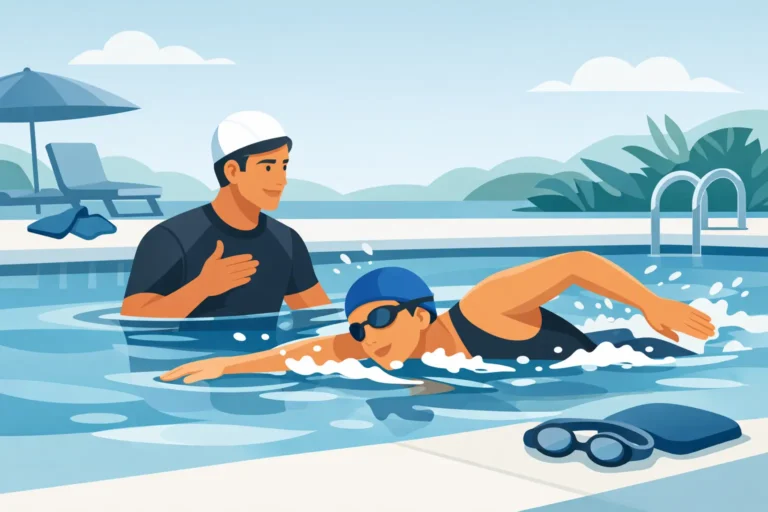
Swimming is especially valuable when athletes need conditioning with minimal joint stress. It encourages steady breathing, shoulder mobility, and full-body coordination. It is not a replacement for skiing, but it can be an excellent recovery-day aerobic session or an alternative when an athlete is managing impact-related discomfort. Athletes who are not confident swimmers should learn in a structured setting before using longer pool sessions as training.
Most endurance cross-training sessions should remain easy enough to hold a conversation. This develops the aerobic base that supports repeatable training and helps athletes recover between harder sessions. Save high-intensity work for planned days rather than turning every bike ride, run, or swim into a test.
Strength for powerful, stable skiing
Biathletes need force, but they also need control. A strong squat is useful only if the athlete can keep the knees, hips, and trunk aligned. A powerful upper body is useful only if it supports efficient poling rather than creating shoulder tension.
A well-supervised strength program should prioritize movement patterns: squatting, hinging, stepping, pushing, pulling, carrying, and rotating with control. Younger athletes can begin with bodyweight squats, split squats, bridges, crawling patterns, push-ups, and rows. As technique becomes reliable, resistance can be increased gradually through dumbbells, bands, medicine balls, or appropriately coached barbell training.
Single-leg work deserves special attention. Skiing is a series of controlled transfers from one leg to the other, often while climbing, cornering, or responding to uneven snow. Step-ups, reverse lunges, single-leg Romanian deadlifts, and lateral bounds can improve strength and alignment when introduced progressively. Quality repetitions matter more than heavy loads or complicated exercises.
Balance, coordination, and calm under fatigue
A biathlete does not need circus-style balance drills. The purpose of balance work is to create better body awareness and more stable positions. Simple exercises such as single-leg stands, controlled hops, lateral movement drills, and mobility work can build this foundation.
Add coordination when the athlete is ready. For example, a short easy run or bike interval can be followed by a pause for controlled breathing, posture reset, and a low-stress precision task. This teaches the athlete to shift from effort to calm. Actual shooting practice must always take place only at an approved facility under qualified coaching and all relevant safety procedures. Cross training can support range composure, but it never replaces formal shooting instruction.
The Most Useful Cross-Training Options
The most effective program usually uses a small number of activities consistently rather than changing activities every week. Cycling, swimming, trail hiking, strength training, and mobility-based recovery each have a clear role.
Cycling is ideal for adding endurance volume when an athlete needs to reduce running impact. Keep most rides steady, with a smooth cadence and controlled effort. A hillier ride can develop leg strength, but it should not replace all ski-specific climbing work.
Swimming provides low-impact conditioning and can improve comfort with steady, rhythmic breathing. Use technique-focused swimming for recovery or longer easy intervals for aerobic development. A hard swim session can still create fatigue, so it should be scheduled with the same care as any other workout.
Trail hiking develops time on feet, climbing tolerance, ankle strength, and confidence over varied terrain. It is particularly useful for athletes who are too young for high-volume running or who need a lower-intensity outdoor session. Poles can be included when they help reinforce posture and uphill rhythm.
Strength training is the clearest way to address weak links. If an athlete loses posture late in races, struggles on climbs, or has recurring knee discomfort, a coach should assess movement quality and build a focused plan instead of simply adding more endurance miles.
Mobility and recovery work should be simple enough to repeat. A short routine for ankles, hips, thoracic spine, and shoulders can protect movement quality when training volume rises. Consistency beats an occasional long stretching session.
A Weekly Structure That Protects Progress
A developing biathlete may do two strength sessions per week, two to four aerobic cross-training sessions, and regular mobility work, alongside ski and shooting practice. The exact total depends on age, experience, and the overall schedule. For a newer athlete, two short strength sessions and one easy aerobic alternative may be enough.
Avoid stacking demanding sessions without a reason. A hard hill run followed by heavy lower-body strength work can compromise technique and increase soreness. Pair harder work with adequate recovery, then use easy cycling, swimming, walking, or mobility on the following day if needed.
One practical approach is to place strength training after an easier ski session or on a separate day from interval work. Keep at least one lower-load day each week. Young athletes especially need room for growth, school responsibilities, social time, and consistent sleep. Progress is built during recovery, not only during workouts.
Track Results, Not Just Training Hours
A structured program should produce visible markers of improvement. Athletes and parents can monitor how easily an athlete completes an easy endurance session, how well posture holds during single-leg exercises, how quickly breathing settles after effort, and whether soreness disappears within a reasonable period.
Keep a simple training record with session type, duration, effort level, sleep quality, and any pain or unusual fatigue. This makes it easier to spot problems early. A sudden drop in motivation, persistent soreness, declining school energy, or disrupted sleep is a signal to reduce load and seek guidance from a qualified coach or health professional.
Cross training is most valuable when it makes ski practice more productive, not when it becomes a separate competition. Build capacity patiently, protect technique, and give recovery the same attention as hard work. When the athlete arrives at the start line with strong legs, steady breathing, and confidence in their preparation, the training has done its job.