Does My Child Need Swimming Lessons?
A lot of parents ask the same question right after a beach trip, a pool party, or a shaky first experience in the water – does my child need swimming lessons? In most cases, the answer is yes, not because every child needs to become a competitive swimmer, but because water safety is a life skill. The real question is not whether lessons matter. It is when to start, what kind of instruction your child needs, and how to choose a program that builds real progress.
Why does my child need swimming lessons?
Swimming lessons are not only about learning strokes. A strong program teaches children how to move safely in water, stay calm, follow instructions, and respond when they lose balance or feel unsure. For parents, that matters far more than whether a child can do a perfect freestyle.
Children are naturally curious, and water is part of daily life for many families. Pools, water play areas, vacations, and school activities all create moments where confidence in the water becomes essential. A child who has never been taught what to do in water may panic quickly. A child with structured lessons is more likely to understand breath control, floating, basic propulsion, and safe pool behavior.
That does not mean lessons remove all risk. Adult supervision is still necessary at every age. But proper instruction lowers risk and gives children practical skills they can use instead of relying on luck or instinct.
The strongest reason is safety
Parents sometimes wait because their child is still young, still nervous, or not showing much interest. That hesitation is understandable. But water safety is exactly why many children should start earlier than parents expect.
A child does not need to love the water before beginning lessons. In fact, lessons often help a child become comfortable in a structured, controlled way. Good instruction introduces the water step by step. That progression matters. Random exposure can create fear. Guided exposure builds confidence.
Safety-focused lessons typically begin with simple but critical skills: entering and exiting the pool safely, blowing bubbles, holding the wall, kicking with support, floating on the back, and turning to recover. These may look basic from the pool deck, but they are the foundation of survival and future swimming ability.
When should children start?
There is no single perfect age for every child. Readiness depends on age, maturity, comfort level, and the lesson format. Some toddlers benefit from early water introduction with a parent nearby. Preschoolers often respond well to short, structured instruction. School-age children can usually progress faster because they can follow directions more consistently.
The mistake is assuming there is a narrow window. Starting at 3 can work well. Starting at 6 can work well. Starting later is still worthwhile. The key is matching the teaching method to the child in front of you.
If your child is very young, the goal may be water familiarity and safe habits rather than independent swimming right away. If your child is older, the focus may shift more quickly to breath control, floating, kicking, and coordinated movement. Structured programs are effective because they adjust expectations by developmental stage instead of pushing the same outcomes on every beginner.
Signs your child should start now
Some parents are unsure because their child seems fine around water. But comfort is not the same as skill. If your child enjoys splashing, jumps in without thinking, clings tightly in the pool, or cannot recover after getting water on the face, lessons are a smart next step.
The need is even more urgent if your child has regular exposure to pools, takes family vacations near water, or is approaching school programs that include swim assessments. In these cases, learning later can create more pressure. Learning now gives your child time to build confidence properly.
Another sign is inconsistency. If your child can paddle a little but cannot float, breathe comfortably, or move independently for more than a short distance, there are still gaps in safety. Many children look more capable than they really are. Structured assessment helps identify what they can actually do, not just what they attempt.
What if my child is afraid of the water?
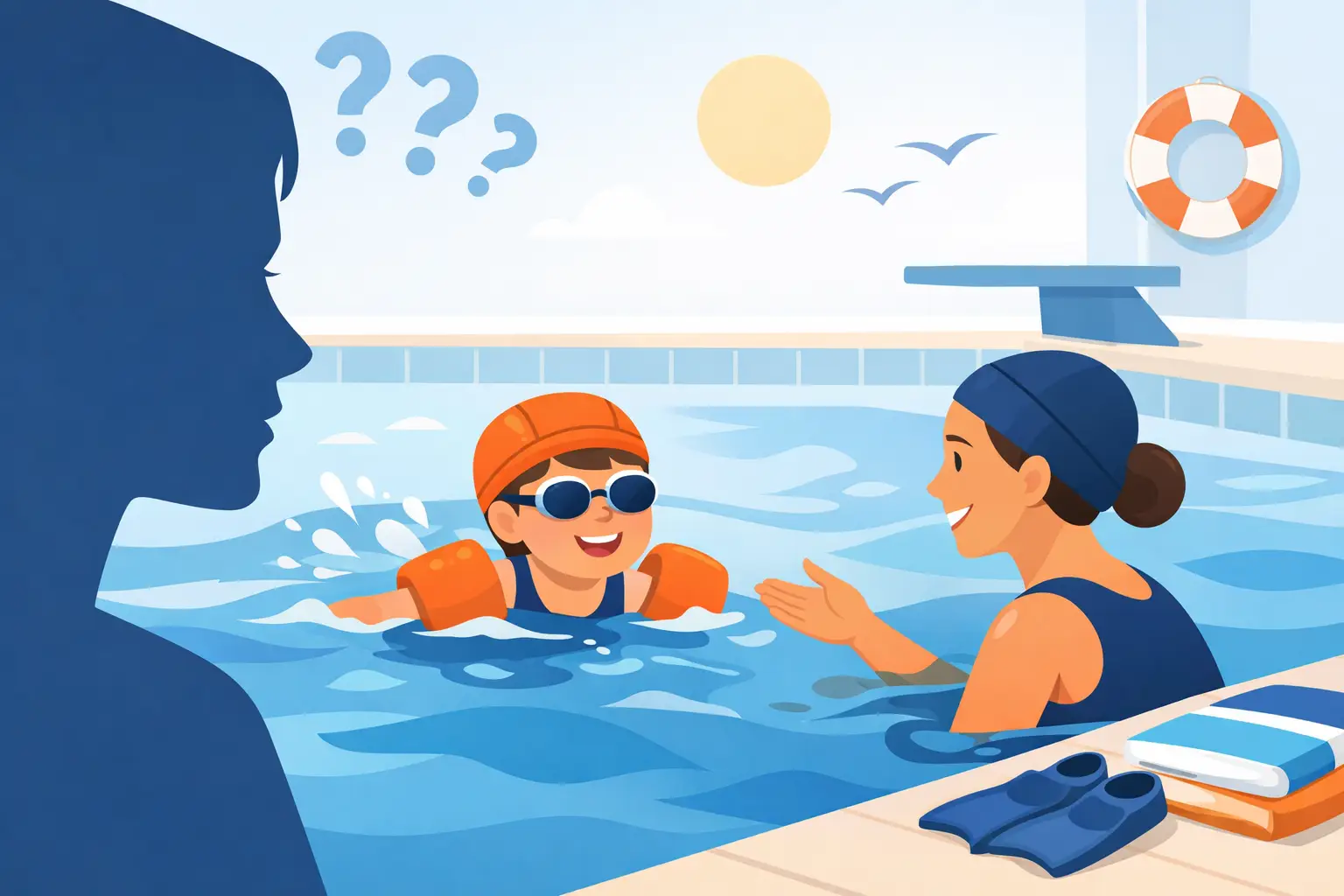
This is one of the most common concerns, and it is where quality coaching makes a major difference. Fear does not mean a child is not ready. It means the teaching approach must be patient, progressive, and clear.
Children who are anxious often need predictable routines and small wins. That may start with sitting on the pool edge, splashing with control, wetting the face gradually, or learning to exhale in the water. Once trust is built, progress usually becomes much smoother.
What does not work well is rushing, comparing, or forcing performance. A nervous child who is pushed too hard may resist lessons longer. A child who feels safe with the coach is more likely to cooperate, try again, and improve. Results still matter, but the path to results has to be managed correctly.
Group lessons or private lessons?
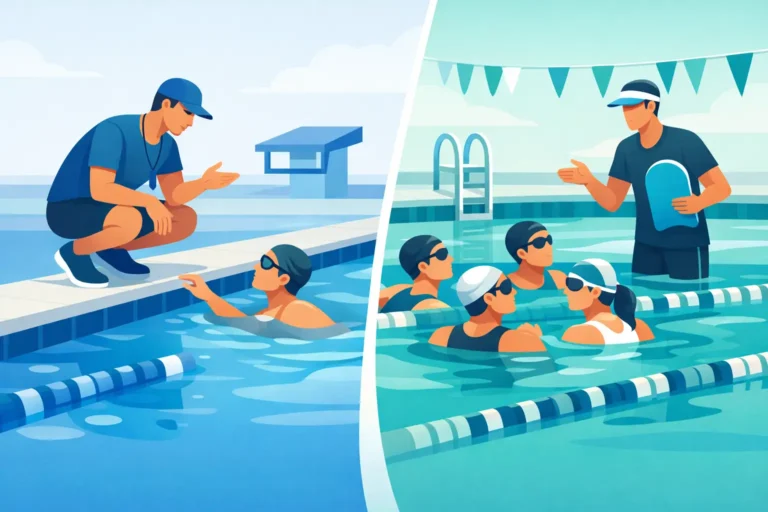
It depends on your child’s personality, confidence, and goals. Group lessons work well for many children because they create routine, social motivation, and steady progression at a reasonable pace. They are especially useful for children who can follow instructions and learn comfortably alongside peers.
Private lessons can be the better option if your child is highly anxious, needs faster correction, has very limited water experience, or is preparing for a specific test standard. One-to-one coaching allows the instructor to adapt every minute of the lesson to your child’s needs. That can speed up early breakthroughs, especially in breathing, floating, and coordination.
Some families begin with private instruction to build confidence, then move into group classes for continued progression. That blend often works well when the first goal is reducing fear and the second goal is developing consistent skill.
Why structured progression matters
One of the biggest differences between casual exposure and real swimming education is progression. Children do not become safer just by spending time in the pool. They improve by learning skills in the right order, practicing them consistently, and moving forward only when they are ready.
A structured program gives parents something important: visible benchmarks. You can see whether your child is learning breath control, floating, kicking, arm action, recovery skills, and distance management. You can also see whether they are becoming more independent and test-ready over time.
This is especially relevant for families who want outcomes beyond basic comfort. In a progression-based system, children work toward measurable standards rather than repeating the same play-based activities without advancement. That creates confidence for both the child and the parent.
Does my child need swimming lessons if we already supervise closely?
Yes. Close supervision is essential, but it is not a substitute for skill. Adults can reduce risk, but they cannot give a child water competence by watching from nearby.
Supervision also has limits. Children move quickly. Busy environments create distractions. Relatives may assume someone else is watching. Lessons help children become less dependent on ideal conditions and more capable when something unexpected happens.
That is why experienced swim schools treat swimming as an essential life skill, not just an enrichment activity. Safety habits, survival responses, and progressive skill development belong together.
What should parents look for in a lesson program?
Look for a program that teaches with structure, not guesswork. The coach should be able to explain what your child is working on, what comes next, and how progress is measured. Safety should be built into every stage, not treated as a separate topic.
It also helps to choose a school that understands formal progression and assessment standards. For families who want a clear path from beginner skills to stronger swimming and certification readiness, that experience matters. In Singapore, AQZOG has built its reputation around exactly that kind of structured development, with safety, confidence, and measurable progress at the center.
You should also pay attention to your child’s response. A good program challenges children, but it also builds trust. After a few lessons, most children should show some form of progress, whether that is better comfort, better listening, improved floating, or more controlled movement.
The better question to ask
Instead of asking whether your child needs swimming lessons, ask what water skills you want your child to have six months from now. If the answer includes safety, confidence, independence, and steady progress, lessons are the practical next step.
Children do not need to be fearless before they begin. They do not need perfect coordination, and they do not need to be naturally sporty. They need a safe environment, a qualified instructor, and a structured path that turns uncertainty into skill. Starting sooner gives that process more room to work, and that is often what gives parents the greatest peace of mind.
🟦 Useful FAQs – Does My Child Need Swimming Lessons?
1. At what age should my child start swimming lessons?
Most children can begin structured swimming lessons from 4 years old, when they are able to follow instructions and learn independently.
However, babies and toddlers (6 months onwards) can start with water familiarisation and parent-assisted classes.
2. Is swimming really necessary for children in Singapore?
Yes. In Singapore, swimming is considered a critical life skill, not just an enrichment activity.
With easy access to pools, beaches, and water activities, learning to swim helps reduce drowning risks and improves water safety awareness.
3. My child is afraid of water. Should I still enroll them?
Absolutely. Fear of water is very common.
A structured beginner program (like SwimSafer Stage 1) focuses on building confidence first, before teaching strokes.
4. What if my child cries or refuses to participate?
This is normal in the early stages. Children need time to adapt.
Experienced coaches use progressive exposure, games, and trust-building techniques to help children feel safe and comfortable.
5. Can my child learn swimming without lessons?
While informal learning is possible, structured lessons provide:
Proper technique
Safety knowledge
Progressive skill development
Qualified supervision
Without guidance, children may develop poor habits or unsafe behaviours.
6. How long does it take for a child to learn swimming?
Every child progresses differently, but a general guide is:
Stage 1 (Water Confidence): 1.5–3 months
Stage 2 (Basic Skills): 2–4 months
Stage 3 (Stroke Introduction): 3–5 months
Consistency is key to faster progress.
7. What will my child learn in swimming lessons?
Children will learn:
Water confidence and floating
Breathing techniques
Basic strokes (freestyle, backstroke)
Survival skills and safety awareness
How to stay calm in water emergencies
8. Do swimming lessons help prevent drowning?
Yes. Swimming lessons significantly improve a child’s water competency, which includes:
Floating
Turning and moving in water
Safe entry and exit
These are essential survival skills that can reduce drowning risk.
9. How often should my child attend lessons?
Most children attend once a week, but faster progress can be achieved with:
2–3 sessions per week
Holiday intensive programs
Consistency matters more than frequency alone.
10. Do parents need to join the lesson?
Toddlers (below 4): Parent-assisted classes are common
Age 4 and above: Children usually learn independently under coach supervision
11. What if my child is already active and sporty?
Swimming complements other sports by improving:
Coordination
Lung capacity
Muscle endurance
It also provides a lifelong safety skill, unlike many other activities.
12. Is swimming part of the school curriculum in Singapore?
Yes. Swimming is strongly encouraged under the MOE SwimSafer Programme, which many schools implement as part of water safety education.
13. What should my child bring for swimming lessons?
Basic items include:
Swimwear
Towel
Goggles
Swim cap
Water bottle
14. Will my child get certified?
Yes. Upon meeting the required skills, your child can take the SwimSafer assessment and receive certification.
15. What are the benefits of starting swimming early?
Children who start early:
Are more confident in water
Learn faster
Develop better motor skills
Adapt better in school swim programs
Carry survival skills into adulthood
16. Is swimming only for children who like water?
No. Swimming is especially important for children who:
Fear water
Have never been exposed
Are frequently near pools or beaches
These children benefit the most from structured