History of Swimming Pool in Singapore
History of Swimming Pools in Singapore
Introduction
Swimming has long been part of Singapore’s culture, from seaside bathing in colonial times to today’s sleek ActiveSG complexes spread across every housing estate. The history of public swimming pools here tells a fascinating story about the island’s development: how a colonial trading port became a modern city that placed sports, health, and recreation within easy reach of its people.
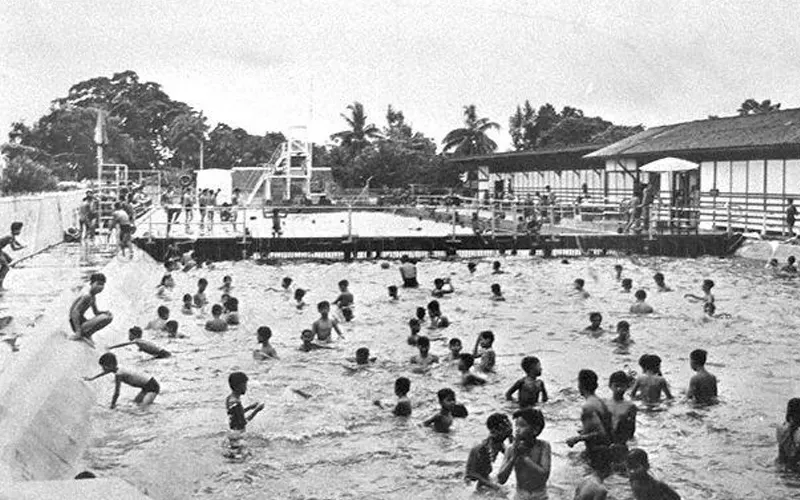
(Insert picture: A vintage black-and-white photo of Singapore’s first swimming pool at Mount Emily in the 1930s)
Swimming Before Pools: Clubs and the Sea (1800s–1920s)
Before there were proper pools, Singaporeans swam in the open sea or in club facilities. The Singapore Swimming Club, founded in 1894 at Tanjong Rhu, catered mostly to European residents and was one of the earliest organisations to formalise aquatic activities. On the other side of town, the Chinese Swimming Club began in 1905, serving the Peranakan and Chinese community at Marine Parade.
At this stage, swimming was still seen as a pastime for the privileged. Most ordinary people simply swam at the beach. Municipal “bathing pagars” — fenced enclosures in the sea — were introduced in the early 1900s to provide safe bathing spots. The most famous, Katong Park Bathing Pagar, opened in 1931 and became a weekend favourite for families.
(Insert picture: Katong Park Bathing Pagar with children playing in the sea enclosure, circa 1930s)
The Birth of Public Pools: Mount Emily (1931)
Singapore’s first true public swimming pool was Mount Emily Swimming Pool, opened on 10 January 1931. Converted from an old reservoir near Little India, it was a civic milestone. For the first time, everyday residents — not just club members — had access to a clean, chlorinated pool.
Mount Emily became immensely popular. By the mid-1930s, thousands of swimmers visited monthly. Entry fees were kept low, making swimming accessible to schoolchildren and working families.
However, public health was a concern. In 1948, a polio outbreak forced temporary closure. The authorities responded with upgraded filtration and chlorination systems, pioneering Singapore’s approach to safe public swimming.
Mount Emily thrived for decades but was eventually overshadowed by newer neighbourhood pools. It closed in 1981 and was demolished by 1984. Today, the site is a quiet green space — Mount Emily Park — but memories of the nation’s first pool remain strong.

(Insert picture: Old photo of Mount Emily Swimming Pool with swimmers lined up at the edge, 1950s)
Yan Kit and River Valley: The 1950s Expansion
As Singapore’s population grew, more pools were needed. In December 1952, the Yan Kit Swimming Complex opened in Tanjong Pagar. At its debut, it was the largest pool complex in Singapore, boasting separate pools for adults, learners, and divers. Its Art Deco design and central location made it a hub for decades, serving office workers, students, and entire families.
In 1959, the River Valley Swimming Complex was added. Located near Kim Yam Road, it became another beloved community pool, attracting huge weekend crowds. The sloped surroundings and busy urban backdrop gave it a unique charm.
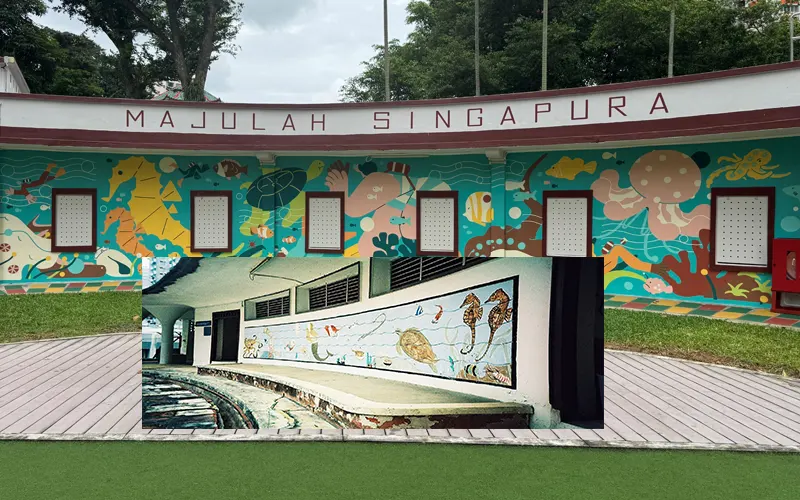
Both complexes eventually closed — River Valley in the early 2000s, Yan Kit in 2001 — but their legacies live on in the memories of generations who learned to swim there. Yan Kit has since been converted into a community playfield, complete with a heritage mural.

(Insert picture: Yan Kit Swimming Complex with swimmers in the learner pool, 1970s)
Swimming at Yan Kit Pool as a Child (Life experience)
When I think back to my childhood, one of the most unforgettable places that comes to mind is the Yan Kit Swimming Complex. My family would often bring me there, and for a child, those visits were filled with wonder and excitement. The atmosphere was always lively—families chatting, children splashing about, and the echo of water lapping against the pool walls. Yet, what etched itself deepest in my memory was not just the swimming, but the feelings the place inspired in me.
The diving pool was my favorite spot, even though I was far too young and inexperienced to be there. I can still picture the water—its blue was so vibrant, almost enchanting. It looked impossibly clear and deep, drawing me in with an irresistible pull. At that time, I did not even know how to swim properly, but the beauty of the water was enough to make me leap in without hesitation. I was fearless, though now I realize it was more a mix of innocence and ignorance of danger. The thought of what could have happened never crossed my mind. As a child, all I saw was a shimmering world of blue, waiting for me to dive into it.
The structure of Yan Kit Swimming Complex was nothing like the modern pools of today. Its walls and flooring were made of rough cement, unpolished and unforgiving. The surfaces were sharp in places, and I often went home with red marks, scratches, and skin abrasions as souvenirs of my time there. Back then, these little injuries seemed insignificant compared to the fun I had. They were almost like proof that I had truly thrown myself into the experience, quite literally.
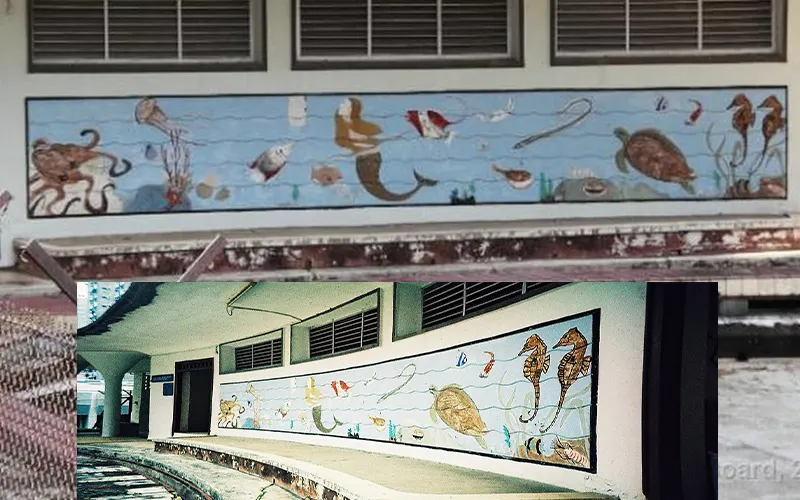
But beyond the physical pool, what makes Yan Kit unforgettable in my mind are the wall murals that surrounded it. The drawings of sea creatures—a seahorse, a turtle, and even a mermaid—captured my imagination. They were colorful, playful, and magical to my young eyes. Whenever I looked at them, I felt as though I was swimming not in an ordinary pool, but in some kind of underwater kingdom. Those paintings gave life to the place and made it more than just concrete and water. Even today, the images of that seahorse, the gentle turtle, and the elegant mermaid remain vivid in my memory. They were part of the identity of Yan Kit, symbols that added a touch of fantasy to the otherwise rough and rugged complex.
Looking back now, I realize how much those visits shaped my love for water. Yan Kit was not perfect; it was rough around the edges, sometimes even harsh. Yet, in its imperfections lay its charm. It was a place where families gathered, where children discovered both joy and risk, and where imagination was sparked by simple murals on a wall. Though the complex is long gone, it remains alive within me, preserved through the memories of that dazzling blue water and the timeless drawings that watched over us as we swam.
The roughness of the environment never took away from the excitement. In fact, it gave Yan Kit a certain raw authenticity. It was not just a swimming complex; it was a gathering place. Families bonded there, children learned to overcome their fear of water, and friendships were formed along the poolside. For me, it was where I first developed a love for the water—a fascination that began with simply admiring the pool’s color and later grew into a lifelong connection with swimming.
As I think about it now, I realize how much that place shaped my perspective. It taught me that beauty can be found in the simplest of things, even in a patch of blue water shimmering under the sun. It also reminds me of how fragile and fearless childhood can be, how a child’s curiosity often outweighs their understanding of safety. Yan Kit Swimming Complex may no longer exist, but the memories I hold of it remain sharp, just like the rough walls of the pool itself.
Nation-Building Pools: The HDB Era (1960s–1980s)
In the years after independence, Singapore prioritised sports and recreation as part of nation-building. Housing and Development Board (HDB) estates were designed with amenities to support healthy lifestyles, and swimming pools were central to this vision.
The Queenstown Swimming Complex, opened in the early 1970s, was one of the first estate-based pools. It became famous not only for recreational swimming but also as a venue for water polo training, producing players who dominated regional competitions.
Another landmark was the Farrer Park Swimming Complex. Known as the cradle of champions, it nurtured some of Singapore’s greatest swimmers, including world sprint champion Ang Peng Siong in the 1980s. Farrer Park was where many school meets and national selections were held, showing how public pools could serve both everyday swimmers and elite athletes.
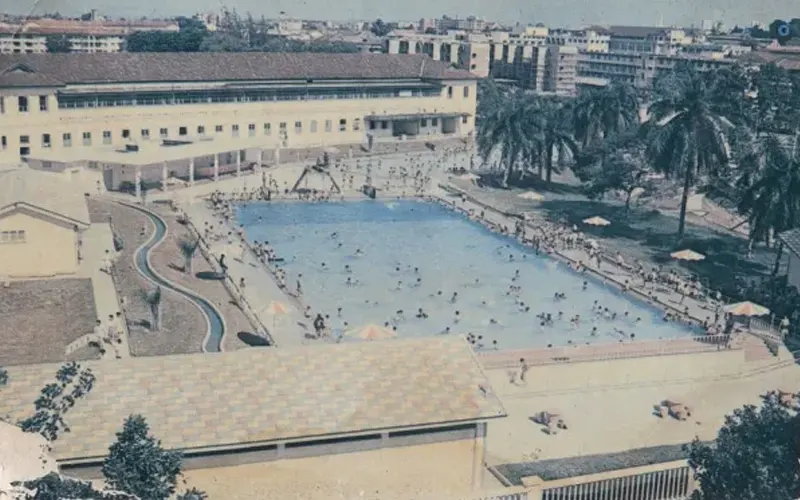
(Insert picture: Farrer Park Swimming Complex in the 1960s.)
By the 1980s, public pools had become a normal part of life. Toa Payoh, Jurong, Bedok, and other towns each had their own complexes. Swimming was no longer a luxury; it was a public service. Affordable entry fees, school programmes, and the later SwimSafer curriculum ensured that nearly every Singaporean child had the opportunity to learn swimming.

Clubs, Private Pools, and Leisure Parks
While public pools grew, private clubs continued to expand. The Chinese Swimming Club upgraded to a full Olympic-sized pool by 1939 and has since produced national athletes. The Singapore Swimming Club modernised its facilities too, maintaining its reputation as a competitive and social hub.
By the late 20th century, Singapore also saw the rise of leisure pools and waterparks. Places like Jurong’s “Big Splash” and later Wild Wild Wet at Downtown East offered slides, wave pools, and themed attractions. These coexisted with lap pools, showing how swimming culture diversified into both sport and recreation.
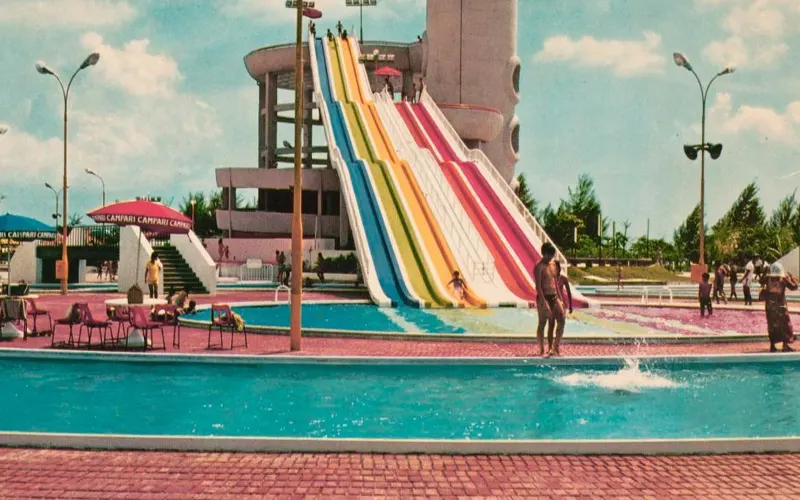
(Insert picture: Big Splash at East Coast, iconic water slides, 1980s)
Closures, Memories, and Heritage
As new ActiveSG complexes emerged, older pools were gradually retired. Mount Emily, River Valley, Yan Kit, and later Farrer Park were all closed. Each closure was met with nostalgia, as countless residents had childhood memories tied to these places.
Interestingly, Singapore has found ways to preserve their memory. Yan Kit became a playfield, complete with heritage boards. Farrer Park’s legacy lives on in archival photos and oral histories. And heritage groups continue to document the stories of swimmers, lifeguards, and coaches who kept these places alive.
(Insert picture: Heritage mural of Yan Kit Swimming Complex at Yan Kit Playfield – Before and After)
The Pools of Today
Today, Singapore’s swimming pools are part of the ActiveSG network, operated by Sport Singapore. Every major estate has at least one complex, often integrated with gyms and stadiums. Pools now feature learner-friendly designs, energy-efficient systems, and barrier-free access for all ages.
SwimSafer programmes ensure children are equipped with water survival skills, while competitive clubs train future champions. Seniors use pools for aqua aerobics and rehabilitation. From toddlers to national athletes, pools remain one of the most inclusive public spaces in the country.
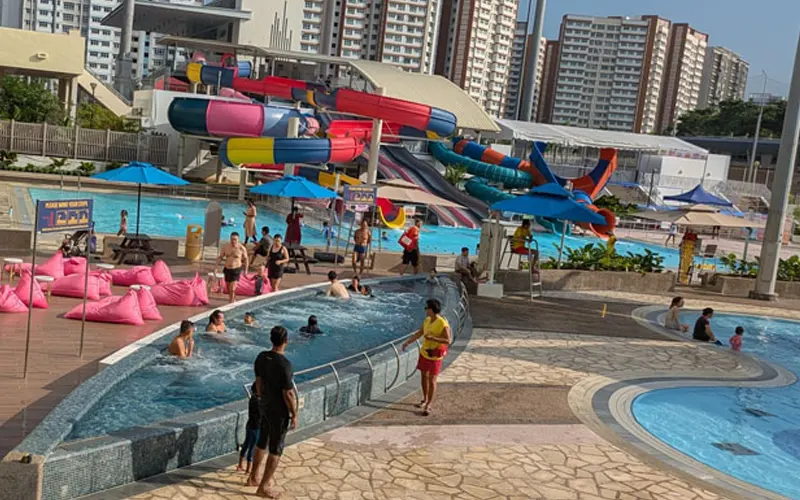
(Insert picture: A modern ActiveSG swimming complex with families and children in the pool, 2020s)– SengKang Activesg Pool Facilities.
Conclusion
The history of swimming pools in Singapore is more than just about sport. It reflects the nation’s growth from a colonial port to a modern city-state committed to community well-being.
- From sea bathing in Katong to the first public pool at Mount Emily, Singapore took its first steps toward safe, structured swimming.
- Yan Kit and River Valley expanded access, serving urban communities through the 1950s.
- Queenstown and Farrer Park showed how pools could nurture both everyday families and national champions.
- Today’s ActiveSG complexes continue this legacy, making swimming a lifelong activity for everyone.
Public swimming pools remain deeply woven into Singapore’s social fabric. They are places of learning, leisure, health, and heritage — reminders that beyond skyscrapers and expressways, Singapore has always been an island that finds joy and strength in water.