World Drowning Prevention Day 2026
Every 90 seconds, somewhere in the world, a person drowns. That staggering reality is why the United Nations designated 25 July as World Drowning Prevention Day — a global call to action observed each year to raise awareness, share life-saving knowledge, and ultimately stop preventable tragedies before they happen.
In 2026, the day falls on a Friday, 25 July, and carries a deeply personal theme: “Your Story Can Save a Life.”
What Is World Drowning Prevention Day?
World Drowning Prevention Day was officially established in April 2021 through United Nations General Assembly Resolution A/RES/75/273. Championed by the World Health Organization (WHO) and international lifesaving organisations, the annual observance brings together governments, health professionals, educators, communities, and families to spotlight one of the world’s most under-discussed public health crises.
Drowning ranks among the ten leading causes of death for children aged 5–14 globally. Over 236,000 people lose their lives to drowning every year — a toll that falls hardest on low- and middle-income countries, where rivers, lakes, open wells, and home water storage containers pose daily risks.
The most sobering fact? Over 85% of drowning deaths are entirely preventable.
The 2026 Theme: “Your Story Can Save a Life”
This year’s campaign invites survivors, families, lifesavers, and advocates to share their personal experiences with water safety and drowning. A story told at the right moment — about a near-miss, a swimming lesson that changed everything, or a rescue that came just in time — can motivate someone else to act before it’s too late.
Alongside the central theme, new grassroots campaigns such as “Find Your Float” (running in the UK and Australia) are focusing on floating as a core survival skill. If a person falls into water unexpectedly, the ability to float calmly buys critical seconds for rescue — and it is a skill anyone can learn.
“Drowning is silent and swift. A person can struggle on the surface for as little as 20 seconds before submersion. Awareness, preparation, and the courage to share what we know are the most powerful tools we have.”
Who Is Most at Risk?
While drowning can happen to anyone, certain groups face a disproportionately higher risk:
- Children aged 1–14 — particularly those under 5, who can drown silently in as little as a few centimetres of water
- Male adults, who statistically engage in higher-risk water behaviour
- Communities in low-income regions with limited access to swimming education and safety infrastructure
- Rural populations living near unprotected natural water sources
- People with epilepsy, who are at significantly elevated risk in bathtubs and pools
Most fatal drownings happen alone, or in situations where bystanders are unaware of the danger or lack the skills to help.
10 Evidence-Based Ways to Prevent Drowning
The WHO has outlined cost-effective, scalable measures that communities can implement right now:
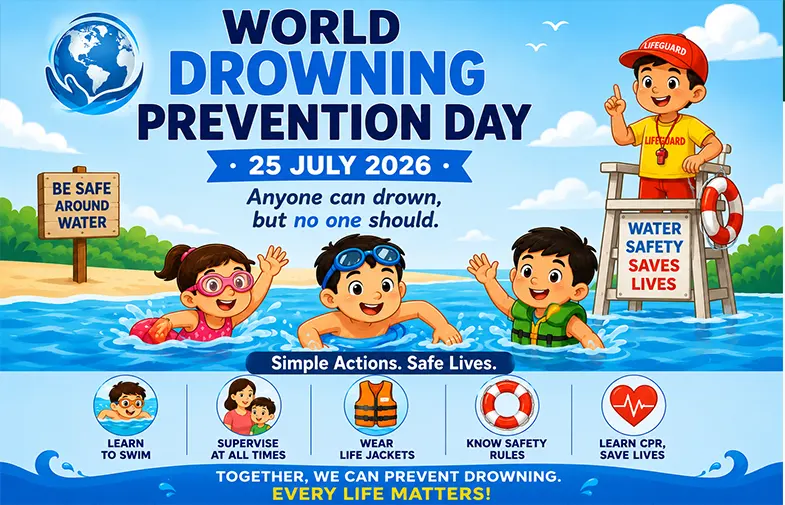
- Teach children to swim — enrol kids in structured swimming lessons as early as possible
- Learn to float — the “Find Your Float” principle: if you fall in, float first, then call for help
- Never swim alone — always have a buddy and tell someone where you are going
- Supervise actively — keep a dedicated, undistracted adult watching children near water at all times; put the phone down
- Install pool barriers — four-sided fencing with self-latching gates reduces child drowning risk by up to 83%
- Wear a lifejacket — on boats, open water, and in flood-prone areas, always wear a correctly fitted lifejacket
- Learn CPR — bystander CPR can triple survival rates; take a certified first-aid course
- Check the forecast — avoid open water in bad weather; currents and flash floods claim lives quickly
- Cover water storage — buckets, cisterns, and tanks at home should be securely covered
- Respect signs and flags — always swim at lifeguarded beaches and observe warning flags
How to Mark World Drowning Prevention Day 2026
You don’t have to be a lifeguard to make a difference. Here’s how anyone can participate on 25 July — and every day:
- 📲 Share your story on social media using #WorldDrowningPreventionDay and #YourStorySavesLives
- 🏊 Enrol yourself or your child in swimming lessons — it’s never too early or too late
- 🔵 Wear blue on 25 July to show solidarity with drowning prevention efforts worldwide
- 💬 Talk to your community — share water safety information with parents, neighbours, and schools
- 🏫 Advocate locally — push for pool barriers at community facilities, lifeguards at beaches, and swimming programs in schools
- 💙 Donate to organisations working to provide water safety education, especially in underserved communities
- ✅ Check your home — inspect pool gates, remove standing water hazards, and verify lifejackets are accessible
A Global Effort, A Personal Mission
World Drowning Prevention Day exists because these deaths are not inevitable. They are not random acts of nature. They are the result of gaps in knowledge, access, and infrastructure — gaps that awareness, education, and community action can close.
Whether you’re a parent teaching your child to float, a teacher advocating for school swim programs, a survivor ready to speak out, or a community leader pushing for better water safety policies — your role matters. Your story can, and does, save lives.
This 25 July, let’s make some noise for a quieter tragedy that the world can no longer afford to ignore.
Key Facts at a Glance
| Date | Friday, 25 July 2026 |
| 2026 Theme | “Your Story Can Save a Life” |
| Established by | UN General Assembly, April 2021 (Resolution A/RES/75/273) |
| Annual deaths | ~236,000 worldwide |
| Preventable | Over 85% of drowning deaths can be prevented |
| Highest-risk group | Children aged 1–14, especially under 5 |
| Official hashtag | #WorldDrowningPreventionDay |