CAMS SwimSafer Procedure JULY 2025
CAMS Swimsafer Procedure JULY 2025
What’s new: key changes since July 2025
The transition to CAMS for SwimSafer represents a major overhaul in how the programme is administered — from registration, booking, assessment centres, assessor roles, result reporting and certification. Some of the headline changes include:
1. Centralised booking, registration and documentation
- All assessments for SwimSafer (private/club) from 1 July 2025 onward must be booked via the CAMS platform managed by Singapore Aquatics (SAQ).
- Participants (or their parents) must have a CAMS account; swim schools and coaches must ensure their students are linked to the correct club/coach before registration.
- Assessment slots are opened weekly, up to three months in advance; registrations close three (3) weeks before the assessment date.
- Results (practical) will be released within 48 hours on the CAMS portal, with a detailed breakdown of “must-see criteria” for each stage.
- Certificates are issued digitally via CAMS (for assessments from July 2025) after both practical and theory components are cleared.
2. Fixed assessment centres and time-slots
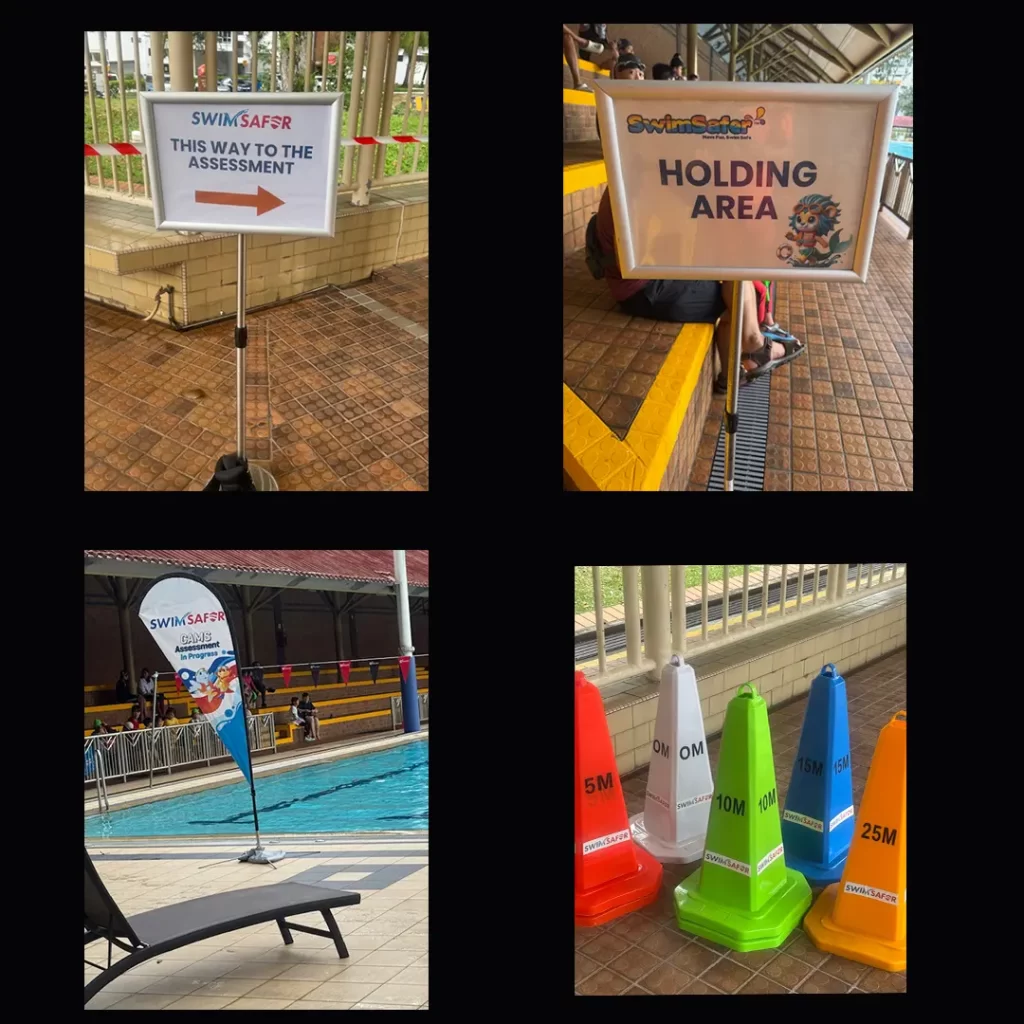
- Instead of the more flexible schedule previously, CAMS defines five (5) national assessment centres across Singapore for SwimSafer practical assessments:
- Bukit Batok Swimming Complex
- Yio Chu Kang Swimming Complex
- Yishun Swimming Complex
- HeartBeat@Bedok Swimming Complex
- Jalan Besar Swimming Complex
- Time-slots are prescribed (e.g. weekends: 11:30 / 12:45 / 14:00 / 15:15); (weekdays evening 5:30pm and 6:45pm).
- The maximum number of participants per stage per slot is capped (e.g., Stage 1 up to 20, Stage 2 up to 15, Stage 3–6 up to 10 per stage) to ensure manageable waves.
3. Reinforcement of “must-see criteria” and competence standard
- The new handbook stresses that to clear a stage you must attend to two components: (a) Practical assessment – must meet 100% of the specific criteria (i.e. be judged “Competent” in all tested items); (b) Online theory quiz – must achieve 90% or higher. Prefer to do right after Swimsafer Test is Booked.
- The “must-see criteria” have been made more explicit, with greater nuance in acceptable technique and survival skills as the stages advance. For example: “In this stage, the criteria become more specific and stricter in the higher levels.”
- Practice in clothing, survival strokes, underwater object retrieval, PFD usage, exit skills etc. now feature more prominently. Items/Component did not conform to the “Must see criteria” will be deem as incompetent.
4. Introduction of full-time assessors and stronger assessor governance
- As part of CAMS, SAQ has introduced the concept of a Full-Time Assessor (FTA) role (in addition to mobile assessors) with fixed remuneration and schedule, to ensure consistency and fairness across assessments.
- The assessor manual emphasises that coaches cannot assess their own students (to manage conflicts of interest).
- There is a disciplinary action framework, and random audits/checks of venue-compliance and assessor conduct.
5. More standardisation, transparency and reporting
- Detailed results include which specific criteria were not met (if any), giving clearer feedback to children/coaches/parents.
- There is an appeals policy: participants must submit within 72 hours if they wish to appeal for a fee of $50. If appeal successfully, it will be refunded. Otherwise no.
- Registration/payment/slot management now handled centrally; fewer bespoke arrangements allowed (eg no special outside-slots after cut-off).
| Challenges | AQZOG Response Opportunity |
| Higher failure rates expected | Offer “CAMS 2.0 Ready” prep classes |
| Stricter must-see criteria | Run mock tests with real-time feedback (Sign up under “Advisory” |
| Increased failure rate on survival skill | Launch “Survival ” workshop |
| Parents anxious about failure | Introduce confidence tracking reports |
| Busy children no time for weekly class | Join our 6 Days Swimsafer Program |
Addressing your three bullet-points
• “More stringent test based on must-see criteria”
Yes – this is confirmed by the new CAMS handbook. The requirement of 100% competency on the practical sequences means that any single criterion designated under the “must-see” list must be met.
Furthermore, the handbook emphasises that re-attempts are limited: an assessor may allow up to three attempts for a failed item, but only if time permits, and the participant still must clear all sequences within the time slot.
Also, the criteria themselves have become more refined (e.g., technique of survival strokes, transitions, underwater dives) as moved upward in stages. For example:
“The acceptability of certain swimming techniques… changes as a swimmer progresses through the stages. The criteria become more specific and stricter in the higher levels.”
Therefore your bullet is correct: the assessment is more stringent, with fewer ‘leeway’ allowances, emphasising survival skill and water competency rather than just length.
• “Assessments are done by the full-time assessor”
Partly yes, but with nuance: Under CAMS there is a designated Full-Time Assessor (FTA) role created. According to a March/April 2025 briefing:
“As a Full-Time Assessor (FTA)… you will play an active role in preparing, delivering and administering the program to ensure fair and transparent assessments.”
That said: these FTAs are in addition to, not necessarily replacing mobile or part-time assessors entirely. The documentation still refers to “appointed assessor(s)” for each assessment. So while many assessments will be overseen by FTAs, you should verify at your venue whether the assessor is a full-time or mobile one.
From a messaging standpoint, yes: assessments are increasingly being done by dedicated assessors appointed by SAQ rather than ad-hoc coaches, enhancing standardisation and fairness.
• “Higher failure rate than before”
Most feedback from swim schools indicates that the failure rate has increased in the early CAMS cycles—largely because of the more stringent criteria, fewer assessment venues/time slots (creating more pressure) and the tighter schedule of registration/quiz deadlines. For example, one swim-school article notes:
“With stricter assessment structures, children may feel extra pressure.”
Moreover, because the criteria are stricter and consequences clearer (i.e. if you miss one must-see item you fail), more students are failing or being deferred to next assessment slot. The capped group sizes, fixed waves and standardised logistics also reduce flexibility for ‘make-up’ or ‘fudge’ attempts.
So while we cannot quote a numerical failure-rate, the evidence supports that- – yes, you can expect greater selectivity under CAMS, and swim schools should plan accordingly.
Implications for swim schools, coaches and parents
Given these changes, here are some practical take-aways:
- Planning & Preparation: Registration slots are limited and open in batches; missing the slot or booking late can mean wait-lists. Coaches should map student readiness well in advance and reserve slots early.
- Mock Assessments: Because the bar is raised and must-see criteria emphasised, swim schools should conduct mock assessments that replicate the CAMS sequences exactly (timings, clothing, PFD usage etc).
- Theory Quiz: The online theory quiz must be completed within 7 days of the practical assessment, and the pass mark is 90%. Schools should prepare students (and parents) for this component too.
- Coach/Assessor Awareness: Coaches must ensure students have the correct account linkage, parent consent forms, pre-assessment briefs. Assessors must abide by SOPs; coaches cannot assess their own students.
- Parent Communication: With the higher selectivity, parents should be briefed not just about “passing the test” but about what each criterion means, how to practise it, and what happens if a child fails (re-slotting, extra lessons, cost).
- Venue & Logistics: As the five national centres are fixed, schools outside these catchment zones maybe need to plan travel/time for participants. The fixed time-slots mean late arrivals may be disallowed.
- Mindset Shift: The emphasis is on competency (100%) not just “getting a certificate”. It is about water survival and safety. Children failing one item means re-attempt or re-booking; that needs to be set as expectation.
FAQ – Frequently Asked Questions
When did the CAMS system for SwimSafer take effect?
Officially from 1 July 2025 all (private/club) SwimSafer 2.0 assessments must go through CAMS.
Note: A pilot phase ran earlier in 2025.
What are the two components of each stage now?
(i) Practical assessment – must demonstrate full competency in the designated “must-see criteria”; (ii) Online theory quiz – pass mark is 90% or higher.
Both must be cleared for certificate issuance.
Are there fewer venues now?
Yes, there are five main national assessment centres for SwimSafer under CAMS. Schools outside those may need to bring students to those centres. SAQ reserves the right to amend venues/time-slots with notice.
Who assesses the students now?
Assessments are overseen by assessors appointed via SAQ/CAMS. The new “Full-Time Assessor (FTA)” role has been introduced to enhance consistency and quality of assessments. Coaches must not assess their own students to avoid conflict of interest.
Has the pass-threshold or criteria become tougher?
Yes. The “must-see criteria” have been made more explicit and stringent as stages progress (for example tighter requirements on survival strokes, underwater retrieval, clothed swimming, Wearing Life Jacket in the water). Also, full competency is required to pass the practical.
Is there evidence of higher failure rates?
Official aggregated data is not publicly published yet. However, swim schools and commentary suggest greater selectivity and higher failure (or deferral) rates owing to stricter criteria, limited slots, and the new system’s transparency. Therefore, it is wiser to say, the higher the stages, the higher the failure rate due to more components to be tested.
What happens if a student fails one part of the assessment?
If a student does not meet one or more “must-see criteria” then they are marked “Not Competent” and cannot obtain the certificate for that stage until they re-attempt and pass.
The CAMS handbook allows assessors to permit up to two re-attempts within the same slot if time permits, but there is no guarantee. Then they must re-book a new assessment slot.
What about the theory quiz?
The online theory quiz is available via CAMS after practical registration. It must be completed within seven (7) days after the practical assessment date. But you can do the quizzes as soon as the practical test is booked. Unlimited attempts allowed until 90% pass. One-time extension possible (with fee). If the quiz is not completed in time, the practical result may be forfeited.
How the assessment are being conducted?
The assessor will base on the “Must See Criteria” stipulated in the latest Swimsafer Manual or handout.
My child failed his Swimsafer Test recently. Do you provide training to guide him?
Yes we offer such training during the 4th and 5th week of every month. You can apply online here.
Do you provide Swimsafer Test Booking?
Yes we do. You can book the test online via this link.
Does the coach need to be there during the test?
The coach need not be there as the staff from the CAMS will handle the event along with the Full time assessor already present in the venue.
I need a swimsafer certificate for the MOE Swimsafer program next year. Is this certificate recognise by them?
Yes, this certificate is recognised by MOE. You need to create an account in the cams in order to book the test.
Can I appeal if my child failed in this swimsafer test?
Yes, the appeal cost is $50 and maybe forfited if the appeal is not successful. I would advice they re take the test.
Can we warm up at the venue before the actual test?
It is advisable not to do any warm up or mock test at the venue on the same day as test day. This will stressed up the kids base on the SAQ email.
How to book CAMS Swimsafer Test?
Key Take-aways
- The SwimSafer 2.0 programme under CAMS from July 2025 is more rigorous, more systematised and less flexible than previously.
- The emphasis has shifted firmly to survival competence + water safety awareness, not simply “swim a distance”.
- Coaches and schools must align their teaching and prep to the “must-see” criteria, allow adequate time for revision, and manage logistics (booking, venue, timing).
- Parents should expect that passing is no longer automatic; preparation and mindset matter strongly.
- For your swim-school business and article-writing (given your audience and expertise), this is a valuable pivot: emphasise how the new system ensures integrity, consistency and quality in water-safety certification, and how your programmes (for example your holiday camps, confidence building, survival skills) should match up to the raised standard.