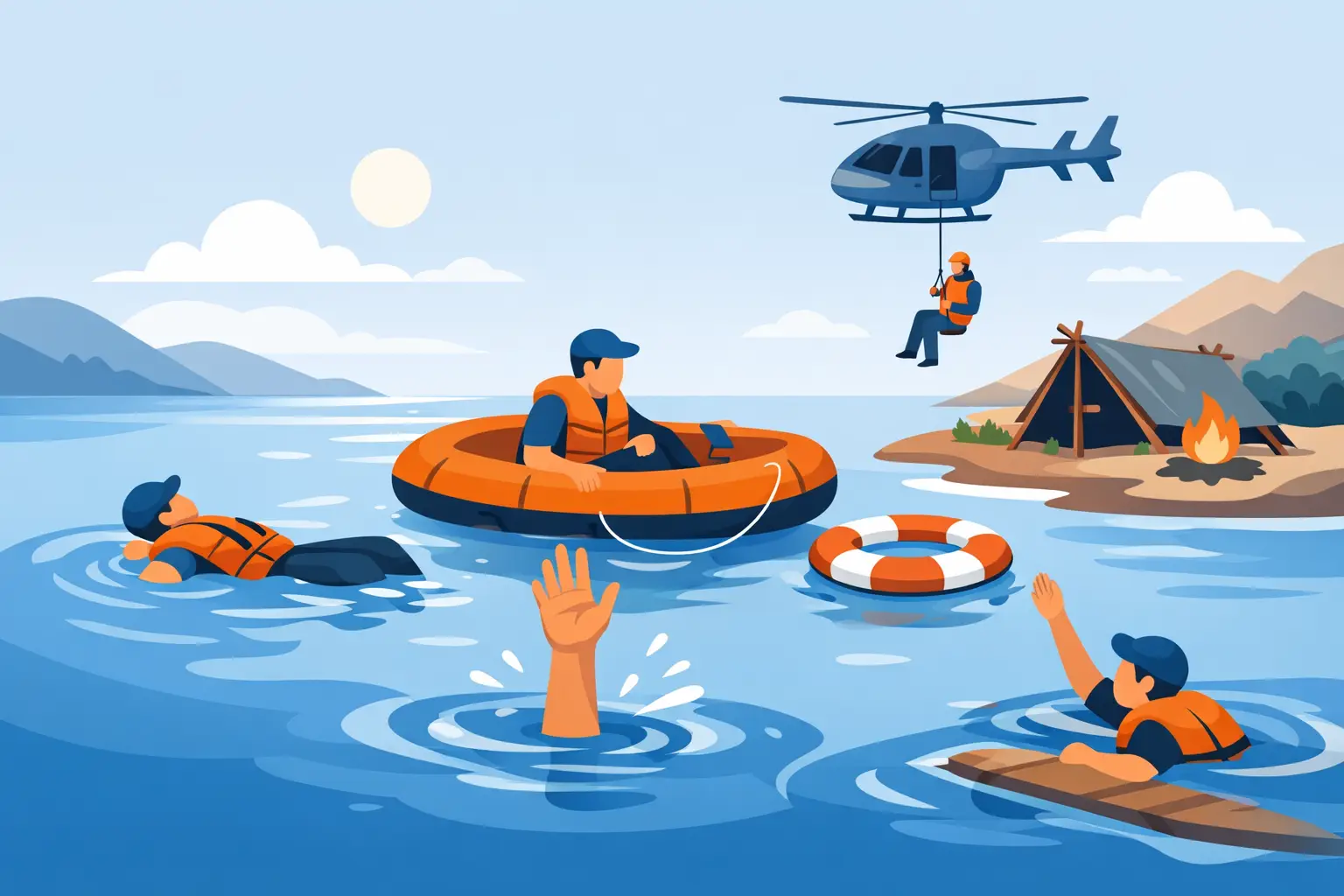
Beginner Guide to Water Survival Skills
The first 30 seconds in the water often decide what happens next. Not strength. Not speed. Not even age. What matters first is whether a person knows how to stay calm, keep the airway clear, and make simple survival choices under stress. That is why a beginner guide to water survival should start with one truth: survival skills come before swimming style.
For parents, this means looking beyond strokes and laps. For adult beginners, it means understanding that water confidence is built through repeatable safety skills, not guesswork. A child who can float, turn, breathe, and move to safety has a far stronger foundation than a child who can only kick a short distance with panic. The same applies to adults who are returning to the pool after years of fear or avoidance.
What water survival really means for beginners
Water survival is the ability to stay safe in the water long enough to breathe, think, and reach help or a safe exit. It is not the same as being a competitive swimmer. Many people assume survival begins once a person can swim a full lap, but that is rarely how emergencies work. Real situations are often sudden, tiring, and disorienting.
A beginner needs a smaller set of skills, practiced well. That includes safe entry, breath control, floating, changing position in the water, moving short distances without panic, and recognizing when to stop and signal for help. These are practical outcomes. They can be measured, taught progressively, and improved with structured coaching.
For children, this progression should be age-appropriate and supervised closely. For adults, the pace often depends on comfort level, body position, and previous fear around water. In both cases, progress is usually faster when lessons are systematic rather than improvised.
Beginner guide to water survival: the core skills
The first skill is breath control. A beginner who holds the breath rigidly or gasps every time water touches the face will tire quickly and lose confidence. Controlled exhalation into the water helps reduce panic and creates the base for floating and movement. This may look basic, but it is one of the biggest turning points for nervous learners.
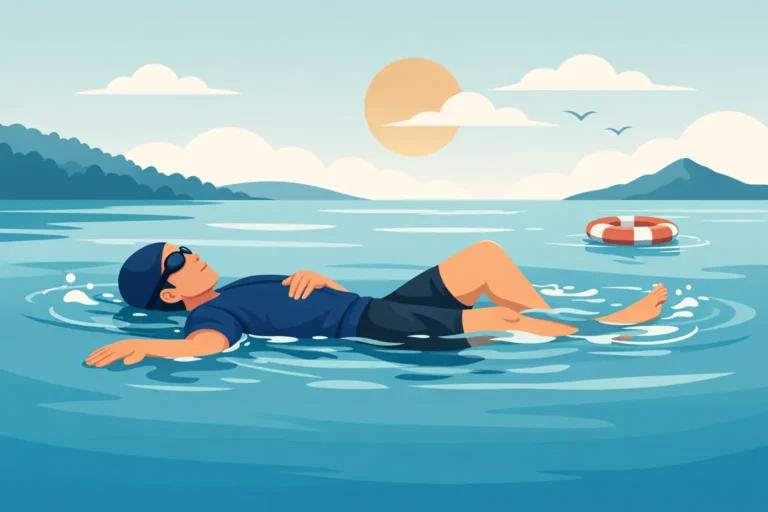
The second skill is floating. Survival floating does not need to look perfect. A back float, star float, or simple resting position can give a swimmer time to recover. Some learners float easily, while others struggle because of body tension, sinking legs, or fear of the ears going underwater. That is normal. Floating improves when posture, breathing, and relaxation are taught together.
The third skill is rotation. A beginner should learn how to move from front to back and back to front without losing control. This matters because few people stay in one neat position during stress. If a swimmer can roll onto the back to breathe and then return to a forward position to move, survival options expand immediately.
The fourth skill is short-distance propulsion. In survival, the goal is not elegant technique. The goal is to move enough to reach the wall, lane rope, steps, or shallow area. Kicking, paddling, and basic arm action all help, but they should be practiced with a clear destination. Moving three to five yards with control is more useful for a beginner than thrashing twenty yards in panic.
The fifth skill is safe exit. Reaching the wall is not the end if the swimmer cannot hold on, orientate, and climb out safely. Young children especially need repeated practice getting to the side and waiting securely.
Why panic is the real risk multiplier
Most beginners do not fail because they lack effort. They fail because stress changes breathing, body position, and decision-making. Panic lifts the head, drops the legs, speeds up exhaustion, and narrows attention. Once that chain starts, even a strong kick can become ineffective.
That is why good instruction teaches calm responses before hard skills. A learner should know what to do when water enters the nose, when goggles shift, or when balance is lost. The answer is not to fight the water. It is to pause, regain breathing, return to a float, and reset.
This is especially important for children, who may become distressed quickly if they feel surprised. It also matters for adults, who often carry embarrassment along with fear. In structured lessons, these moments are practiced in a controlled way so the swimmer builds familiarity instead of avoidance.
Water survival for children starts with habits, not bravery
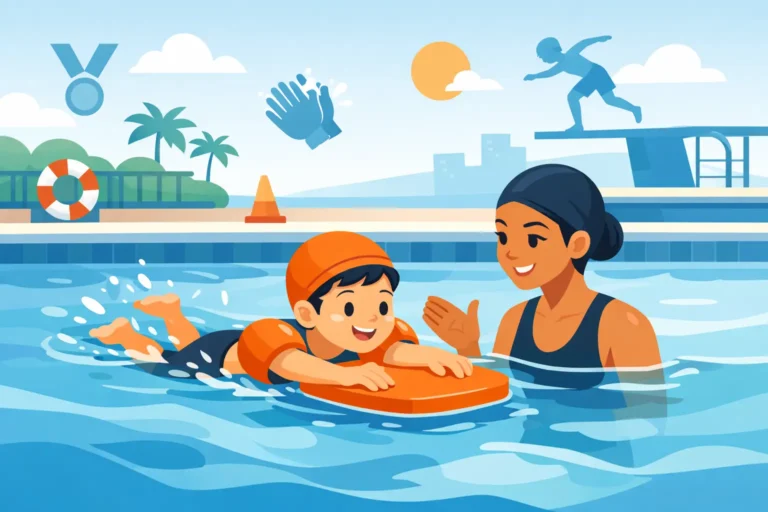
Parents sometimes want quick proof that lessons are working, usually in the form of visible swimming distance. Progress does matter, but early water survival is often quieter than that. It looks like a child entering safely, listening promptly, putting the face in the water, floating for a few seconds, and returning to the wall without panic.
These are not small wins. They are the framework of future safety. A child who learns to wait for permission, hold the wall, and recover after submersion is building decision-making as well as physical skill.
There is also an important trade-off here. Confidence is necessary, but overconfidence is dangerous. A child should feel comfortable in the water while still respecting depth, supervision, and pool rules. The right teaching approach builds capability without creating false security.
Adult beginners need a different starting point
Adults often arrive with specific barriers. Some never learned to swim. Some had one frightening incident years ago. Others can move through the water but never learned true survival skills. They may appear composed on deck and still tense up the moment buoyancy changes.
For adult learners, water survival training works best when it is direct and practical. Start with breath control and supported floating. Then add recovery positions, short movement sequences, and deep-water orientation when ready. Rushing this process usually slows it down because fear returns when the foundation is weak.
Adults also benefit from understanding the why behind each drill. Knowing that a back float conserves energy, or that exhaling helps prevent breath-holding panic, can make practice feel purposeful instead of random. AQZOG has long emphasized this kind of structured progression because adults improve faster when safety skills are taught with clear outcomes.
How structured practice builds real results
A beginner guide to water survival is only useful if the skills can be practiced consistently. One-off exposure can create familiarity, but it rarely creates dependable response under stress. The body learns survival through repetition.
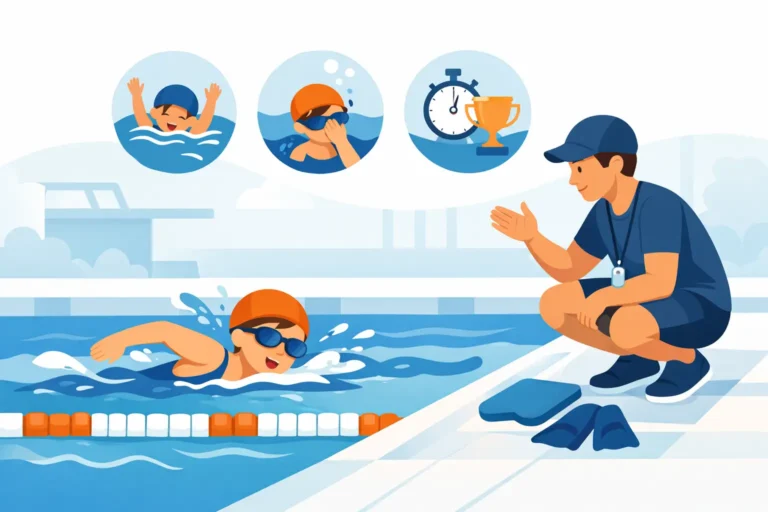
That repetition should be progressive. Beginners usually do best when each lesson reinforces a few key skills: breathing, floating, turning, moving, and exiting. As those improve, the swimmer can combine them into short sequences. For example, enter safely, submerge and exhale, return to float, rotate, move to the wall, and climb out. That is a meaningful survival chain.
Formal progression frameworks help because they reduce gaps. When learners skip steps, they often compensate with speed or force, which looks fine until pressure increases. Structured instruction catches these gaps early and corrects them before they become habits.
Common mistakes beginners should avoid
The biggest mistake is treating water survival as optional until later. Many learners start with stroke goals and assume safety skills will come naturally. Sometimes they do. Often they do not. Survival needs direct teaching.
Another mistake is relying on flotation aids too heavily. Some equipment is useful for instruction, but if a beginner never experiences natural body position and breathing control, confidence may disappear once the aid is removed.
A third mistake is confusing familiarity with readiness. A child who enjoys splashing is not automatically safe. An adult who can cross a pool once is not automatically prepared for fatigue, depth, or unexpected immersion. Water ability has layers, and survival sits near the base.
What families and learners should aim for first
Early goals should be simple and clear. Can the swimmer keep the face calm in the water? Can they float briefly without grabbing? Can they return to the wall? Can they recover after losing balance? Can they follow safety instructions without delay? These benchmarks matter more at the start than polished freestyle.
Once those are reliable, the learner is in a better position to develop stronger strokes, endurance, and formal certification skills. That is where swimming becomes not just possible, but sustainable and safe.
Water survival is not dramatic when taught well. It is methodical, repeatable, and confidence-building. For a beginner, that is exactly what it should be. The best next step is not to prove bravery in the water, but to practice the few skills that make calm possible when it counts.