How to Find the Best Public Pool Swim Lessons
A child who can put their face in the water, float independently, and return to the wall has gained more than a new activity. They have started building a safety skill that can matter for life. That is why the best public pool swim lessons are not simply the closest class with an open slot. They are lessons with a clear safety standard, a qualified instructor, an appropriate class level, and a visible path from nervous beginner to capable swimmer.
Public pools can be excellent places to learn. They are often convenient, familiar, and more affordable than private facilities. However, a public setting also brings variables: shared lanes, changing water conditions, busy deck areas, and classes with mixed abilities. The right program accounts for those realities instead of treating every swimmer the same.
What Makes the Best Public Pool Swim Lessons Different
A strong lesson program begins with assessment. Before a swimmer is placed in a group, the instructor should understand what they can actually do in the water. Age is useful, but it is not enough. Two seven-year-olds may have completely different needs if one is comfortable floating and the other avoids getting their ears wet.
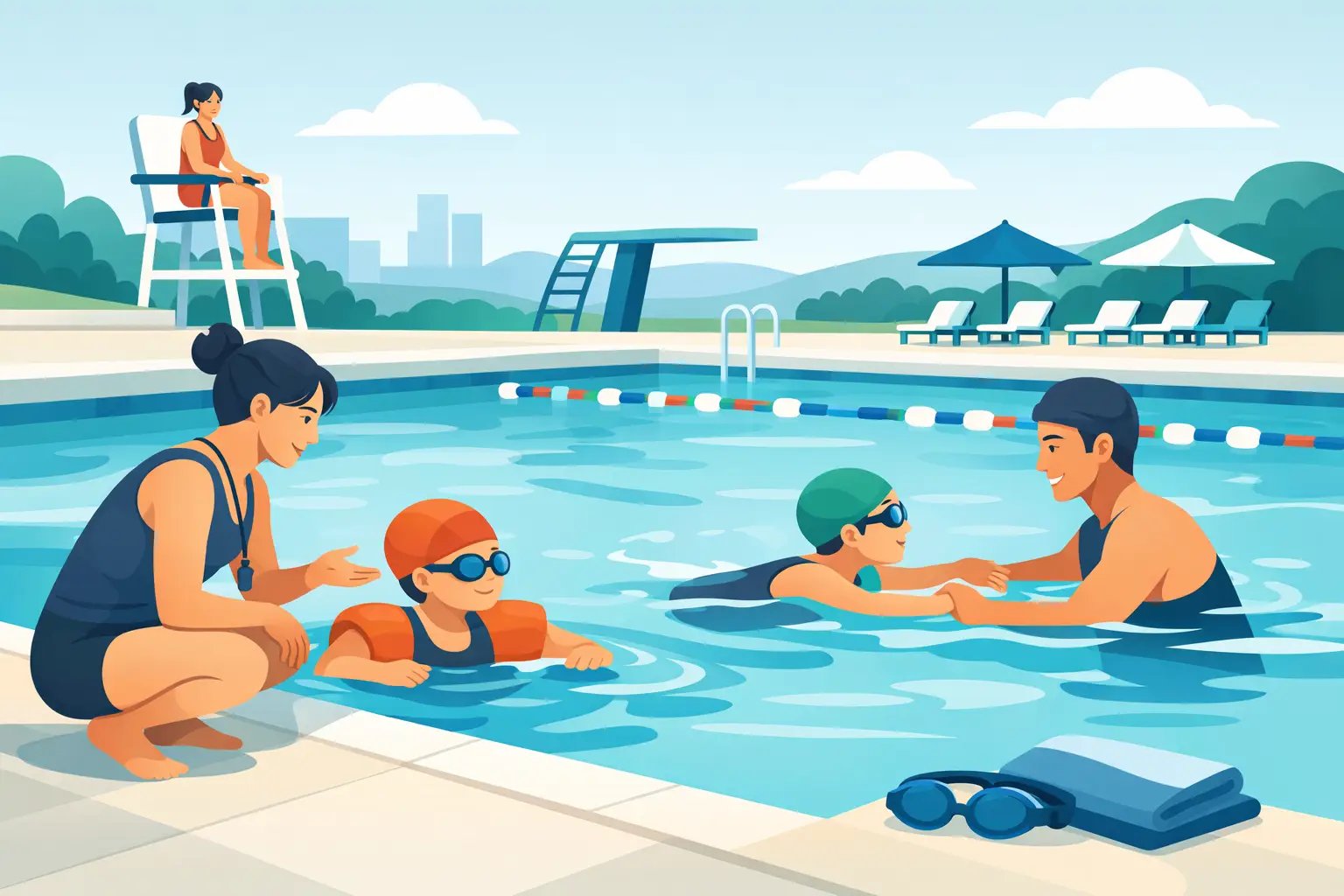
For young children, early lessons should establish comfort without confusing comfort for competence. Splashing, kicking, and holding a noodle can help a child settle in, but progress should move toward meaningful water skills: safe entry, bubbles and breath control, face immersion, front and back floating, rolling over, and reaching a safe point. These are the building blocks of water survival.
For school-age swimmers, the next question is whether instruction follows a progression. A good class does not jump from basic kicking to long freestyle laps because it looks impressive. It teaches body position, breathing rhythm, arm recovery, propulsion, and safe turning in an order the swimmer can understand and repeat. Each skill should prepare the swimmer for the next one.
Adult beginners deserve the same structured approach. Fear of deep water, difficulty putting the face in, or anxiety about breathing are common and manageable when a coach works at the swimmer’s pace. Adults often improve quickly when lessons are specific and consistent, but they should not be pushed into water that exceeds their current confidence or control.
Check Safety Before You Compare Prices
Price matters, especially for families planning weekly lessons. Yet the least expensive class is not always the best value if it is overcrowded, inconsistent, or poorly matched to the swimmer’s level. Start by looking at the safety environment.
Ask who is supervising the class and what qualifications the instructors hold. Coaches should be trained to teach swimming, recognize unsafe behavior, manage a group at the water’s edge, and adapt an activity when a swimmer is distressed. Lifeguard coverage is an added layer of protection, but it does not replace active instruction and careful class management.
Also consider the pool itself. Shallow teaching areas are useful for first-time swimmers, while access to deeper water becomes necessary as swimmers learn floating, treading, deep-water confidence, and survival skills. The facility should have clear rules for entry, changing areas, deck movement, and parent observation. At a busy public pool, these details make a real difference.
A reliable program should be able to explain how it handles a child who is crying, refusing to submerge, or unable to keep up with the group. The answer should not be to force the child through an exercise. It should be a calm plan that protects safety while building trust and steady participation.
Choose the Right Class Format for the Swimmer
Group lessons are often the best starting point for children who are comfortable learning alongside peers. They offer routine, social motivation, and repeated practice at a manageable cost. The trade-off is that each swimmer receives less individual attention, so class size and level placement matter greatly.
Private lessons are useful when a swimmer has a strong fear of water, needs rapid improvement, is preparing for an assessment, or has technique issues that need focused correction. One-to-one coaching can produce efficient results because every activity is tailored to the swimmer. It also costs more, and some children enjoy group energy more than an individual format.
Semi-private lessons can provide a practical middle ground for siblings or friends of a similar level. They work best when both swimmers have compatible goals. Pairing a confident swimmer with a fearful beginner may leave one waiting and the other overwhelmed.
For toddlers, parent-and-child water introduction can be a positive first step. Look for a program that teaches parents how to support safe holds, calm water play, gentle submersion readiness, and basic movement without making unrealistic promises. Toddlers need close adult supervision at all times, even when they appear confident.
A practical enrollment checklist
Before enrolling, confirm these five points:
- The swimmer has been assessed or can be placed by demonstrated ability, not age alone.
- The instructor-to-swimmer ratio allows for observation, correction, and safe supervision.
- The program teaches water safety alongside stroke development.
- Progress is tracked through clear skills, levels, or assessments.
- There is a suitable option if the swimmer needs extra support, faster progression, or test preparation.
Look for Measurable Progress, Not Just Pool Time
Children often say they had fun in class, and enjoyment matters. It helps them return with confidence. But parents should also be able to see what the child is learning and what comes next.
Meaningful milestones might include entering and exiting safely, floating without support, traveling a set distance with controlled breathing, recovering from a float to a standing position, treading water, and swimming with sound technique. The distance and complexity will depend on the swimmer’s age and stage, but the outcomes should be clear.
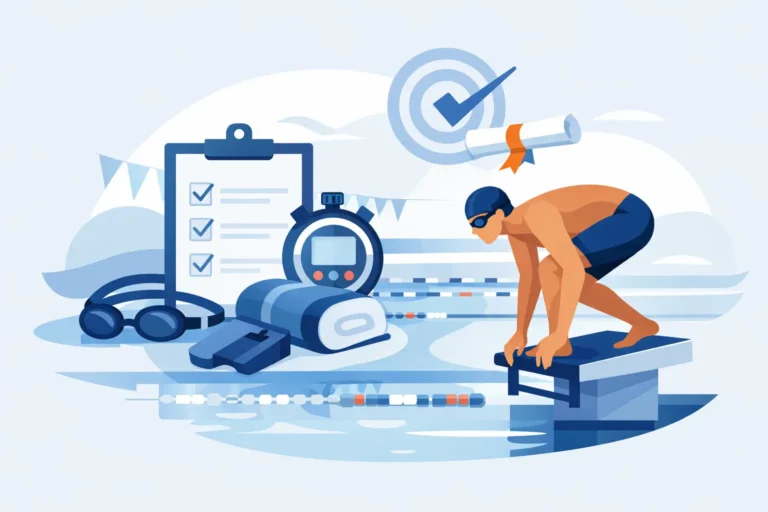
Ask how instructors communicate progress. Some programs provide level reports, skill checklists, or assessment feedback. Others offer formal certificates or preparation for recognized safety and swim standards. Certification can be motivating, but it should reflect genuine capability rather than attendance alone. A swimmer who earns a level should be able to demonstrate its required skills reliably.
This is especially relevant for families whose children need structured test readiness. Mock practical assessments can reveal gaps before a formal evaluation. Theory preparation can also help older children understand water safety rules, rescue awareness, and responsible pool behavior. The strongest programs treat assessment as a learning tool, not a stressful one-day event.
Questions to Ask at the First Lesson
You do not need to be a swim expert to judge whether a class is well run. Watch the first session closely. Is the instructor positioned where every swimmer can be seen? Do children receive specific feedback, such as “keep your chin down” or “reach long before you pull,” rather than only general praise? Are waiting swimmers engaged safely, or are they drifting and losing focus?
Notice whether the coach adjusts instruction. A beginner may need a wall-supported float before attempting independent movement. A more advanced swimmer may need a breathing correction, not another round of basic kicking. Good coaching is organized, but never mechanical.
It is also reasonable to ask how missed lessons, pool closures, and weather interruptions are handled. Public-pool schedules can change. A program that communicates clearly and offers sensible make-up policies helps families maintain the consistency that swimming progress requires.
Match the Program to Your Long-Term Goal
The best choice depends on where the swimmer needs to go next. A preschooler may need water familiarity and safe independent movement. A child in elementary school may need a progression that combines stroke development with survival confidence. A teenager may be working toward a school requirement, a safety certification, or more advanced lifesaving skills. An adult may want to overcome fear, swim for fitness, or prepare for triathlon training.
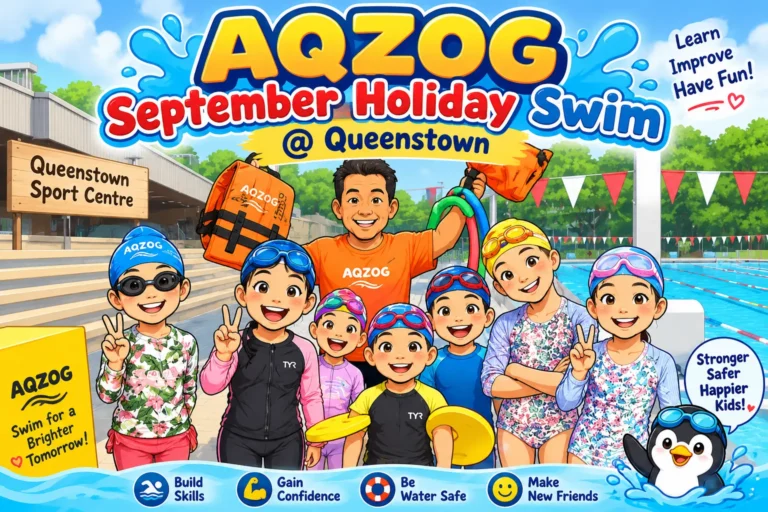
Choose a school that can support that journey rather than offering only a single beginner class. Programs with regular progression, holiday intensives, private coaching, and assessment preparation give families options when goals change. AQZOG, for example, centers its instruction on structured progression, water safety, and measurable readiness, because confidence is strongest when it is supported by real skill.
A good public-pool lesson should leave a swimmer more capable than when they arrived: calmer in the water, clearer on safety rules, and ready for the next skill. Start with the program that can show you exactly how it will help them get there.