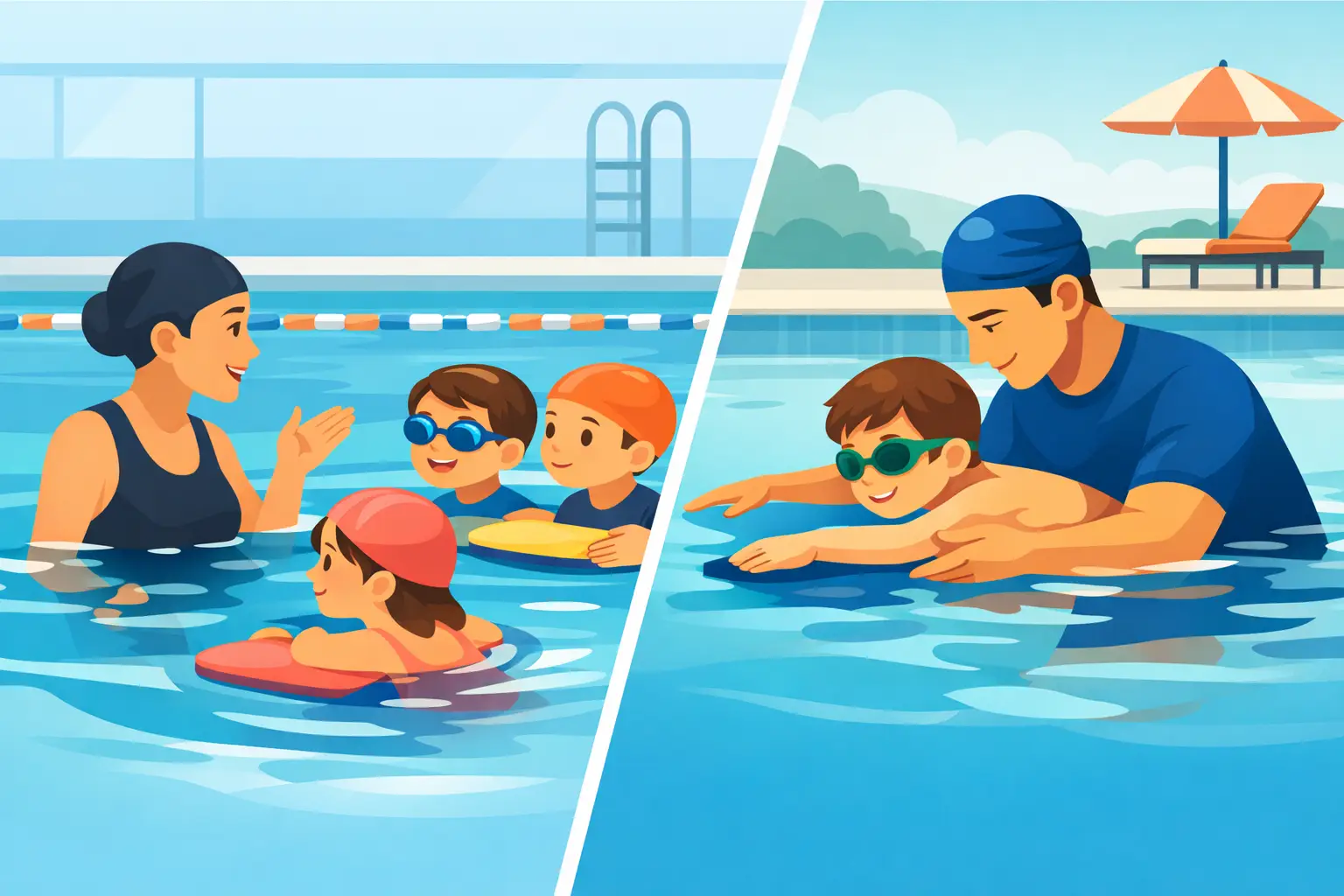
Group vs Private Swimming Lessons
A child who clings to the pool wall needs something very different from a child preparing for a SwimSafer assessment. An adult learning freestyle after years of water fear needs something different again. That is why the choice between group vs private swimming lessons matters so much. The right format can improve confidence, speed up skill development, and make water safety training far more effective.
At first glance, the decision seems simple. Group lessons are usually more affordable and social. Private lessons offer more individual attention. But for most families and adult learners, the better choice depends on learning pace, comfort level, goals, and how urgently results are needed.
Group vs private swimming lessons: what really changes?
The biggest difference is not just class size. It is how instruction is delivered, how quickly a swimmer progresses, and how closely the lesson can be adjusted in real time.
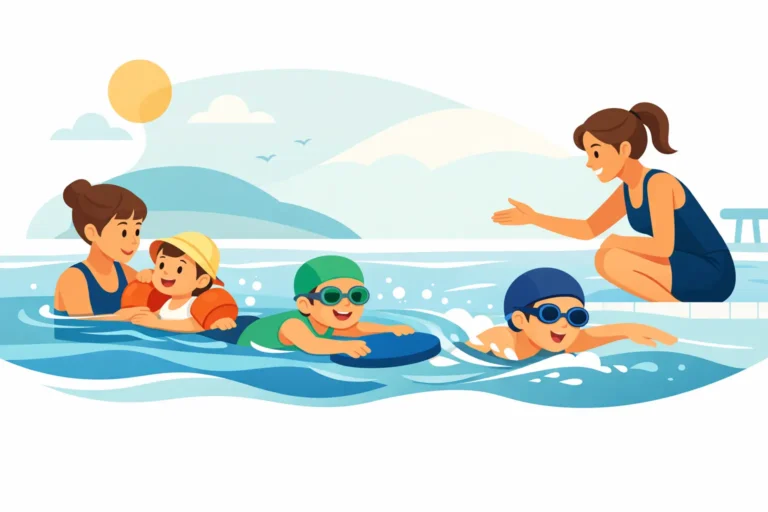
In a group class, the coach manages several swimmers at once, usually by level and age. A good program still follows a structured syllabus, but lesson time is shared. That setup works well when swimmers can learn alongside peers, follow instructions in sequence, and benefit from repetition within a group environment.
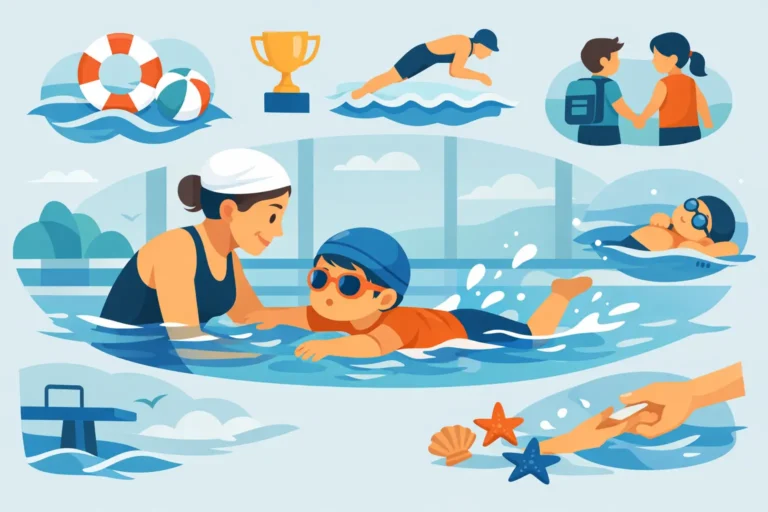
In a private lesson, the entire session is built around one swimmer. The coach can correct body position immediately, repeat a skill as many times as needed, and adjust the pace on the spot. For swimmers who need close guidance, this can lead to faster progress and better technical accuracy.
Neither format is automatically better. The real question is which environment gives the swimmer the best chance to learn safely and consistently.
When group lessons are the better choice
Group classes are often the strongest option for children who are ready to learn in a structured social setting. Many young swimmers gain confidence when they see other children putting their faces in the water, kicking across the lane, or practicing floating drills. That peer effect can reduce hesitation and make lessons feel more normal and less intimidating.
Group learning also supports routine. Weekly lessons with the same structure, clear milestones, and level progression help children build water familiarity over time. For families who want steady development without the higher cost of one-to-one coaching, group classes are usually the most practical path.
There is another advantage that parents sometimes overlook. Group lessons teach listening, turn-taking, and following instructions while still practicing core swimming skills. Those habits matter, especially for school-age children moving toward formal water safety benchmarks and test-based programs.
For adults, group classes can also work well if the learner is comfortable practicing in front of others and does not need constant correction. Fitness swimmers, stroke improvers, and learners who enjoy shared motivation often do well in this setting.
That said, group classes do have limits. The coach cannot spend the whole lesson on one swimmer’s breathing issue, fear response, or coordination challenge. If a child needs repeated reassurance or an adult is struggling with a basic movement pattern, progress can slow down.
When private lessons make more sense
Private lessons are often the right choice when a swimmer needs targeted support, faster progress, or a more controlled learning environment.
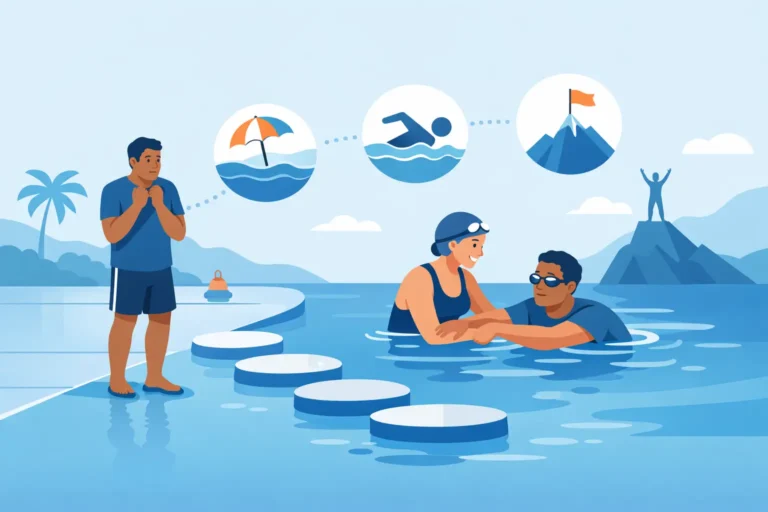
For beginners with strong fear of water, one-to-one coaching can be especially effective. Instead of trying to keep up with a group, the learner can focus on trust, breathing control, floating, and basic movement without pressure. This matters for both children and adults. Confidence is not built by rushing. It is built through successful repetition, clear coaching, and a pace the swimmer can handle.
Private lessons are also valuable when there is a specific goal with a deadline. A child preparing for a SwimSafer stage, a student needing help before a practical assessment, or an adult working on a stroke correction often benefits from concentrated instruction. The coach can identify weak points quickly and work on them without distraction.
Technique-focused swimmers usually improve faster in private sessions as well. Small errors in breathing timing, kick rhythm, body alignment, or arm recovery can be hard to fix in a group. In a private lesson, those details can be corrected immediately before they become habits.
For toddlers and very young children, the answer depends on temperament. Some do well in a guided group introduction. Others need the familiarity and close attention of a private setting first. Safety and emotional readiness should lead that decision, not age alone.
Cost matters, but value matters more
For most families, cost is a real part of the decision. Group classes are more budget-friendly because the coaching time is shared. Private lessons cost more because every minute is focused on one swimmer.
But the cheaper option is not always the better value. If a swimmer stays stuck in a group setting for months because the pace does not match their needs, the long-term cost may be higher than starting with private coaching. On the other hand, if a child is progressing steadily in a structured group, paying for private lessons may not be necessary.
A useful way to think about it is this: group lessons often deliver better value for general progression, while private lessons often deliver better value for targeted improvement. The right choice depends on whether the swimmer needs broad ongoing development or fast correction in specific areas.
Some learners do best with a mixed approach. They attend weekly group classes for regular progression and add private lessons before assessments, after a plateau, or during school breaks when intensive work is possible. That can be a very efficient strategy.
Safety, confidence, and learning pace
Swimming is not just another enrichment activity. It is a safety skill. That changes how parents and adult learners should evaluate lesson formats.
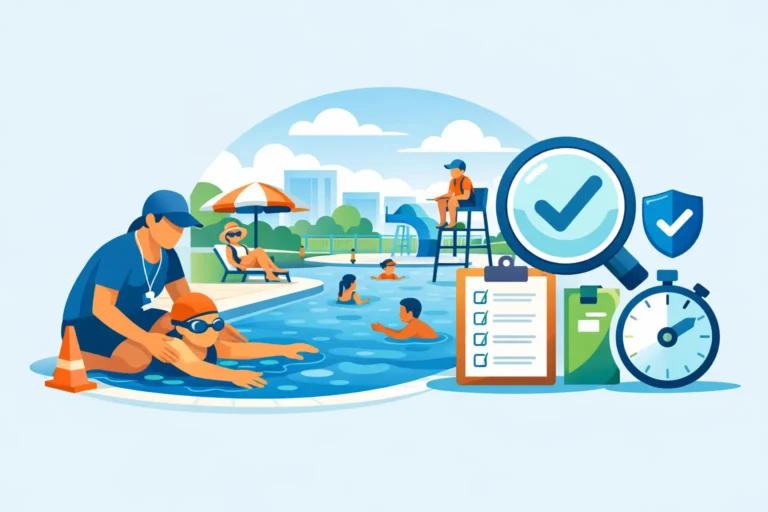
If a swimmer is not gaining water confidence, not responding to group instruction, or not developing key survival skills such as floating, breath control, and safe movement through water, then the lesson format needs to be reviewed. Progress should not be judged only by how happy the lesson looks from the poolside. It should be judged by measurable improvement.
In a strong program, both group and private formats should follow structured progression. Skills should build in sequence. Coaches should know how to teach beginners, improve stroke mechanics, and prepare swimmers for assessments. The lesson type is important, but coaching quality and progression planning matter just as much.
That is why experienced schools often offer more than one pathway. AQZOG, for example, serves swimmers across group classes, private coaching, toddler introduction, and assessment preparation because different swimmers need different structures to succeed.
How to decide for your child or yourself
A simple rule helps. Choose group lessons when the swimmer is comfortable in water, learns well with peers, and can follow structured instruction at a shared pace. Choose private lessons when the swimmer is fearful, needs faster results, has a technical barrier, or requires close support for certification or skill progression.
Parents should also consider behavior in other learning settings. A child who thrives in classroom groups may do very well in swim classes with peers. A child who becomes overwhelmed easily or needs repeated prompting may progress faster with one-to-one attention.
Adult learners should be honest about confidence. If embarrassment, anxiety, or past negative experiences are limiting performance, private lessons usually create a better starting point. If motivation comes from shared effort and the basics are already in place, group classes can work very well.
The best decision is not the one that sounds most efficient on paper. It is the one that keeps the swimmer learning, progressing, and becoming safer in the water.
A final word on group vs private swimming lessons
If you are choosing between the two, start with the swimmer’s real needs, not just the price tag or the most popular option. The best lessons are the ones that build confidence, produce measurable progress, and move the swimmer toward genuine water safety. When the format matches the learner, everything else becomes easier.