Backstroke Swimming Skills Technique Tips
A swimmer who can float calmly on the back, move in a straight line, and keep a steady rhythm is already showing strong backstroke swimming skills technique. That matters for more than speed. Backstroke builds water confidence, teaches body control, and helps swimmers learn how to stay relaxed while breathing freely. For children, it supports safer movement in the water. For adults, it often becomes the stroke that improves posture, endurance, and confidence without the stress of face-down breathing.
Backstroke looks simple from the pool deck, but good technique is built from small details. Head position, hips, kick rhythm, arm timing, and straight-line control all work together. When one piece breaks down, the stroke becomes hard work very quickly. The goal is not just to move the arms faster. The goal is to create a long, balanced shape in the water so each action supports the next.
Why backstroke technique matters
Backstroke is often introduced early because swimmers can breathe naturally while learning movement patterns. That makes it accessible, but it also creates a common problem. Many swimmers assume it is easier than it really is. They rush the arms, bend at the hips, or kick wildly, then wonder why they are not moving well.
A structured approach makes a big difference. When swimmers learn proper backstroke swimming skills technique from the start, they usually gain better balance, stronger kicking habits, and more awareness of how the body should sit in the water. Those skills carry into other strokes and help with broader progression, including test readiness, survival skills, and overall stroke development.
Body position is the foundation of backstroke swimming skills technique
The first priority is body position. A swimmer should feel long and flat, with the water supporting the back of the head, shoulders, hips, and legs. The ears stay in the water, the eyes look upward, and the chin remains neutral. If the head lifts too high, the hips and legs usually sink. Once that happens, the kick has to work harder, and the stroke becomes inefficient.
A common correction is to ask swimmers to press the back of the head gently into the water and keep the chest relaxed. This helps the hips rise naturally. The body should not be rigid, but it should stay aligned. Think of the swimmer traveling through the water as one connected unit rather than separate parts.
This is especially important for beginners and children. Many new swimmers try to sit in the water instead of lie on it. That instinct is understandable because leaning forward often feels safer on land. In the pool, it creates drag. Learning to trust the water and hold a proper floating position is one of the biggest early breakthroughs.
The role of rotation
Good backstroke is not completely flat. The body rotates gently from side to side with each arm stroke. That rotation helps the shoulder recover more easily and allows the pulling arm to catch more water. Without rotation, the stroke can look tense and shallow.
The key is controlled rotation, not rolling all over the lane. A swimmer should turn just enough for the shoulder to clear comfortably and for the pulling arm to work with more power. Too little rotation limits efficiency. Too much causes zigzag movement and loss of balance.
The backstroke kick should be steady, not frantic
The kick in backstroke comes from the hips, with loose ankles and relatively straight legs. There can be a slight bend at the knees, but the motion should not start from the knees alone. When swimmers bicycle kick or let the knees pop out of the water, they create resistance instead of propulsion.
A good backstroke kick is small, fast, and consistent. The toes should stay pointed, and the feet should flick the water rather than slap it. Coaches often tell swimmers to keep the kick narrow enough that it stays mostly under the surface. Excessive splashing usually means the movement is too large or disconnected.
There is a trade-off here. Some swimmers need a slightly stronger kick to keep the hips high, especially when they are still developing balance. Others overkick and burn energy too early. The right rhythm depends on the swimmer’s age, body position, fitness, and goals. A child learning stroke control may focus on balance first. A competitive swimmer may tune the kick for tempo and speed.
Arm action needs a clear path above and below the water
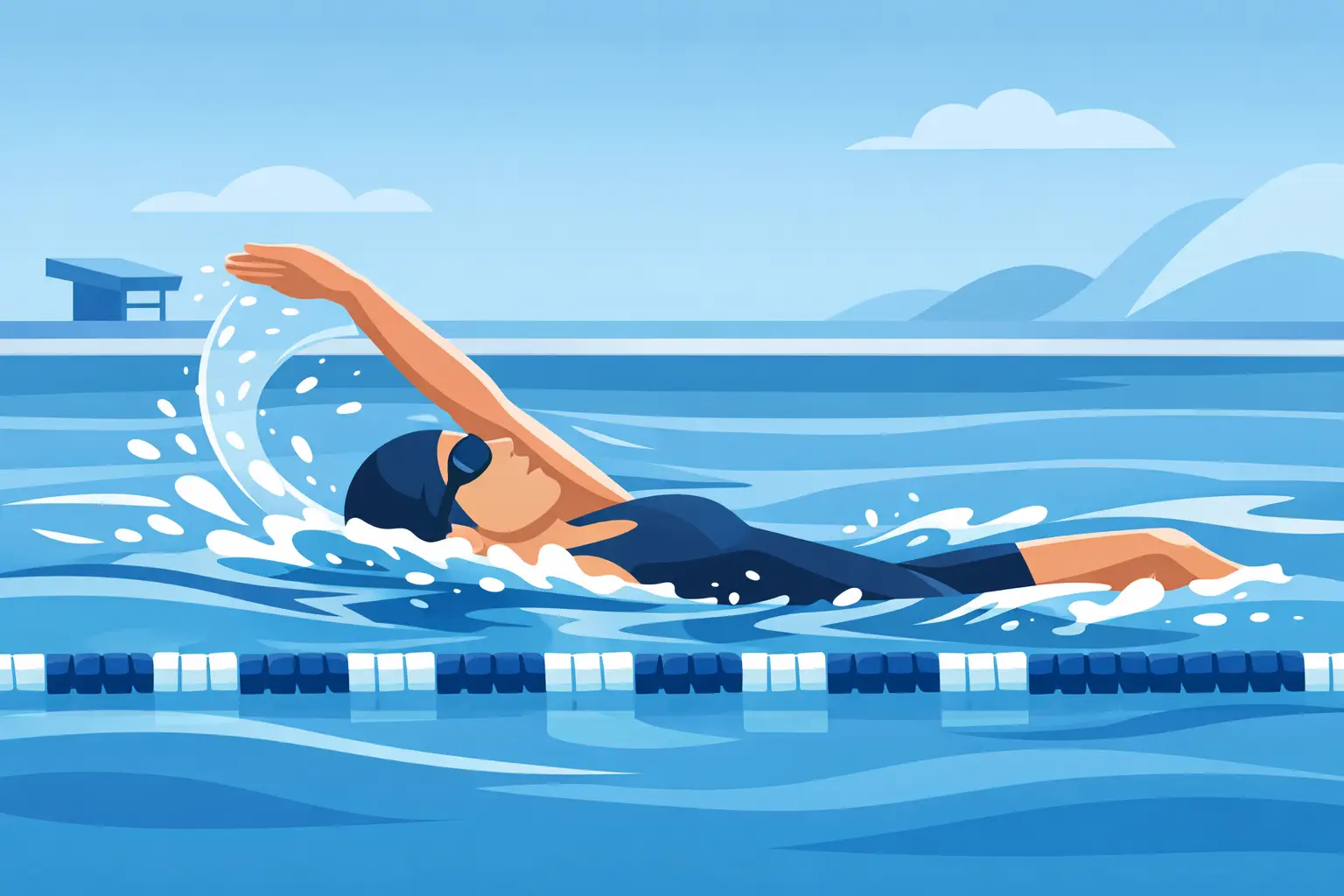
In backstroke, each arm takes turns recovering over the water and pulling under it. The recovery should be straight and relaxed, with the thumb generally leaving the water first and the little finger entering first. That entry helps set up a cleaner catch.
Once the hand enters, the arm should not rush downward randomly. The swimmer needs to catch the water and begin the pull with control. Underwater, the arm bends as it presses water toward the feet. The goal is to move the body forward, not simply to spin the arms.
Many learners cross the hand over the center line during entry. This often leads to snaking through the lane and shoulder discomfort. Ideally, each hand enters in line with the shoulder, creating a stable pathway for the pull. Straight-line swimming is one of the clearest signs that technique is improving.
Timing the arms and kick together
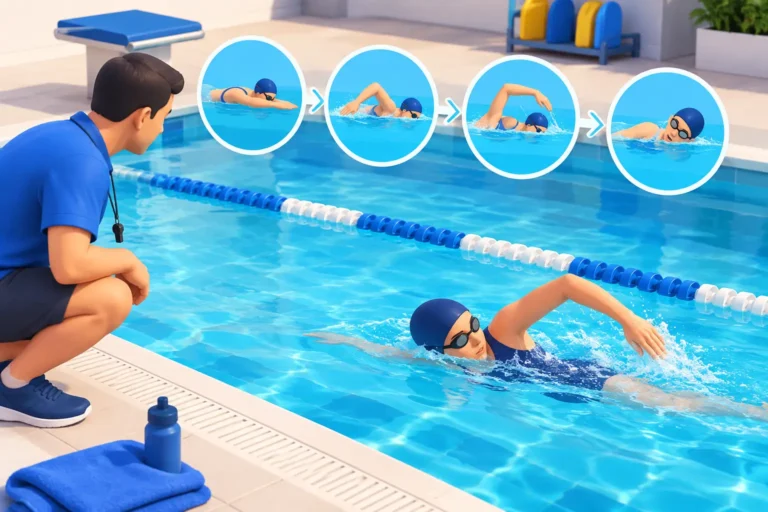
Backstroke works best when the stroke feels continuous. While one arm recovers, the other arm is pulling. The kick supports that rhythm in the background. If there is a pause between arm cycles, momentum drops. If the swimmer hurries the recovery and loses the catch, effort increases without much gain.
For many swimmers, smooth timing matters more than raw power. A calm, connected stroke often travels better than a forceful but disorganized one. This is why experienced coaching matters. Timing errors are not always obvious to the swimmer, but they are easy to spot from the deck.
Common mistakes and how to correct them
One of the most frequent mistakes is dropping the hips. This is usually linked to head position, tension, or weak kicking rhythm. The correction is often simple in theory: keep the head still, relax the chest, and kick continuously. In practice, it takes repetition.
Another common issue is bent-knee kicking. Swimmers who do this may feel as if they are working hard, but much of that effort is wasted. Drills that isolate kicking on the back with hands at the sides or streamlined overhead can help build better awareness.
Arm crossover is another major problem, especially for swimmers who drift across the lane. Focusing on shoulder-width hand entry and controlled body rotation usually improves alignment. Some swimmers also need to slow the stroke temporarily so they can rebuild the correct path.
Then there is the problem of tension. Because the face is out of the water, swimmers sometimes hold the neck stiffly and overthink every movement. Backstroke should feel supported. Relaxation is not a soft skill here. It is a technical skill.
Drills that build better backstroke technique
The best drills are the ones that target one error at a time. For body position, simple back floating and kicking drills help swimmers trust the water. For alignment, kicking with arms at the sides can improve awareness of head and hip position. For rotation, single-arm backstroke is useful because it slows the stroke and highlights balance.
Sculling drills can also help swimmers feel how the hand holds water during the pull. This is especially valuable for intermediate swimmers who have the basic shape of the stroke but lack propulsion. The drill itself is not the goal. The goal is transferring that feeling into full stroke.
For children, drills need to stay clear and manageable. Too many instructions at once can reduce confidence. For adults, video feedback and repeated correction often speed up progress because they can connect what they feel with what they are actually doing.
Technique standards change with the swimmer
A beginner does not need the same technical detail as a swimmer preparing for assessment or performance goals. Early on, the focus should be safety, floating confidence, straight kicking, and basic arm rhythm. Once that foundation is stable, coaches can refine rotation, underwater catch, stroke rate, and turns.
This is where structured progression matters. Strong instruction should match the swimmer’s current stage, not overload them with advanced detail too early. At AQZOG, that progression-based approach is central because skills are built in sequence, with safety and measurable improvement always kept in view.
For parents, this means looking beyond whether a child can simply complete one lap. Ask whether the swimmer can maintain body position, control direction, and repeat the stroke with confidence. For adults, the same principle applies. Completion is one milestone. Efficient, safe, repeatable movement is the real standard.
Backstroke rewards patience. When swimmers learn to float well, kick with purpose, rotate with control, and pull on a clear pathway, the stroke starts to feel lighter and more effective. That is usually the moment confidence rises, because the swimmer is no longer fighting the water. They are learning how to work with it.