Adult Fear of Water Learning Journey
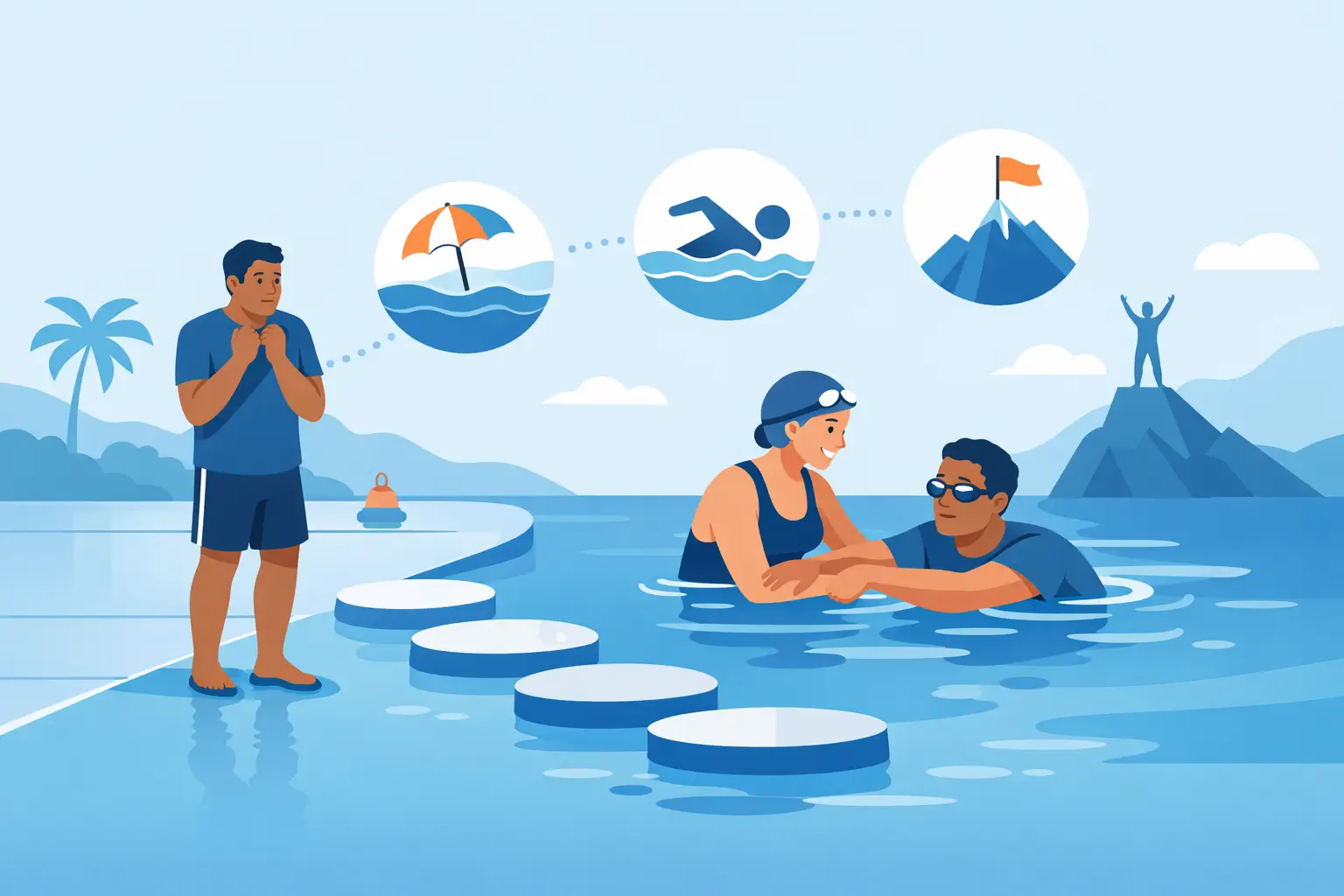
The first challenge for many adults is not floating, breathing, or kicking. It is standing at poolside while your body tells you to step back. An adult fear of water learning journey often begins there – with hesitation, embarrassment, and years of avoiding lessons, deep water, or even family pool activities. That is exactly why adult instruction must be different from children’s classes. Adults need a safe, structured process that respects fear while still creating measurable progress.
Fear of water in adulthood is more common than many people think. Some adults had a bad experience as a child. Some never learned because lessons were not available, not affordable, or simply not a family priority. Others are comfortable around shallow water but panic when their face goes in, when they lose contact with the floor, or when they cannot fully control breathing. These are not small issues. They affect safety, confidence, and the ability to respond calmly in water.
Why the adult fear of water learning journey is different
Adults usually arrive with stronger reasoning skills than children, but they also arrive with stronger tension patterns. They analyze every movement, anticipate what could go wrong, and often carry a clear memory of fear. That can make progress feel slower at the start. It does not mean progress is harder overall. It means coaching must be structured around trust, repetition, and small wins.
A beginner adult rarely benefits from being pushed too fast. Telling someone to just relax is not useful when their breathing shortens the moment water reaches the chin. Effective progression starts with control. The learner needs to know where to stand, what the next step is, and how each skill connects to safety. Once the body stops treating water as a threat, technique improves much faster.
This is also why lesson structure matters. A proper adult program does not jump straight into full strokes. It builds water comfort first, then breathing control, then buoyancy, then movement, and only after that does it develop sustainable swimming technique. For fearful adults, confidence is not a side benefit. It is the foundation of skill development.
What fear of water actually looks like
Not every fearful adult looks visibly afraid. Some laugh it off. Some say they only want to learn “basic survival.” Some insist they are fine in shallow water, then freeze during submersion drills. Coaches who work with adults regularly recognize the signs quickly.
The most common signs are gripping the pool edge, lifting the head too high, holding the breath for too long, refusing to put the ears or face in the water, or standing up immediately during any floating attempt. Sometimes the issue is not fear of depth itself but fear of losing orientation. Sometimes it is fear of swallowing water. In other cases, the learner can perform one skill in isolation but becomes anxious when combining two skills, such as floating while breathing out.
That distinction matters because the training approach should match the trigger. A person afraid of submersion needs a different sequence than someone who is comfortable underwater but afraid of floating independently. Good instruction identifies the exact barrier instead of labeling the learner as simply nervous.
The first stages of progress
A successful adult fear of water learning journey usually starts with very controlled exposure. The goal is not to force bravery. The goal is to create enough predictability that the brain stops treating each movement as a risk event.
At the beginning, progress may look modest from the outside. Standing comfortably in chest-deep water. Wetting the face without retreating. Exhaling into the water for three seconds. Holding a supported float. Recovering to standing calmly. These are major milestones for a fearful adult because they replace panic responses with repeatable actions.
This stage is where many adults either gain momentum or quit too early. If lessons are rushed, fear often gets reinforced. If lessons are too passive, the learner stays comfortable but does not improve. The right pace sits between those extremes. Each session should feel manageable, but it should also move forward.
That is one reason experienced coaching matters so much. Adults need clear explanations, not vague encouragement. They also need to understand why a drill is being used. When learners know that bubble blowing improves breath control or that back floating teaches trust in buoyancy, they are more willing to stay with the process.
Why breathing control changes everything
For fearful adults, breathing is often the turning point. Panic and breath holding feed each other. The body stiffens, the head lifts, the hips sink, and the learner feels even less secure. That creates a cycle of anxiety and poor body position.
Breaking that cycle starts with simple exhalation work. Controlled breathing in water teaches the nervous system that submersion is temporary and manageable. It also supports nearly every later skill, from floating to freestyle rhythm. Adults who master calm exhalation usually progress faster because they stop fighting the water with every movement.
There is a trade-off, though. Some adults want to move quickly into stroke learning because it feels more like real swimming. But if breathing remains unstable, stroke work becomes exhausting and discouraging. A structured program may spend longer on breathing and floating than the learner expects. In practice, that time is rarely wasted. It creates a more stable platform for later progress.
The role of private and small-group lessons
Adults with fear of water often ask whether private coaching or group lessons are better. The honest answer is that it depends on the severity of the fear, the learner’s personality, and how quickly they need to progress.
Private lessons can be especially effective for adults with strong anxiety, past trauma, or a need for close coach support. The pace can be customized completely, and the coach can adapt drills in real time. For adults who are embarrassed about being beginners, one-to-one instruction also removes the pressure of performing in front of others.
Small-group lessons can work very well when the environment is supportive and the group is matched appropriately. Some adults gain confidence by seeing others at a similar stage. It normalizes the process. But group learning is less ideal if the learner needs constant reassurance or if their fear causes frequent stops. In those cases, private instruction often leads to faster and more consistent improvement.
What realistic progress looks like
One of the biggest mistakes adults make is comparing themselves to children or to confident swimmers. Adult beginners often want a deadline: three lessons, six lessons, one month. Structured instruction can absolutely deliver visible progress in a short period, but the timeline varies.
For some adults, early success means putting the face in the water comfortably and floating with support. For others, it means swimming a short distance independently in shallow water. A learner with mild fear and regular practice may progress quickly into basic stroke development. A learner with deep anxiety may need more sessions before independent movement feels safe.
Neither path is failure. Progress should be measured against the starting point. If an adult began by refusing submersion and can now breathe out calmly, float, and recover without panic, that is real skill development. It is also real water safety progress.
In structured swim education, success is not only about looking polished. It is about becoming safer, calmer, and more capable in water. That matters whether the goal is fitness, family confidence, travel, or lifelong survival skill.
Building confidence that lasts
Confidence in water is not built by motivational talk alone. It is built by repeated evidence. The learner experiences a task, completes it safely, and realizes they can do it again. Over time, that pattern changes expectations. Fear no longer leads every decision.
This is why consistent lessons matter more than occasional bursts of effort. Long gaps can make adults feel as though they are starting over, especially in the early stages. Regular practice helps skills become familiar instead of fragile. Even one lesson a week can create strong momentum when the program is progressive and the learner stays engaged.
A well-designed adult program also keeps safety at the center. Learners should understand how to recover balance, how to control breathing under stress, and how to respond when water feels unfamiliar. These are not secondary skills. They are part of becoming genuinely competent.
For adults who have delayed lessons for years, starting can feel like the hardest part. But fear of water is not a fixed identity. It is a barrier that can be addressed with patient coaching, clear progression, and the right learning environment. AQZOG has seen this across many adult learners: once the first layer of fear is reduced, improvement becomes much more achievable.
If you are standing at the edge wondering whether it is too late, it is not. The right first lesson is not about proving anything. It is about beginning safely, building trust step by step, and giving yourself the skill that should have been yours all along.